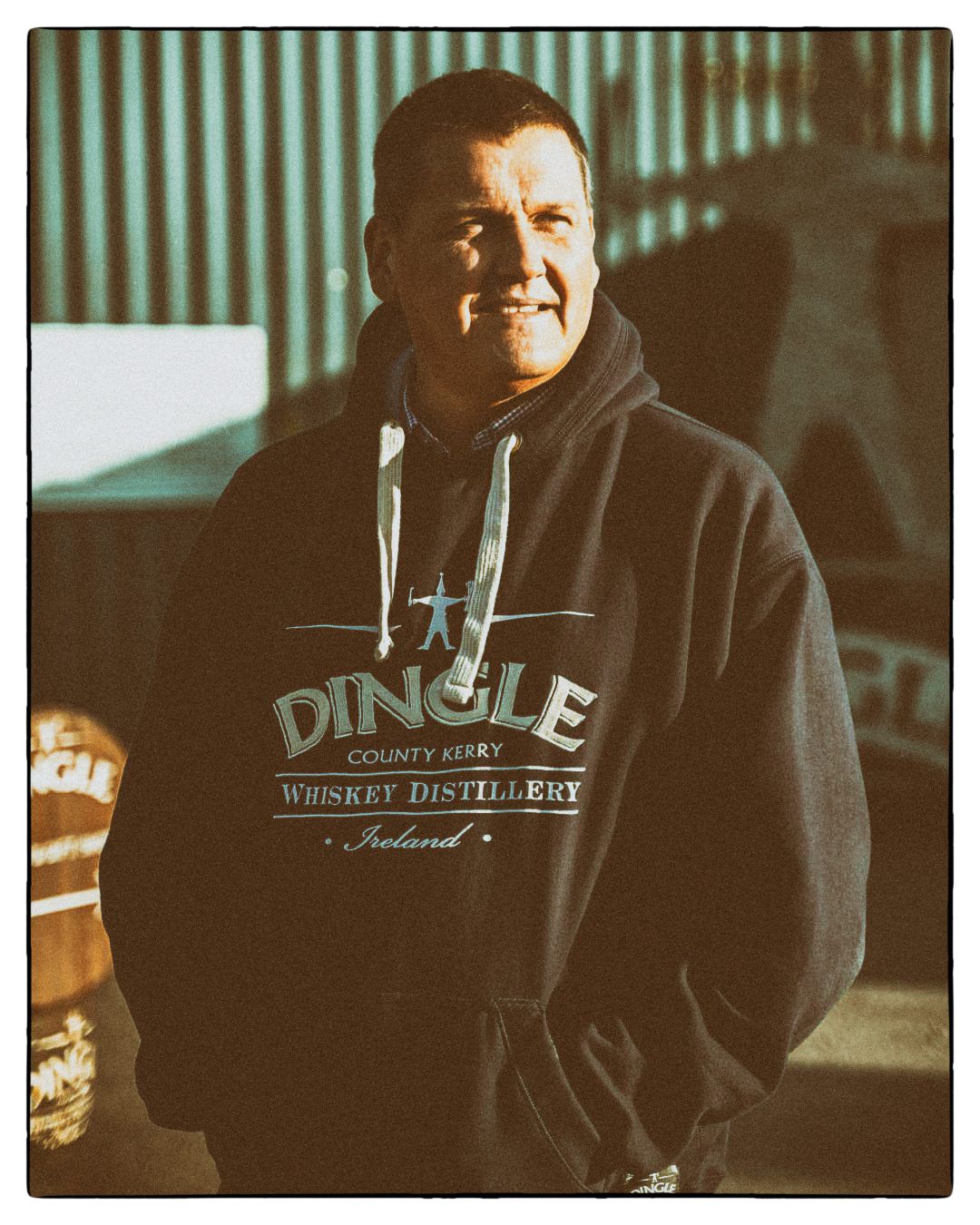
There is a long history of Scots working in the Irish whiskey business – from consultants to blenders to master distillers, they turn up in quite a few distilleries across the country. It makes sense – our industry is a relatively new one having gone from a handful of operations a decade ago to almost 50 now, so there is a dearth of experienced industry professionals. And besides, the king of them all, Jameson, was started by a Scot.
But there was still an oh moment when Dingle Distillery announced in late 2019 that their new master distiller was proud Scot Graham Coull. At that stage he had spent 14 years with Speyside distillery Glen Moray, but says he was looking to expand his horizons. Irish whiskey’s resurgence was in full flight and Dingle was the first and most beloved of the new breed of distilleries that had been set up around the island, and was about to enter an important phase of expansion both in physical terms and in markets. Coull’s considerable experience would be central to those changes.
A native of Elgin on Speyside and the son of two teachers, he grew up in a whisky obsessed household, with his father writing a course on whisky production. After graduating chemistry in Edinburgh University, with few jobs available in whisky at the time, Coull had a choice of either working in the nuclear power industry, or going into brewing. He got a job with Webster’s Brewing in Halifax, then moved into bottling and in 1994 started working with Wm Grant & Sons, and then became the process leader in Dufftown, which gave him distillation responsibilities for Glenfiddich, Balvenie and Kininvie, before joining Glen Moray in 2005. He spent most of his life working in Scotland, as he explains: “Apart from a short period of two years after university working in Halifax, England I had spent all of my working life in Speyside. Eleven years at Glenfiddich/Balvenie and 14 years at Glen Moray. My only visit to Ireland previously was a few days in and around Dublin attending the Alltech Alcohol School and as you can imagine my memory of that is a little fuzzy.
“Prior to accepting the job Fay and I spent less than 24 hours in Dingle but the town and especially the late Mary Ferriter won us over and persuaded us to up sticks and make the move to Kerry. As blow-ins we were made to feel very welcome not only in Dingle but also by the wider Irish whiskey community.”
But as the proud owner of a definitively Scottish accent, how did he manage with the local dialects and inflections down on the tippy toes of Ireland?
“The West Kerry accent is unique and it definitely took us a while to tune in. Living a full calendar year in Dingle is an experience; the hustle and bustle of the summer months were completely different to the dark, stormy damp months of January and February. However, it was the winter months where we got to know the town better and the town got to know us – well Fay mainly because she speaks to everyone.”
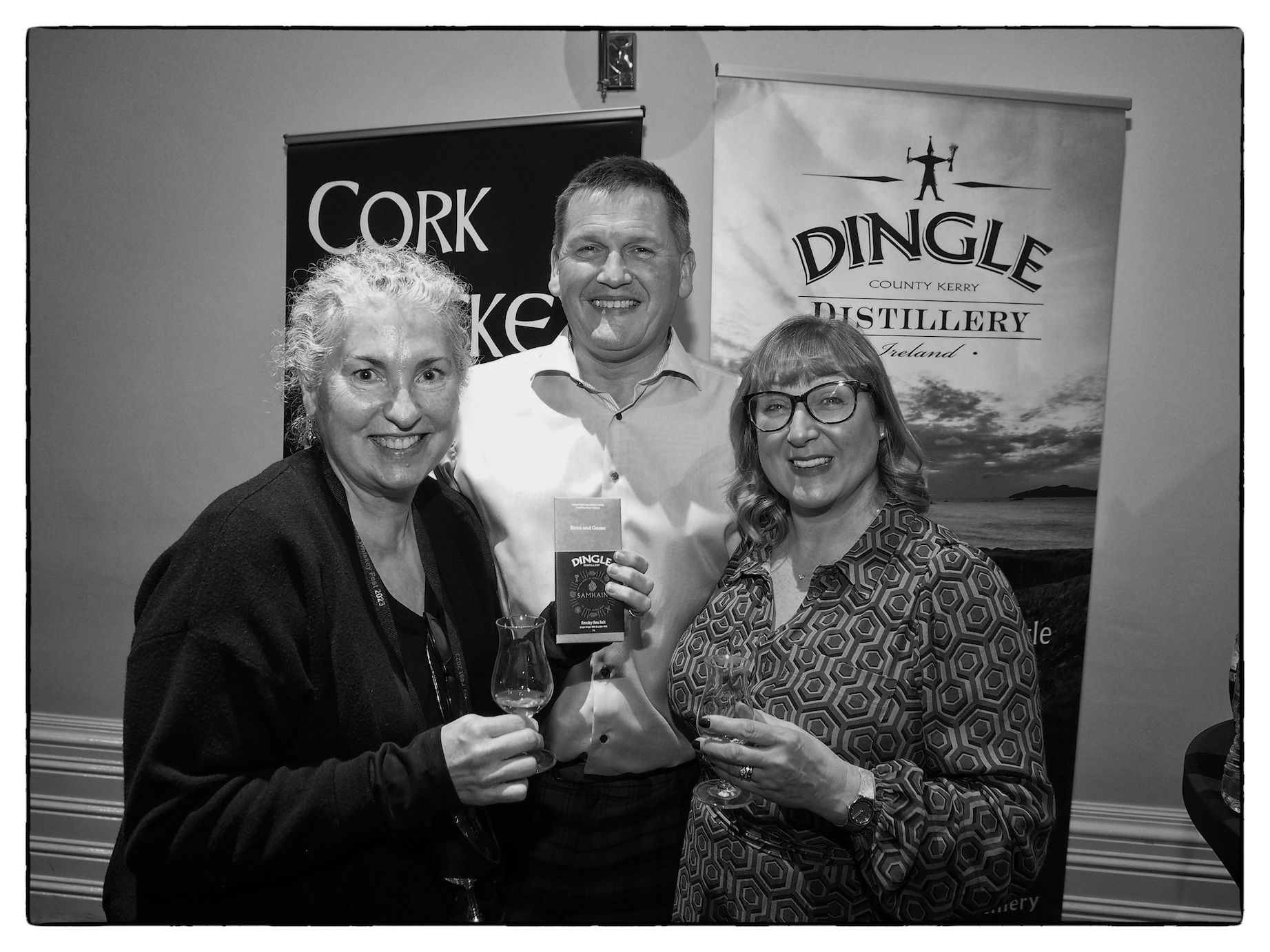
And while there might not have been too many cultural changes moving from rural Scotland to rural Ireland, moving from a mid-sized Speyside distillery to a boutique (a nice word for small) Irish distillery was a challenge: “Dingle and Glen Moray have very little in common. Glen Moray is an established medium to large sized distillery producing spirit mainly for blending but also for single malt, whereas Dingle is small and very much in its infancy as a whiskey producer. However, it is well established as a gin producer and vodka to a lesser extent.
“From a job perspective it was very much back to basics for me. Along with my knowledge of whiskey production, I was able to call on my bottling and packaging experience from Glenfiddich to help me find my feet quickly. I was heavily involved in long-term whisky planning at Glen Moray and it was this area that I focussed on initially at Dingle. I remember in my first couple of weeks explaining to Managing Director Elliot Hughes that the warehouse would be full in four years’ time! As owners of a young distillery, they were quite rightly only looking at the next few months and not years ahead. The success of the gin had allowed Dingle to lay down more whiskey stock than they probably thought possible. My challenge was to create a plan for when to release the stock.
“The batch releases which had served the distillery very well in the early years were reaching the end of their natural lifespan. It would also be fair to say that whiskey consumers were beginning to grumble a bit about Dingle and were looking for better value for money. When the time was right and stock levels allowed it, I created the Dingle Single Malt as a permanent expression. It broke the consumer habit of buying Dingle whiskeys and shoving them in a cupboard unopened. I was delighted to see bottles of Dingle being opened, consumed, enjoyed and a repeat purchase made.”
The Dingle single malt core release is made up of 61% PX sherry cask matured spirit and 39% bourbon cask, aged between five and seven years old. At an ABV of 46.3%, it stands out in the Irish whiskey scene as being a reasonably priced bottle retailing for €55.
“I also had to create Dingle whiskeys to satisfy the almost insatiable desire amongst Irish whiskey consumers for something ‘new’. To satisfy this thirst for new releases I created the Celtic Wheel of the Year Series which consists of nine releases which are all cask finishes. The series is made up of single malt and pot still releases, some of which are finished in the same type of cask.
“These releases were the result of my own education process to see how the different spirit types interacted with different cask styles. When I joined Dingle the cask profile in the warehouse was very much ex bourbon and ex sherry. Using different cask styles was my way of learning about the differences between single malt and pot still.”
Coull had developed something of a name for himself with cask experimentation at Glen Moray – at the time, the Scotch Whisky Association’s strict rules on cask types prohibited cider casks being used for whisky maturation, so Coull took ex Glen Moray casks, aged hard cider in them and then took the casks back for spirit maturation. There has since been an amendment to the SWA rules, but without creating too much wriggle room:
Scotch Whisky can only be matured or finished in new oak casks or oak casks which were previously used to mature wine, beer/ale or spirits but not if those casks were previously used to mature
- wine, beer/ale or spirit produced from, or made with, stone fruits
- beer/ale which has had fruit, flavouring or sweetening added after fermentation
- spirit which has had fruit, flavouring or sweetening added after distillation
Irish whiskey can be aged in any wood, typically oak, and cider casks have been used in several releases here. Coull naturally seized the opportunity to experiment with casks and put Dingle spirit into non-oak casks, as well as creating peated Dingle expressions – he sourced peated malt from Muntons maltsters in England which was at a 40-50ppm level, then double distilled to a 20-25ppm single malt, some of which would be coming of age of late. But for these and other experiments, he won’t be in charge to oversee their release.
Earlier this year, Coull announced that he was leaving Dingle for a large project back home in Scotland. The European spirits company, Stock Spirits Group, owner of the Clan Campbell whisky brand, lodged a Planning Application Notification with Argyll and Bute Council for the construction of a €30 million whisky distillery at Inveraray Castle, seat of the Duke of Argyll, who is Chief of Clan Campbell. Like a lot of aristocrats, there are many stories which brands can be built around, but a quick browse on Wikipedia reveals this gem: During the 19th century, a distant Prussian descendant of the family, Jenny von Westphalen, became the wife of the philosopher Karl Marx. When exiled to Paris and reduced to poverty, Marx was nearly arrested for attempting to pawn a part of Jenny’s dowry: a silver dinner service bearing the coat of arms of the House of Argyll. Surely a tale worth of a single cask release down the road.
Clan Campbell is one of the leading scotch brands in France and sells 1.2 million nine-litre cases across Europe. It has been recently launched in Germany and the Czech Republic with further plans to offer it to consumers in other countries. The brand was acquired by Stock Spirits Group from Pernod Ricard in 2023. Stock Spirits owns and manages more than 80 brands, which are available in more than 50 countries worldwide. It employs over 1,800 employees and operates eight production plants – in Poland, the Czech Republic, Germany, Italy and France. The current CEO is Jean Christophe Coutures, formerly CEO of Pernod’s Chivas Bros and Irish Distillers Limited.
For Graham, it’s not just about career progression, or being back home near his family and old friends, but about legacy.
“It was always going to take something special to tempt me away from Dingle and the opportunity to head up the Clan Campbell brand in Scotland and build a malt distillery at Inveraray Castle was too good an opportunity to miss. To be able to bring together all the experience I have gained from working in whisky for 30 years and use it to create not only a new distillery but also a new single malt will be a nice way to complete my career.
“I don’t think anyone likes moving house so being settled back home in Scotland is a nice feeling. We loved Dingle but it was always our plan to return to Scotland at some point. Our grown-up children seem to be happy with the move and get to spend more time with us before we become a burden to them.”
As for the category he leaves behind, the future is bright, but perhaps less blindly optimistic than it was in 2019 when the Coulls joined the Irish whiskey fraternity. Bord Bia’s Export Performance and Prospects report 2023/24 revealed that the country’s drinks exports fell by 8% to €1.8 billion – and Irish whiskey, which holds a 49% value share of Irish drinks exports, declined by 14% to €875 million in 2023. Coull sees choppy waters ahead for the category, the success of which was very much built on overseas markets rather than domestic.
“Unfortunately, I think there are some tough times ahead for the new Irish distilleries. Many of them are small producers in the grand scheme of spirits and trying to break into new markets is difficult. The domestic market can only give so much support and domestic consumers have to make choices as to which brands they will follow and support.
“America is obviously a key market for Irish whiskey but it is very difficult to gain traction there because of the different state systems. European markets are easier to reach but are very competitive. Weaning consumers away from scotch whisky to Irish whiskey is not that easy. Irish whiskey does not have age on its side and unfortunately age is still highly regarded amongst many whisky consumers.”
As for Dingle Distillery and the Porterhouse Group to which it belongs, the Coulls leave it in good shape – the Irish Independent reported in January this year that revenues at the Dublin-based group rose 35% in 2023, rising from €25.55m to €34.45m, and this was before their sale of the group’s Glasnevin brewery to controversial former MMA fighter Conor McGregor. Their planned expansion for Dingle Distillery, however, was shot down after two years of wrangling through the planning process last November.
What the Coulls brought to Dingle Distillery and the category as a whole was not just years of experience but a deft use of social media and engaging online personalities – landing as they did right before COVID-19, they became brand champions and storytellers online, sharing their Irish adventure each step of the way. The Irish whiskey discourse is a little poorer for their departure.
But Graham points out that there is much to be hopeful about and that the future is bright for Irish whiskey as a whole: “The new distilleries are by necessity filling into high quality first fill casks so the spirit is maturing quickly and to a high standard.
“The almost industry wide choice to go down the non-chill filtered, natural colour, > 46% abv will also reap dividends in the future giving Irish whiskey a premium ‘feel’ and one up on its whisky producing near neighbour. I think the future success of Irish whiskey will be built on collaboration. This could be through distilleries coming together through common ownership (for synergy and economies of scale) or working together to market Irish whiskey as a ‘brand’ in itself.”
 Triple Distilled Communications
Great article, and even though I have a good knowledge of Dingle, I learnt things. And it’s always a pleasure reading your words, Bill!
LikeLike