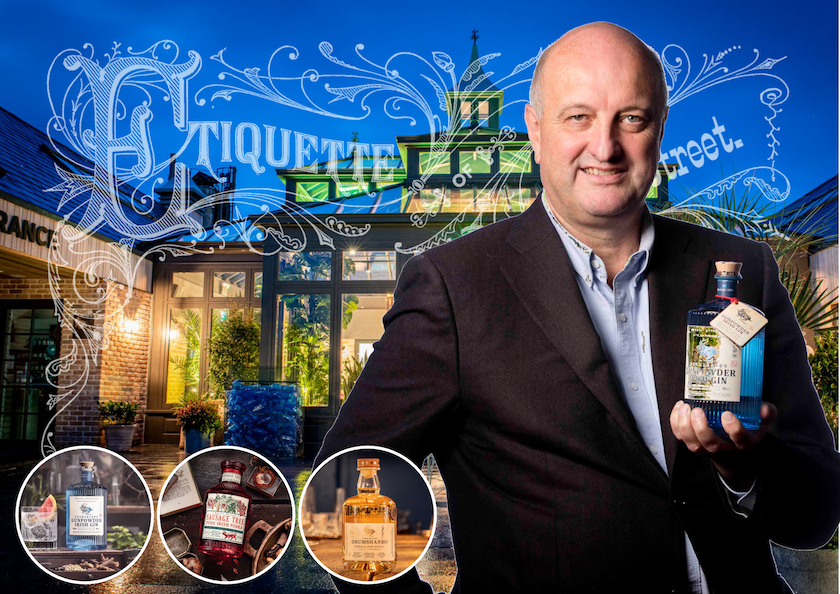
Pat Rigney has pedigree. That was how his career was described to me by another whiskey maker about ten years ago. It had just been announced that Rigney was opening a distillery in Leitrim and I admitted I knew little of him, so this was how he was described – as a man with pedigree. There followed a roll call of some of the brands he had worked on, for, and with – the brands he built and sold, the drinks companies he had founded and steered, and how whatever he was up to in Leitrim, it would be successful. Pat Rigney knew his onions.
Rigney grew up in Stepaside, Co. Dublin, attended Sandford Park School in Ranelagh before completing a B.Comm at UCD. After graduating in 1983 he found himself working for William Grant in Clonmel, then moving to Gilbeys, the Irish arm of International Distillers And Vintners (IDV) which would later become one of the component parts of Diageo. At Gilbeys he worked on the Baileys Irish Cream brand as a regional director for ten years, managing the Americas and Australasia markets.
At this point cream liqueur was the flavour of the month. Other brands were copying Bailey’s success and even iconic Dublin coffee house Bewleys had released a coffee cream liqueur of its own – so Gilbeys decided that they would play them at that game. Pat Rigney headed up the team who were tasked with creating a new coffee cream liqueur, so he commissioned the creators of Baileys, led by David Gluckman. During an early morning pitch in a hotel adjacent to Dublin Airport, Gluckman interrupted the proceedings by ordering a pint of Guinness, explaining that he had had a heavy night. According to Gluckman, Rigney, as head of the client contingent, thought it a bit excessive but after some playful banter the pint was ordered and delivered – Gluckman then stood up, pint in hand, and delivered what he called the fastest presentation of a new idea he had ever pitched. Using the pint to illustrate his vision, he pitched a coffee cream liqueur where, like in a stout, you drink the dark through the light – what if you used a two chamber bottle to create a drink with two component parts which would be poured into and united in a glass as one. That drink ultimately became Sheridan’s, perhaps best known for its ubiquitous presence in duty frees and being a standard festive gift of choice for returning emigrants.
After that success, Rigney went out on his own. With a small team of fellow drinks creatives including David Phelan, they started building brands that they would own, and ultimately, sell on. Roaring Water Bay Spirits Company released successful brands such as Boru Vodka in 1999 and white chocolate cream liqueur Coole Swan shortly after, but they also released a whiskey. It was built in the style of the vodka; the vodka came in a three-part bottle with three flavours, the whiskey came in a three part bottle with blend, malt and grain; the vodka was called Boru after the former high king of Ireland Brian Boru, the whiskey was called Clontarf after Boru’s famous battle; and the vodka was charcoal filtered for smoothness, so naturally the whiskey was too – taking their lead from Jack Daniels, they charcoal mellowed the whiskey. The whiskey came from Cooley, the charcoal was made from windfall oaks in west Cork, and the filtering and bottling took place at Terra in Cavan. Speaking at the time, Rigney said that Cooley was a natural supplier as John Teeling lectured him in college. Also as there were only two other distilleries on the island at the time – Bushmills and Midleton – it was probably their only option.
Roaring Water Bay Spirits Company ended up being merged with Great Spirits Company (of Knappogue Castle whiskey fame) to form a new company, Castle Brands. In 2019 Pernod Ricard bought the group for US$223 million.
Rigney was not done. Alongside these products he also started Fastnet Brands and Dalcassian, a wine and spirits distribution company, and invested in a range of other companies in the drinks, pharmaceutical, tourism and equestrian sectors.
In 2013 he started to look for a new challenge – he had shown he knew how to build a brand, but he wanted something physical – a wellspring. The Irish food board, Bord Bia, were looking for new Irish products to market, the gin boom was in full swing and the long-dormant Irish whiskey category was starting to accelerate. Rigney and his wife, now business partner, Denise started to look around for a base – his parents had met in a small village in Leitrim named Drumshanbo so he chose that as the home of what would become The Shed Distillery Of PJ Rigney.
At the time, there was little to speak of in terms of buzz in the Irish whiskey category – in 1975 New Midleton Distillery opened, but it was another 12 years before Cooley started operations, then another decade before Kilbeggan joined them. In 2013 Dingle Distillery and Echlinville Distillery started, but that didn’t mean anyone outside of the drinks sector could see what was happening. No banker could have foreseen what was coming and thrown money at anyone looking to build a distillery. So for all his pedigree, Rigney says that securing funding was incredibly difficult.
“When we established The Shed in 2014 it was at a time when it was not in vogue to do so. Raising finance was a nightmare – we were rejected by all the financial institutions, despite our good track record – everyone except for Enterprise Ireland’s High Potential Start Up Scheme who were pivotal to getting us up and running.”
Rigney says he is proud of the fact that he has since paid back in full and with interest the funding he received through the scheme, but even with that help, they still needed to dig for the funds to make the dream come true.
“We boot-strapped the start-up from savings and family borrowings, locating at a social enterprise in the heart of Drumshanbo at the former Lairds jam factory.”
The Shed boasts three copper pots focused on Irish whiskey, a two-and-a-half-thousand litre copper gin still, and another copper pot and three columns focused on vodka, all made by Arnold Holstein in Germany. They prepare all of their botanicals and all of their grain on site with their own mills; they cask all the whiskey themselves and all bottles are filled and labelled on site. In April this year it was announced that they were investing €10 million to double the whiskey-making capacity from 1,000 casks per annum to 2,000, with €3 million spent in the past 12 months and at least another €7 million to come over the next three years to support the company’s growth and to double its capacity to 120,000 cases of whiskey a year. Along with the distillery, they also have The Jackalope Café, and in 2022 they boasted a massive 50,000 visitors. They also have an 80-acre nature reserve, and 100 acres of commonage for livestock, which they share with local farmers. They also bought the local Methodist church and plan to turn it into an events centre and community space.
Asked if he had any advice for those looking to follow his path, he says patience – and money – is key: “Think it through. Now is a challenging time to set up a distillery in most parts of the world – be aware of the pitfalls and opportunities that lie ahead – don’t be naïve and prepare for it to take longer, a lot longer to work than anticipated. Ensure you are financed for at least seven years or more from the get-go. A distillery in particular is about the long game.”
What marks The Shed out in the whiskey landscape is its focus on gin – for many Irish whiskey start-ups, clear spirits are released to keep the lights on: You make the vodka and gin while you wait for the whiskey to mature. Not so with The Shed – from the outset, this was a gin distillery that also made whiskey. Their gins came in beautiful bottles, with slick label designs and interesting botanicals – their centrepiece Gunpowder Gin is made with gunpowder tea (as opposed to actual gunpowder). They also release special editions – Brazilian pineapple, Year Of The Dragon and Distillery Cat ceramic bottles, a Sardinian Citrus edition, and a Californian Orange iteration. Their Sausage Tree vodka is made with the oblong fruit of the African Kigelia plant as well as nettles, and comes in a blazing red glass bottle. Rigney knows how to build eye-catching, imaginative brands – so why build a distillery? There are many non-distilling producers who have achieved great success without the burden of a production site. Rigney admits that it was not a decision for the faint-hearted, but one that was necessary.
“Having our own family distillery was essential to give our Drumshanbo and The Shed Distillery brand a place, authenticity and transparency. It was always a massive dream throughout my 42-year career in the drinks industry to establish a full working distillery as I crossed the world over and back countless occasions – myself and Denise were actually talking about it the other day and 4,500 days travelled to the four corners of the world since 1982 and still counting.
“Starting with just one employee (head distiller Brian Taft) and Denise and I working other jobs for five years we now employ more than 100 extraordinary persons in Drumshanbo distilling, bottling and marketing our brands to more than 100 countries across the world. We now have seven fully trained distillers at The Shed.”
This search for authenticity is also behind the decision not to release any sourced liquids – many new distilleries in Ireland happily release products from other distillers under their own labels, but it leads to inauthentic brands and disillusioned consumers. For Rigney, sourcing was not part of the equation, no matter how tempting it might have been: “Our reputation for truth, authenticity and place in Drumshanbo is paramount and the foundation of our promise and core to the brand essence. We must ensure our customers have full confidence on where Drumshanbo Gunpowder Irish Gin and our Drumshanbo Irish Whiskeys come from – our motto is ‘every precious drop distilled at The Shed Distillery of PJ Rigney, Drumshanbo’.”
This is the first brand he has created that carries his name; albeit an exaggerated version of himself. The PJ Rigney of the brand is a persona, a character, part Filleas Fogg, part PT Barnum – a traveller and explorer, alchemist and apothecary, finder of curiosities and showman. Perhaps it’s a side effect of a lifetime working on brands, that being the face of one necessitated some separation, or the feeling that somehow Pat Rigney’s story is less interesting than that of PJ Rigney, but there is something slightly discordant about it. Maybe this is the architecture of brands – that they are built on extensions, exaggerations, stories, myths. But in whiskey, sometimes a little bit of grit and some rough edges are really what helps a brand gain purchase. Many similar sized enterprises to The Shed get more traction, because their founders are less polished, more outspoken, and are perceived to be more raw and real. In this regard, all of Rigney’s pedigree – especially in the dark arts of marketing and brand building – is a disadvantage. But The Shed make excellent whiskey, with their latest seven year old single pot still, matured in Sicilian Marsala wine casks, being a standout. Their focus is on single pot still and it makes up 90% of their whiskey production, and they have reaped the rewards – it was named one best in class at the 2023 Irish Whiskey Awards and The Shed Distillery was named International Distiller of the Year at the 2022 Wine Enthusiast awards in San Francisco where Drumshanbo Gunpowder Irish Gin also won the overall award for best international spirit of the year.
As they mark ten years of growth and expansion this year, Rigney is cautiously optimistic about the future: “While the drinks industry is going through a reset internationally, Irish whiskey has great potential to grow and take more market share. It is not without risk however. In our case our focus on exceptional quality will endure and secure our future. Taking decisions for the long term rather than for the short term with our family values at the core will be key. We will continue to innovate and bring excitement to our fans across the world.”
 Triple Distilled Communications