I did not like La La Land when it came out. It felt like everyone else did, which in itself might have given me unrealistic expectations about how life-changing it might be. Perhaps my nonplussed reaction to it came from the fact that I don’t watch a huge amount of musicals (does anyone any more?). Whatever the reason, I thought it was poor. Nice songs, good cast, let down by meandering plotline and a sense of smug self-satisfaction.
Fast forward to 2020, during one of those rambling scrolls through Netflix I stumbled across it again and thought, well let’s give this a go. It’s relatively PG, so I can stick it on when the kids are about. Why not watch it again on the off chance I missed what everyone else saw, just like I did with Magic Eye paintings, moving statues, and that blue/gold dress? Long story short, La La Land is amazing. Since that second viewing I have watched it again, and again, and again, and loved it more each time. The film didn’t change, but I and the world around me did; I came to it the second time round with no expectations, with a more open mind, and besides, I was now in lockdown and the primary colours and big musical numbers of La La Land was just the escapism I needed. I’m sure there is an irony in the fact that a film about good things happening with bad timing became my top film of the last 12 months, but there you go.
Ardbeg Ten was the first peated whisky I tried. Someone I knew had a bottle and it was clear they were not into it, so they offered it to me. I gave it a try and was struck immediately at how different it was to all the other whiskies I had tried (I almost refused to accept it was whisky, checking the label to make sure, like a drunk in a movie who sees a UFO or talking dog and then throws a bottle over his shoulder). An acrid, smokey tang, it was a thunder bolt for my senses. I genuinely wasn’t ready for peat, especially not at that level of intensity. I was only starting my journey into whisky and frankly this came a little soon. It’s like suddenly being told oh, you like Guns ‘n’ Roses, well how about you try some Pig Destroyer? Like boiling a frog, you gotta do it gradual.
But I still took the bottle away with me (the owner was delighted to see the back of it). I nibbled away at the bottle over the intervening years and while you couldn’t say it changed, I did. Like Alan Patridge’s sudden revelation that, actually, he likes wine, despite all those things he said earlier – I actually really like peat, despite my initial recoil. It’s not the centre of my universe but peat is one of the facets of whisky that is accessible for a casual fan like me. I can taste something and say, yeah, this is peated. I couldn’t tell you cask type, age, mashbill, or anything else, but smoke is one of those things that triggers the primitive parts of our brain – Smoke! Danger! Fire! Warmth! We can all identify smoke. I could be nosing forever to try and guess a single other detail about a whisky, but peat will always make itself known. It is a broad and beautiful brushstroke in any whisky, and, in my experience, I have yet to taste a whisky where I thought wow, they should really dial down the peat here.
I still have that bottle of the ten sat in a press somewhere. I never got around to finishing it, but I have milled through three bottles of Uigideal, which is an absolute gem that I recommend to anyone. Aside from that I don’t know much about Ardbeg, aside from the usual Hunger Games of their committee releases, when Whisky Twitter goes into meltdown in its attempts to secure a bottle. I’m here for the everyman, on-the-shelf-in-the-offie drams, I don’t need to hassle or the drama of trying to get the rare exclusives. I don’t want to have to find the mythical isle of Tortuga, Torbay will do just fine.
So while I like to sound the fanfare for the common dram, I am also comfortable with the odd freebie, which is why I was happy to celebrate Ardbeg Day this year by taking delivery of a free bottle of the ten from my new best friends at The Hive. I assume they are a PR firm and not an invading alien species who think with one mind and whose sole aim is to destroy humanity, but even if they are flesh eating creatures from another galaxy, free booze, amiright?
Ardbeg uses malt peated to a level of 50ppm at the maltings in the village of Port Ellen. It is then milled in Ardbeg’s rare Boby malt mill, installed in 1921.
Water comes from Loch Uigeadail, via Loch Airigh Nam Beist, via Charlie’s Dam at the distillery, and into the mash house.
The washbacks at Ardbeg are made of Oregon pine. Fermentation time is longer than other distilleries because of the high phenolic content of the original malt.
Ardbeg distils twice.
On the Lyne arm of the spirit still at Ardbeg there is a piece of apparatus called a purifier. As the boiling continues in the spirit still, the heavier impure alcohols reach the top of the still (the initial light alcohols are sweet and fruity). Some of the heavier compounds are captured in the purifier and fed back down into the main pot of the still. As the boiling process continues, the heavier phenolics come through, this occurs from about halfway through the spirit run. The purifier gives a little extra reflux, so we have two distillations and a little bit more. The purifier is unique on Islay and balance is the key.
The vast amount of whisky matures in ex-Bourbon oak. In maturation only 1st and 2nd fill casks are used. Their new 1st fill Bourbon casks come from suppliers in the US. Other casks come from Speyside Cooperage, and Craigellachie.
Primarily barrels have been used in the past, but now there is a substantial mix between barrels (for Ardbeg Ten Years Old,) Sherry Butts (some of which are used for Ardbeg Uigeadail), and new French Oak Barrels for Ardbeg Corryvreckan. And these are their three core expressions.
Because Ardbeg sits very close to the sea, the whisky receives a certain salty, iodine character while it matures.
I included that last factoid despite my best judgement as, if I’m honest, I am extremely cynical about maturation location as a factor in flavour. If it’s stuck in a pine forest will it faintly taste of pine? Midleton’s Dungourney warehouse complex is surrounded by pine woods, and I will chortle if they ever claim it gives a pine-fresh Toilet Duck-esque flavour to the whiskey.
So Ardbeg Ten – a dank bass note of a dram, in a bottle with a label that looks like a biker insignia, and tastes like arson. So from that first smokey taste years ago, what do I reckon now?
Nose: Cordite, treacle, liquorice.
Palate: Smoke! Fire! Etc! Fenugreek, caramel, dark chocolate, aniseed.
Finish: Demerara sugar, mint, toffee.
Is Ardbeg Ten the best intro to peat you can have? I would say not – I’d steer any newcomer to one of the more subtle peated drams (always love a Benromach) before this hefty unit. Ardbeg is unashamedly peated, and while I respect that, and while I found my way back to peat over time, not everyone will give it that second chance. But everyone and everything changes – the idea that we spend our lives in some kind of epicurean stasis is a sad one indeed, so here’s to second chances.
Whoever decided to launch one of the best-known luxury brands in the Irish whiskey category on budget day must have quite the sense of humour. We are still in the midst of a pandemic, the economy is in the process of being intubated by the State, and while this budget day may not have been the bloodbath that those in 2009-2015 were, it is the beginning of an all-too familiar process of rebalancing. Perhaps there was a spring in the steps of the marketing team at Irish Distillers because they sensed in advance that taxation on spirits would remain static – it was the least the State could do after almost every distiller in Ireland turned their stills over to the creation of hand sanitiser before the summer, when it was impossible to come by.
Cigarettes up 50 cent, making a box of 20 €14, but alcohol untouched.
It would have been unthinkable for publicans (and probably the population) for the Government to increase the cost of a pint or a bottle of wine at this time. #Budget2021
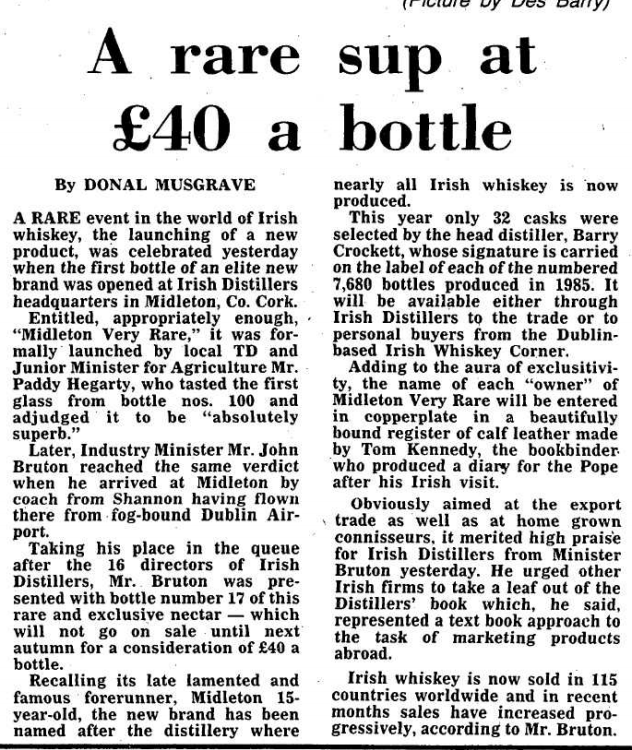
But it still takes gumption to launch a 180 bottle of hooch when hundreds of thousands of people are out of work. Still, this was a luxury brand launched in the 1980s, when there were also hundreds of thousands out of work – although it cost a little less then:
A page in the Cork Examiner after the launch of MVR in 1984.
The background to Midleton Very Rare is: In the dark days of the 1980s, we needed a luxury brand. The Scots had many, so we launched MVR in 1984. It is not very rare. It is ubiquitous. Also, it’s a blend. But it really isn’t aimed at the diehard whiskey nerd – as an annual release, in my experience it is bought as a gift for someone to mark an anniversary, wedding, birth, becoming president of the golf club…you get the idea. This is not something the tragic pot still fetishist is going to queue overnight to get their clammy, webbed flippers on. But it is important – as I pointed out the last time I reviewed it, it has aura, and it has taken decades to build that up.
Just seven short years ago Brian Nation became master distiller of Midleton Distillery, taking over from his predecessor Barry Crockett, who launched MVR all those years before. Then, in June this year came the bombshell news that Nation was moving on, to take up the role of master distiller with O’Shaughnessy Distilling Company. Apparently his role was much more than that – he would be central to the build of their new distillery, and was a chance to make his stamp on a new brand, new products, and a new world. I’d never presume to know what it was that tempted him, but the freedom of it must have been part of the appeal – in Midleton he must have spent much of his time ensuring consistency and while his experiments in the microdistillery gave him some creative wriggle room, running a massive operation like Midleton must be hard. Add to that the PR work of a master distiller – international travel becomes a lot less glamorous when you do it all the time, especially if you have young kids. So I can see why he would make the move. I suspect that he will do great things in the US.
So MVR 2020 is his swansong. I’ll let the press release take it from here:
Chosen from the most outstanding quality single pot still and single grain Irish whiskeys laid down over the past four decades in Midleton, Co Cork, Midleton Very Rare 2020 showcases an expression of whiskeys aged from 13 to 35 years in lightly charred ex-bourbon American oak barrels. This year, Brian Nation selected a higher pot still inclusion when compared to previous vintages, while also increasing the use of refill barrels amongst his choice of casks.
Bottled at 40% ABV, Midleton Very Rare 2020 is available online and in Ireland now, and will hit shelves in the UK, USA, Global Travel Retail, Australia, Germany and Canada in the coming months at the RRP of €180.
In a break from tradition and in response to consumer demand for the annual vintage to be made available earlier in the year in question, newly appointed Master Distiller Kevin O’Gorman will reveal Midleton Very Rare 2021 in spring next year, honouring a rare changing of the guard at the iconic Midleton Distillery.
Confirmation, if you needed it, that this is one whiskey where the year it was released rather than the year it was distilled is the important factor for consumers.
Some tasting notes; it’s a bit early in the week to start necking whiskey, so these are the official IDL notes and are thus possibly slightly more coherent than my own:
Aroma
Initial top notes of cane sugar and vanilla intertwined with pepper and nutmeg spices, complimented by sweet orchard fruits and white chocolate fudge all layered over polished antique wood notes, showcasing an intriguing balance between spirit and wood thanks to the complex interaction from the many years spent in the finest oak casks.
Taste
Initial burst of tangy fruit sweetness of orange peel and sweet pear creating a succulent texture while the pot still spices build overtime adding a mild prickle of chilli oil. The presence of the charred oak remains constant in the background adding balance to the fruits and spices.
Finish
Satisfyingly long finish with the fruits slowly fading, allowing the oak and spices to linger until the very end.
In short, it is nice. Of course the supreme irony of MVR 2020 is not the launch day coinciding with a budget, but rather why would anyone want to commemorate this disaster of a year?
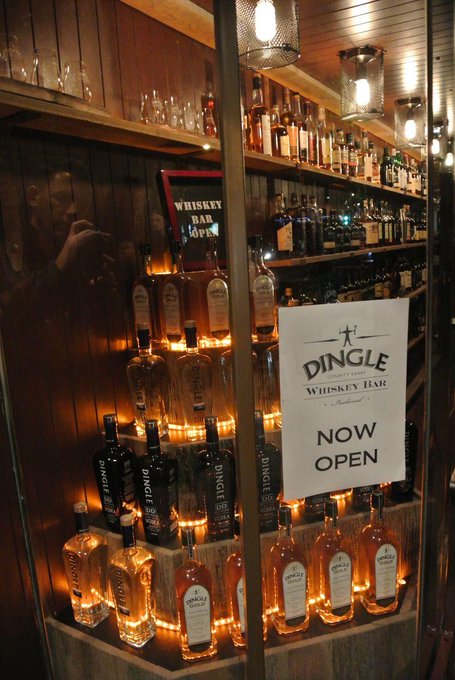
Do you remember Dingle Gold? It was a sourced blend, and it wasn’t very good, even by the humdrum standards of the most unchallenging blends. Of course, you wouldn’t expect too much given how it crashed into existence.
The year was 2010 and the Porterhouse Group were going to be the only Irish firm at the Shanghai World Expo. Known as the ‘economic olympics’ the expo would be their springboard into the Asian market – so they invested €1.35 million and 18 months of hard into securing a space for their pop-up pub, which would showcase their craft beers to some 70 million visitors during the expo’s six-month duration. But it wasn’t just going to be about craft beer. Oliver Hughes – the visionary founder of the Porterhouse who died suddenly in 2016 – was already planning a distillery here in Ireland. To show just how confusing whiskey is to the average person, here’s this from an Irish Times piece on the Expo in 2010:
Porterhouse recently started distilling its own whisky at a still in Dingle [they actually hadn’t started distilling until 2012], the first new one in 220 years. That whiskey won’t be ready in time for Expo, but the group has commissioned a range of 8-year-old and 12-year-old whiskeys from Cooley especially for the Expo.
I sincerely doubt the blend components in Dingle Gold were that old, as it was a fiery number.
Oliver Hughes’s son Elliott, now MD of the Porterhouse Group, told me how it came into being when I interviewed him and then Dingle Master Distiller Peter Mosley in 2017: “We were doing a bar out in Shanghai at the time for the World Expo. So we built a proper full scale bar over there and this was supposed to be the best thing ever and the turnover was meant to be 400 million and all this kind of nonsense, and we had this whiskey built for over there and it did not go very well. It’s one of those non-mentioned things. It [the expo] wasn’t nearly as busy as they said it would be and the Chinese don’t drink as much beer as we anticipated. It was managed poorly.”
Mosley continued: “I don’t think the Chinese had as much disposable income as we thought. So the Dingle Gold was never intended to sell in Ireland. I just got a phonecall from Oliver saying ‘there’s a load of whiskey on the quays, can you organise it to go somewhere?’ and it sat in storage for months before we did anything about shipping it. We weren’t ready for it, we didn’t have any sale structure or staff, I think Mary [Ferriter, Dingle Distillery manager] here sold most of it.”
Elliot: “And we sold lots of it through our own bars in Irish coffees. But in hindsight if we were to do it again i think we certainly wouldn’t. I think we were new to the market, we made a decision and it probably wasn’t the right decision, but at that time nobody was doing anything in Irish whiskey. Oliver was all about the ideas, Liam Lahart [Oliver’s cousin and co-founder] would then have to find out how we would pay for it.”
Mosley: “And I would have to figure out how we were going to do it.”
Elliot: “So a different way of operating completely.”
Mosley: “So Elliott is the ideas guy now.”
He certainly is: Since that interview three years ago, Dingle’s head distiller Michael Walsh moved to Boann Distillery as master distiller, and Dingle managed something of a coup by luring Graham Coull away from Glen Moray in beautiful Speyside to the beautiful arse end of Ireland. Obviously whiskey is a long game, so it will be some time until we get to sample Coull’s creations, but there are positive noises:
3 weeks, 100 barrels. 20 – 25 ppm. Hopefully release something early after maturing in 30 litre casks #thewhiskeychaps
Now comes their fifth batch of single malt, and an expanded reach – one of the primary complaints about Dingle is how hard it can be to come by their bottles; little wonder given that they only fill four casks a day. I’ll let the press release take it from here:
The Batch 5 will make history as the biggest release to date, a total of 36,500 bottles. Five hundred of those will be bottled at cask strength (59.3% abv) as a tribute to the 500 Founding Fathers (and mothers), the
people who backed the distillery at its foundation by each investing in a cask of the first spirit to come from Dingle’s stills.
The Batch 5 launch represents a considerable increase in volume, meaning that on this occasion 9,000 bottles can go to the United States, the remaining 27,500 being destined for Ireland, the rest of Europe, Asia and Australasia.
For Master Distiller Graham Coull, who joined Dingle in October 2019, this is his second batch release. He believes that the use of Madeira casks in this whiskey adds a subtle complexity.
“The Madeira influence adds a great depth of flavour and a kind of backbone to this remarkable whiskey while not masking the subtle spice from the Bourbon casks or sweet tone from the Pedro Ximenez ones”, he says.
In Ireland, the Batch 5 Single Malt will retail at €70; the Batch 5 Cask Strength at €150, will be available exclusively online from irishmalts.ie, and rationed to one bottle per customer.
Full disclosure – while I love what Dingle represents as the first green shoot in a national resurgence of whiskey distilling, I haven’t been wild about the few samples I had. I always thought there was just too much fire and heat in them. I can’t blame it all on youth either – the three to four year old Great Northern whiskeys that I have tried are excellent and show that youth can be smooth and rich. But this Dingle is a decent dram at what is not an outlandish price. A lot of toffee sweetness on the nose, custard on the palate and a decent length of finish, with pleasant astringency. A solid, smashable dram – would be interesting to try the CS and see where it takes you.
Looking back over the Dingle story, you can see how things change – in their prospectus they outlined a range of drinks, many of which never materialised. I think that was part of the charm – the sense of chaos that comes with something smashing barriers and making history. They did what they could to survive.
I still have my bottle of Dingle Gold, signed by Oliver, and I treasure it. It’s not worth anything, but its power is symbolic. Dingle Gold wasn’t amazing, but it was the start of something that was and is.
When I tell people how much I spend on whiskey, they are horrified. You mean you can spend upwards of sixty euro on a bottle? they gasp. It usually leads to more questions – what is the most you would spend on a bottle, how much do you earn, what makes it so expensive? All great questions that I’m happy to answer – the most I would spend is about 120 euro; I earn somewhere around the 50k mark each year, and as for what makes good whiskey expensive, that is a heady brew of real-world elements – age, rarity, source – and more ephemeral ones – legacy, branding, prestige – all of which combine to create that most elusive of things; aura.
Super-premium is not a mode of production. It is a price category, and perhaps more importantly, it is a demographic, one which Irish whiskey has only just started to explore. Midleton Pearl was an early foray into the field in 2014, with a six grand price tag – a figure that seems modest when you consider what was coming next.
This has been eclipsed by Midleton Very Rare Silent Distillery Chapter One, which smashed into the sector this week with a price tag affonting heaven – 35,000 euro.
Midleton Very Rare introduce the oldest ever Irish whiskey collection, Midleton Very Rare Silent Distillery Collection. A new chapter for Irish luxury. pic.twitter.com/KDXQLaUWpL
The launch in London was a VIP affair and the press release and accompanying visuals were typically slick (and typically po-faced, given the brief), all striving to create the required aura.
A price tag like this may seem offensive to us mere mortals, but if you earn half a million a year and want to invest, or if you earn millions and want a treat, the price tag is not that outlandish. Yes, it’s obscene, but that’s capitalism, baby – my purchase of a Redbreast 21 for 180 would be seen by many as completely over the top, so it’s all a question of perspective.
As for the 35k tag, it doesn’t even come close to what the exclusive releases from the Macallan command; nor does it even qualify for this list of the top ten most expensive whiskies. The Scots have been doing super-premium for years, and doing it well – so why not us? And if Midleton are doing it, why not Bushmills?
And so to the liquid itself; John Wilson of the Irish Times has a review of it. It’s a nice bottle, a nice box, and I’ve no doubt it is a nice liquid. Not that this matters, because all anyone needs to know about this is the price. That is the defining factor.
The series opens with a peated single malt from old Midleton. It is worth remembering that there are other bottles of old Midleton out there which you can grab at auction for less than a grand, albeit none of it malt and none of it peated. In fact, this is the first official single malt from old or new Midleton (the Method & Madness one is distilled at Bushmills), and a peated one at that. So it is something of a unicorn. I have no doubt it will sell, because, as McGuane pointed out, we need this offering.
But back to MVRSDCO, and the salient points:
Six releases. The first is a 45-year-old Irish single malt. There will be one release annually until the year 2025, ranging in age from 45 to 50 years old, all from Old Midleton Distillery (1825-1975).
The last release will coincide with Old Midleton Distillery’s 200th birthday, while Chapter One will be the first official release from Old Midleton in 16 years.
Midleton Very Rare Silent Distillery Collection Chapter One is the only release in this collection that is a peated single malt – it has been in a third-fill sherry cask cask for 45 years.
RRP: €35,000 £32,000 $40,000; ABV 51.2%; 48 750ml bottles in Ireland, UK, France and US; two bottles will be sold via ballot system on The 1825 Room, the Midleton Very Rare online members’ programme. Whiskey lovers can register their interest to be entered into a lottery to purchase a bottle from 9pm on 18th February for one week.
You can say that the price is obscene. Many would say the money we, as whiskey lovers, regularly spend on a bottle is obscene. There are people out there who are immensely wealthy, and they want a drink that reflects their status. Super-premium has little to do with how it is made and much to do with how it is sold, and who it is sold to – and in this case, it’s not you, not me, and most likely not anyone we know.
So, in summary – capitalism is bad, whiskey is good, and time is the only commodity of any value.
John O’Connell in one of the Marsh Road warehouses.
It’s Good Friday, and West Cork Distillers is going through an audit for its organic certification. John O’Connell is practically running he is walking so fast. All is going well with the audit; O’Connell seems pleased. Despite breaking the land speed record as he moves from room to room, he still finds the time to show me around. Having visited the distillery 12 months before my Easter visit, my expectation was that little would have changed. I was wrong. The notion that life moves slower down west is disproved by WCD, which seems to be accelerating its already rapid expansion.
In one lab they have a pilot plant alongside analytical equipment, meaning they can work on experimental washes and play around with locally-sourced fruit yeasts taken from Gougane Barra woods – O’Connell is all about fermentation, and is vocal about the role it plays in determining a spirit’s flavour profile.
Wild Gougane Barra yeasts.
One of the newer pieces of equipment dreamed up and built from scratch in WCD is an electrodialysis machine. They can analyse new make, isolate components that they might not be happy with, and run the liquid through the dialysis machine to cleanse the spirit of them.
But while they are relentlessly pushing toward a scientific utopia, they are also pushing for greater transparency in their barrels, now only sourcing from named bodegas, eschewing non-disclosure agreements in favour of greater clarity and information for the consumer. There are few people who WCD refuse to work with, and the firms they do create drinks for run from the aristocratic Baring family behind Lambay Whiskey, to UK TV star (and west Cork man) Graham Norton. But WCD have another project underway, one which may cause ripples in the industry.
Some distilleries here are offering cask programmes as a way of generating some revenue in order to offset the massive cost of getting up and running. It is a great idea – you buy a cask and feel part of a distillery’s story. Some distilleries are charging seven to ten grand a cask. But talk to anyone who has bought casks in Scotland and they will tell you that over there prices are far more reasonable (and thus more realistic as an investment). But with people using Dingle’s founding fathers five grand buy-in as a baseline, the only way is up, and up, and up. This meant that for most of us, cask ownership was just a pipe dream.
One of the Marsh Road warehouses.
Enter then the West Cork Whiskey Co-operative, a small group gathered through word of mouth, who were given the opportunity to buy some of the 5,000 casks released for sale by West Cork Distillers. Some have bought one or two, some have bought many more. And I, dear reader, bought nine, because although I am of meager means, my dual loves of both whiskey and bargains mean that this was an offer I could not refuse: The co-op offered a 200 litre first fill bourbon barrel filled with grain spirit for 888 euro, single pot still for 990 euro, or single malt for 1,086 euro. I bought one grain, four pot and four malt. One is for my godchild, four for each of my kids, and the remaining ones may end up getting bottled at some point (thus the grain). It is a bit of madness, and a bit of fun, and I don’t expect to make any money. Whiskey is a playground for me, not a place to graft.
So here comes the economics; the annual storage and insurance in year one, as well as the administrative cost of running the co-op, is included in the entry price. With a modest price appreciation of 2-5% per annum on current market valuations for aged whiskey, investors could generate 12-15% investment returns per annum over a three-to-10-year period. The co-op will act as the legal trustee and the registered tenant in WCD’s bonded warehouse, and the investor is the beneficial owner and is allocated a share in the co-op: One member, one vote. There is also the online trading platform which offers the ability to bid on other people’s whiskey or auction your existing whiskey to interested buyers. Loss of liquid in the casks beyond evaporation (2.5% per annum) or damage due to fire etc., is fully insured at the purchase price. As for tariffs and Brexit, WCD are a global business with diversified revenue streams so they are insulated better than most.
O’Connell’s approach to this is much like his approach to business in general – be fair. Of course, there is also a bonus for WCD – they get an injection of cash, and will always have the option to buy casks back from the co-op should they need to. After their massive expansion in the past 12 months, they may need to – four warehouses sit at the end of the Marsh Road site (foundations needed to be set 15 metres underground, as the road lives up to its name), while they are finally throwing open the doors to the public, with a sizeable visitors centre, which houses their new distillery, which comprises of three pot stills, one hybrid and one column.
If WCD make all this look easy, these stills are a reminder that it isn’t – all came from planned distilleries that were abandoned, including the stills from the Niche/Quiet Man. Setting up a distillery is an expensive business – WCD exists largely through sheer force of will, and they still embody that Mad Max spirit of innovation and invention, making any equipment they can, and sourcing everything else in as cost-effective a way as possible (they even have ouzo stills, imported to Skibbereen after they were spotted by a staff member on holiday in Greece).
How many people bring back stills from a holiday in Greece? Usually it’s just a straw donkey.
WCD have become a force to be reckoned with – their output of four million litres per annum may be dwarfed by the likes Midleton (100 million LPA); or even their main competitors in the wholesale market, Great Northern, who boast a remarkable 11 million LPA, but WCD have something that others do not – diversity. No parent firm, column and pot distillation, on-site maturation facilities, a bottling hall, and contract activity. As Darwin noted, it is not the strongest that survives, but the most adaptive to change. WCD were created out of necessity, invention and desperation – they will try almost anything (hard kombucha, anyone?), create just about any spirit they can if they find a market for it.
WCD also has a four-pronged revenue stream – their own branded products; bulk spirits and fermentates; contract manufacturing and wholesales. Domestically, they deal with the big supermarkets – Aldi, Lidl, Dunnes, Tesco and the Musgrave Group, who own SuperValu and Centra. They also have multiple contracts overseas, and are looking to expand further. They also bought out the Halewood stake in the firm, so the two McCarthy cousins and O’Connell are now the majority shareholders. They achieved all this with no marketing team – which, in the whiskey world, is possibly the most startling fact of all.
It is early days for the co-op – but if WCD can do it, why not others? Do we want Irish whiskey to be some elitist members-only affair where only those of significant means can afford to buy a cask (or a bottle)? Is it right that some brands are charging seven grand a cask, or 300 euro for a 16 year old whiskey? More importantly, is it good for the category? We need places like WCD to create equilibrium. With the co-op, people can get a sense of how much whiskey actually costs, rather than what someone decides it is worth. Obviously I’m going to roll back on this in spectacular fashion in 16 years when I release my own bottling for a grand a pop, but until then we need to calm the fuck down. An overpriced, overheated market draws the wrong kinds of entities into the marketplace.
If you are interested in buying a cask for a reasonable price, shop around – there are plenty of places that ought to cut you a deal, and at least now punters can say well, WCD charge a grand, why are you charging five times that (or more)? As for the co-op, membership is closed, but it may re-open again in the future. Chances are that if it does, it will be done in typical WCD fashion – quietly, fairly, and with as little fanfare as possible.
What is single pot still whiskey? Is it the past, is it the future? Is it a uniquely Irish style of whiskey, an Irish Irish whiskey, a category within the category? Is it our secret weapon, or is it a marketing trick? Is it a common style, found around the world, a simple mixed mash spirit, a dumbed down single malt? It is a bastard malt, a mongrel? Is it a testament to Irish ingenuity and a spirit born of oppression – is it a flower that grew from ruins? Is it all these things or none, and, most importantly, is it the next step?
When I think single malt, I think of Scotland. There are many exceptional single malts from around the world, and many mediocre ones from Scotland, but it is still there – a century of marketing has linked the concept of the single malt to one nation above all others. But once upon a time they used a mixed mash too. As single pot obsessive Willie Murphy noted, there is this quote the second edition of Whisky: Technology, Production and Marketing:
Following the restoration of the monarchy in 1660, the tax on ale, beer and whiskey (which was still referred to as aqua vitae in all statutes of the period) was essentially doubled, and it was estimated that this provision would yield £384 000 in revenue (Statute 1661, Car II, c.128). To raise this huge sum there must have been several large legitimate stills in existence, such as those of John Haig & Co., who claim that a Robert Haig established their business in 1627 (Anon., 1914). What is interesting, from a technical viewpoint, is the fact that these taxes were imposed not only on malted barley but also on spirit ‘not made of malt’. Other chronicles of this period similarly allude to spirit being made from a mixture of grains, such as oats, barley and wheat (Smith, 1776) as well as malt. So even from the earliest times some whiskey was being distilled from unmalted grain, and not all malt was made from barley. The malt tax introduced in 1701, for example, states that duty shall be paid: ‘upon all Malt, ground or unground, whether the same shall be made of Barley, or any other Corn or Grain whatsoever’ (Statute 1701, 12 &13 William III, c.5).
That Smith they are referencing is none other than the father of capitalism Adam Smith, him of ‘greed is good’/Gordon Gekko fame. In the brutal tome more commonly known as The Wealth Of Nations, Smith notes:
Malt is consumed not only in the brewery of beer and ale, but in the manufacture of wines and spirits. If the malt tax were to be raised to eighteen shillings upon the quarter, it might be necessary to make some abatement in the different excises which are imposed upon those particular sorts of low wines and spirits of which malt makes any part of the materials. In what are called malt spirits it makes commonly but a third part of the materials, the other two- thirds being either raw barley, or one-third barley and one-third wheat.
Smith wrote that back in 1776, and then there’s this from super sleuth Charlie Roche:
Willie I posted this a few years back .. repeat in case you missed from 1833. In the committee reports on Scottish distilleries of 1799 there are a number of instances of mixed Scots mashbills. Can't say categorically when stopped. pic.twitter.com/mQ2tT68n9E
So before single malt knew what it was, it was a mixed mash whisky not unlike our own supposedly uniquely Irish style.
Single pot still can never compete with single malt, but it can become something else. There are obviously obstacles, because it’s not just a complex whiskey, it is also a complicated one. Referring to it as a mixed mash whiskey is actually a welcome simplification – single pot still is a confusing name, as it reflects not the style, nor the key element of the mashbill, but rather the device used to distill it. Also, as they are not allowed to call it ‘pure pot still’ anymore, it now sounds like it is only distilled once, or made using only one still. For consumers approaching the SPS category for the first time, there is a lot of baggage to get your head around. Then there is the requisite explanations of the corn laws, because every whiskey should come with a history lesson that focuses on taxation of grain. But SPS has genuine heritage, and this is where it gets even more complicated.
Peter Mulryan knows a thing or two about whiskey. He went from writing books on the subject to being the public face of Irish Distillers Ltd SPS promos and is now the driving force behind Blackwater Distillery. Mulryan has blogged about his dissatisfaction with the technical file – the document that controls what Irish whiskey is and how it is made – and has started making pot still whiskey from old mashbills, as the more recent rules mean that SPS is what IDL say it is. Mulryan notes that in all the old historical SPS mashbills he has come across, not one meets the standards set out by the technical file.
Published five years ago, the technical file was written by the large whiskey producers in Ireland at a time when a boom was looming and the finer points of the category needed to be locked down. The result is a document defining SPS to suit IDL’s in-house style – imagine if Diageo legally declared that Guinness is the only style of stout allowed by law, which, quite frankly, sounds like exactly the kind of thing Diageo would do.
You can read the file itself here, or David Havelin’s excellent dissection of it here and here, but IDL’s influence is all over it, including references to SPS being made ‘usually in large stills’ and even allowing for a little bit of column still distillation in there, which is clearly a gob in the face of history. But SPS as a style was resuscitated and kept alive by IDL, so little wonder that they felt such a sense of ownership over it that they simply went ahead and redefined it.
And just so I can play devil’s advocaat, I would make this point – it has been five or six years since the big producers sat down to write the tech file, and a lot has changed. Grain has become a major talking point, with words like provenance and terroir becoming part of the global discussion, so one more question before I launch into an actual whiskey review – is it not possible that IDL themselves would change the technical file definition of SPS, given how restrictive it is? Are their hands not tied by the file, now that they have a micro-distillery where they can compete with the likes of Blackwater? Would they not wish to loosen the ball-gag on SPS and let it breathe a little? Is there not an archive filled with old mashbills in Midleton, recipes for pot still whiskeys of yore that could be resurrected and released in tiny batches, little pieces of history brought alive and offered to the world as part of a celebration of our heritage? Perhaps, perhaps not. But until they do, we have Midleton’s interpretation of SPS, ahistorical as it may be, and hey, it isn’t all that bad.
At a Redbreast masterclass at Whiskey Live Dublin in 2017, attendees were given a gift – a sample of Redbreast 21-year-old bottled at cask strength. I, being both antisocial and impoverished, was not in attendance, but John ‘Whiskey Cat’ Egan was there, and through a circuitous route that involved Omar ‘That’s Dram Good’ Fitzell smuggling the sample up from Kerry, I managed to get my paws on a generous portion of this fabled whiskey (a 100ml sample of it sold at auction for more than a hundred euro earlier this year).
And so to some notes on this rarest of birds:
Nose: Hello again, chocolate, tobacco, leather, raisins, and for SPS Redbreast bingo, Christmas cake in a glass, complete with marzipan and brandy butter. Pear drops and camphor, roasted banana, flambé crepe with Nutella. It’s cask strength, but you genuinely wouldn’t know it – this is about flavour, not strength.
Palate: Really reminiscent of the Dreamcask, so much so that it should really become an annual, relatively affordable release – flog 300 of these for 250 a pop one day a year, g’wan. Up front there is more fruit, those JR ice-lollies from the Eighties, rhubarb crumble, bread and butter pudding; it is dark, rich, deep, like meself. There is a lot of toffee, fudge, dark chocolate, hot chocolate with a drop of Baileys in it.
Finish: That zesty snap of the SPS spice fades slowly, and again a lot of notes reminiscent of the Dreamcask, that bergamot, the sweetness, the leather and tobacco wafting. A beautiful whiskey, and one that deserves to be shared with the world (stocks permitting). Is it automatically better than the standard 21? Not really. It’s great, but to me that 21 is the gold standard for Irish whiskey, SPS or SM or SG or blend or vatted malt or anything. It is accessible, widely available and an absolute beauty. That said, the 21CS could easily be the match of the Dreamcask, especially if it was released at a reasonable price and in a fashion that didn’t become a flipping free-for-all.
Aside from all my grumbling about the technical file, and the fact that it could do with some significant edits, if there is a way to open hearts and minds to our unnecessarily complicated indigenous style, then Redbreast is it. Forget the youthful SPS of Dingle, Teeling and impending ones from Great Northern, or even the multiplicity of well-aged Powers single casks, ain’t nobody got time for that. To hell with the Spot family, beautiful as they may be, because they are an even more confusing pitch than Redbreast. The smart money is on the priest’s whiskey. Redbreast was my epiphany, and look at me now, friendless and alone, writing sprawling thinkpieces on a minor category of whiskey. So here’s to our grains of future past, and to single pot still whiskey, whatever it once was, and whatever it may become.
Update 29/04/2019: Irish Distillers Limited have published a piece by Master Distiller Emeritus Barry Crockett, the man who kept that single pot still flame alive for so long, and it goes into a lot of detail about the whys, hows, and wherewithals of the technical file. Well worth a read.
After the passing of Dr Pearse Lyons of Alltech a year ago, I wrote this tribute piece for FFT.ie:
Dr Thomas Pearse Lyons was a man who looked beyond the surface. Many business empires are built on marketing and spin, but Dr Lyons, a consummate scientist, spent his career looking deeper into animal nutrition, brewing and distilling. His death on March 8 left behind a vast empire, with a business that employed more than four thousand people in ninety countries and spanned agrifoods, brewing, and distilling – a fitting legacy for a man who had an endless thirst for knowledge, and a mind like a razor.
Thomas Pearse Lyons (1944-2018) grew up in Dundalk. One of six children, his mother ran a grocers, and it is she who he credits with his drive and entrepreneurial spirit. Aged just 14 he started working in the laboratory of the local Harp Brewery – his parents were both teetotallers, but on his mother’s side he came from five generations of coopers to the great distilleries of Dublin.
On the insistence of his mother, he studied biochemistry in University College Dublin. Later, in 1971, he received his Phd in Biochemistry from the University of Birmingham, after which he worked for Irish Distillers, playing a pivotal role in the design of the new Midleton Distillery, a facility that was to become central to the battle to save Irish whiskey from annihilation during the lean years of the 1980s.
But while his education and experience in Ireland and the UK laid the groundwork for his success, it was in America that he achieved his most remarkable feats.
Emigrating to Kentucky in the 1976, he worked with local ethanol distillers to help improve their processes. After four years, he finally made the move that would define his life’s work, and, using a loan of 10,000, he started a company in the garage of his house.
At this stage he was married to Deirdre, and they had two young children, Mark and Aoife. It was a risky move for anyone, but especially someone who is married with a young family. The company, Alltech, specialised in animal nutrients, and in its first year it turned over a million dollars.
As the value of his company soared, he diversified into brewing and distilling, as well as authoring a number of texts on the subjects. He became involved in philanthropy, building laboratories for schools, and helping Haiti recover from the devastating earthquake in 2010. While he was a well-known figure in the US, back home he was less well known, save for appearances in annual rich lists. It seemed a shame that one of our great success stories was not as celebrated in his native land as he was in the US – but all that was about to change.
The Irish whiskey category was booming, and Dr Lyons stated to consider bringing his brewing and distilling skills back home. In 2013 he started to search Dublin for somewhere to build a distillery. His choice of location show just how he was able to see beyond the surface – a dilapidated church in the Liberties, the spire of which had been removed. Although the site had a rich history that went back centuries, in recent times the site had been left to decay, with the church itself being used as a lighting showroom. There were other site he could have chosen – places less expensive to build, with less heritage and fewer complications – but he did not shy away from a challenge. A complete rebuild and restoration of the church and its surrounds saw the billionaire spend some 20 million euro creating the Pearse Lyons Distillery At St James’s, complete with stained glass windows showing the saint after which the church was named, and one of Dr Lyons’s cooper ancestors. Opening last September, it is a fitting monument to a man who blazed a trail in the sciences and in his many philanthropic work.
As with any business leader, it can be sometimes hard to get a sense of who they are. Dr Lyons always cut a dash, with his dickie bows, sing-songs and boundless positivity. For a man who was able to look beyond the immediately visible, his death leaves you wondering what drove him to achieve all he did.
There is of course, a very simple answer: Family. His family was built into his success from day one – Alltech takes its name from his daughter, Dr Aoife Louise Lyons, while its signature colour was chosen by his son, Dr Mark Lyons. Mark and Aoife are senior members of the firm. Dr Lyons’s wife Deirdre is director of corporate image and design, and even designed the stained glass windows in St James’s, while she also oversees Alltech’s philanthropic works worldwide. Speaking about his wife upon the opening of the distillery, Dr Lyons said: “The builders said that they loved working with Deirdre because she never changed her mind. Never. She has the vision of what she wants to do. I think this is what makes us a formidable team. It’s telling our story. It’s history.”
Dr Lyons’s death on March 8, 2018 from a heart problem, marked the sudden end to a remarkable life. His son Mark said in a statement: ““He saw farther into the horizon than anyone in the industry, and we, as his team, are committed to delivering on the future he envisioned.”
Dr Pearse Lyons will be remembered as a man who dedicated his life to science, to business, and to making the world a better place. But beyond the empire he created, it is his dedication to his family is the most inspirational aspect of his life – he looked beyond the horizon, but he never forgot that family was life’s most important work.
I can still remember the first time I read Vice. It was a 2009 Babes of the BNP piece that summed up their ethos – sleazy, funny, and cruel. From the get-go I loved their skate-punk nihilism and cartoonish approach to journalism – a mix that that saw them become the go-to resource for disenfranchised twentysomethings. Long before Buzzfeed attempted to bludgeon our attention spans to death with listicles, Vice was the face of a new kind of journalism, one that sparked a debate about what journalism actually is. But whether old media liked it or not, Vice was here to stay.
Ten years on from when I first lolled through their skewering of the BNP, this brilliant long-form dissection of their history shows how they are no longer the crazy punks they once were – they are a massive global media brand, and as such they jettisoned questionable founders like Gavin McInnes, brought in questionable investors in the form of Rupert Murdoch, and sprouted many wings, including Virtue, their advertising agency. The landing page for Virtue shows just how they’ve changed, boasting lines like this one:
Rather than try and fix the agency model, we’ve planted a jungle on its grave. Our DIY punk roots, empathy, and irreverent sense of style breeds work that’s as important as it is attractive.
I read that and all I can hear is the Canyonero jingle, as this is exactly the kind of guff that Vice used to eviscerate. But we all have to grow up sometime.
The greatest trick Vice managed to pull off is maintaining that edgy chic despite their world-conquering position, so it is little wonder that when one of the world’s biggest drinks firms, Proximo, wanted something with bite, they hired Virtue (Jameson went the more direct route with sponsored content on Vice itself). Of course, the only problem with massive firms hiring edgy creatives in order to capture the hearts, minds and wallets of millenials is that massive firms don’t really want edgy – they want safe, and cool, but mainly safe. And this brings me to the new Bushmills promo.
Their heads are practically glowing so strong is the dye they used.
We don’t usually see a lot of TV spots for Irish whiskey here. Our market is in the States, so that is where we aim our advertising spend, and also guides our creative choices. This is why a lot of Irish whiskey ads tend to be a version of Irishness that really does not exist, rooted in a past that never was. Just as The Quiet Man was Maurice Walsh’s daydreaming about a place that didn’t exist, most of the imaginings of Ireland we see in US-based ads are selling a never never land of shirtless youths and comely maidens dancing at the crossroads. Obviously, Proximo wanted something different.
They tasked Virtue with creating a more modern whiskey promo for the tragically-named Red Bush, the new Bushmills expression aimed at the American market – the ‘Irish whiskey for bourbon drinkers’. Virtue got one of their shining stars, Jessica Toye, to create something cool and edgy and safe. She explains her motivation thus:
While other whiskey brands show Ireland as a caricature of itself with rolling green hills and tweed suits, we immersed people in the Ireland unseen – the gritty streets of Belfast.
I can only assume this ‘green hills and tweed’ comment is a dig at one of the best Irish whiskey ads of recent years, Tullamore DEW’s The Parting Glass. The multi-award winning advert is a masterclass in emotional manipulation with a comedic twist. Yes it is twee, yes it has tweed, and yes it features many rolling hills and even has Ireland’s greatest natural resource – rain – in copious quantities; but it has wit and it has heart, and despite the fact it was made by a London ad agency and was almost never screened on Irish TV, I still see it as one of the best Irish whiskey ads. It is so good that its premise was flipped a couple of years later by two German film students who made the stellar Dear Brother as a spec ad for Johnny Walker.
But obviously making an ad for Tullamore DEW is a little simpler than making one for Bushmills. As a pitch, the Tullamore DEW brand comes with limited baggage – it is a mix of whiskeys from Bushmills and Midleton, and it is owned by a Scottish firm, but nobody would claim it wasn’t Irish – Tullamore is right there in the dead centre of Ireland.
Bushmills is something else – either Northern Irish, or British, depending on who you are trying to argue with. Irish whiskey may be the category it belongs to, but good luck claiming Bushmills is Irish. But how do you get that message across, if you even want to? How do you retain that magic brand of Irishness, without obscuring the fact that the distillery is in the UK?
The Red Bush promo had a limited range of options as it has to be set in Northern Ireland – a relatively small place, with only a few globally recognised landmarks. This means you can go film crashing waves and rustic charm around the Giant’s Causeway, or you can go urban and feisty in Belfast. Bushmills is seven minutes from the Causeway, and an hour from Belfast, but if they wanted something modern and fresh, they would have to go urban. And so they did, with something Toye’s website describes thusly:
With a pack of 16 Irish red heads running fearlessly through the streets, RED. SET. GO. reflects the feeling of drinking Bushmills straight. The calm before the first sip, the rush of blood coursing through your veins, and the feeling of freedom with nothing in the way.
It’s all very well to trash ‘tweed and green hills’, but don’t follow it up by using the least accurate stereotype of all – that Ireland is overflowing with red-haired people. Scotland has 13% of the world’s population of red haired people, with Ireland in second place with 10%. Perhaps this places Belfast – with its heady brew of Ulster Scots and Irishness – in the eye of a perfect ginger storm, but given the divisions between those two communities, I’m assuming not.
But the real bravery of Toye’s advert comes not from eschewing rolling hills for cobbled streets, but taking a brief associating anything red with anything in the North. Belfast’s streets have literally run red on enough occasions in the past that even contemplating the concept of Red.Set.Go was a bold move. Or perhaps I am overthinking it – after all, the first thing that came to mind when watching the promo was Alan Clarke’s punishingly bleak Elephant, one of the best films about the Troubles. Perhaps America doesn’t know, nor care, about all this history, or what Ireland – North, south and everything in between – is or is not.
I will let the press release fill in the rest of the dead-eyed, joyless details:
Created and produced by Virtue, VICE Media’s celebrated creative agency, “RED. SET. GO.” depicts a fresh, young, real version of Ireland by following a pack of Belfast locals from dusk to dawn on a lively night out, with RED BUSH in hand. The red-hued anthem immerses viewers in the Ireland unseen. Set in Belfast’s alleyways, underground raves, tunnels and cobblestone streets, the :60 spot is backdropped against the gritty and intoxicating single “Louder” by Kid Karate. The ad showcases this group en route from one destination to another, because truly great nights are about the moments in-between and the anticipation of what’s next.
“The next generation of whiskey drinkers craves real experiences and honest brands – we made ‘RED. SET. GO.’ for them,” said Jeffrey Schiller, Brand Director of BUSHMILLS Irish Whiskey. “For so long, Irish whiskey has been about tall tales and green plastic hats on St. Patrick’s Day, so ‘Irish-ness’ has almost become corrupted. We want to show America the real Ireland, and what better Irish whiskey than BUSHMILLS –Ireland’s oldest licensed whiskey distillery – to show the way.”
“With ‘RED. SET. GO.’ we want to show the raw and electrifying Ireland that sets us apart from the romanticized vision of the country that is far too often portrayed,” said Jess Toye, Creative Director at Virtue. “The sounds, the set, the people represent the real Belfast and convey the excitement and energy of the city.”
Ah yes, the real Ireland and the real Belfast. Two places not on any map, as no true places ever are. Except obviously, this ad captures nothing of the city and could have been filmed in almost any city that had a few cobbled streets, or even on a soundstage.
A scene from the ad in which you need to ask – why girls kissing? Why not two guys?
My disappointment with this ad is ultimately part of my despair around one of the great distilleries on this island. Bushmills is a victim of centuries of geopolitics, bounced around from caretaker owner to caretaker owner, with no-one quite understanding what they are meant to do with the place, or how to handle the complexities of identity, culture, and economics in the North. This ad is symptomatic of the policies of remote control have held both Bushmills and the North back – administrative powers that were removed from any sense of place or culture making decisions that assume too much. And as for the liquid it is pitching, I’ll leave the reviewing to someone who knows more about whiskey and the North than I ever could.
Bernard Walsh always strikes me as a hail-fellow-well-met-kind-of-chap. He has built an incredible brand in Walsh Whiskey, and then went on to build an incredible distillery in Royal Oak in Carlow. This makes this news all the sadder, as watching any relationship fail – be it personal or professional or both – is never easy.
FILE PHOTO FROM 2013: Augusto Reina, CEO, Illva Saronno, Bernard Walsh, Founder of Walsh Whiskey Distillery, Minister for Jobs, Enterprise and Innovation, Richard Bruton TD, Rosemary Walsh. Picture by Fennells.
WALSH WHISKEY & ILLVA SARONNO AGREE TO DEMERGE JOINT-VENTURE
Whiskey brands and distillery businesses split with immediate effect and without redundancies.
The Directors of Walsh Whiskey Distillery have decided to split the business by separating out the existing drinks brands business, built on the Writers’ Tears and The Irishman premium and super-premium Irish whiskeys, from the distillery business at Royal Oak, in Ireland’s County Carlow.
Current sales, marketing and distilling objectives are being fully met, however the Irish and Italian Directors differ on how to develop the combined business into the future.
This change will result in the Irish directors taking full control of the existing drinks brands business built on the Writers’ Tears and The Irishman brands that are among the most popular premium and super-premium Irish whiskeys in the world being sold in 50 countries worldwide. Consumers of Writers’ Tears and The Irishman portfolio of brands are assured of their uninterrupted availability. This business will continue to trade under the name Walsh Whiskey.
FROM 21-06-2016 – Walsh Whiskey Distillery at Royal Oak in County Carlow (Ireland) which was officially opened Tuesday 21 June. The 25 million distillery has an annual capacity of 650,000 cases of whiskey. It is unique amongst independent Irish distilleries in being able to distil all three styles of Irish whiskey pot still, malt and grain. Pictured at the opening were The founder of Walsh Whiskey Distillery, Bernard Walsh and Augusto Reina, Chief Executive of Illva Saronno SpA of Milan (owners of drinks brands Disaronno and Tia Maria) which has a 50% share in the Walsh Whiskey Distillery at Royal Oak. Photograph Nick Bradshaw
Illva Saronno will take full ownership of the distillery, which is renamed “Royal Oak Distillery”. Illva’s objective is to further enhance Royal Oak as a centre of excellence in Irish whiskey making by continuously improving its technology and processes, producing all three styles, Malt, Pot and Grain under one roof, enhancing the visitor experience and achieving recognition as one of the best quality Irish whiskey producers in the market.
There is an in-depth piece on WhiskyCast that shows how hard this must be for the Walshes – they built this brand from the ground up, and, in 2013, finally achieved the dream of building a distillery. That said, what they walked away from is nothing in comparison to what they walked away with.
I’m not going to eulogise Writers Tearsagain, but I love that whiskey in every way – the bottle, the design, the name, the liquid, the concept. But it isn’t the only ace the Walshes now hold – the whole parcel includes a range of 12 Irish whiskeys under the Writerṣ’ Tears and TheIrishman brands, the Hot Irishman Irish coffee and TheIrishman – Irish Cream liqueur. Walsh Whiskey has well established supply deals with powerhouse distilleries, a strong distribution network, and a bright future.
The Italians now have a beautiful distillery and a great team – but no brand, and no real identity. Bernard Walsh was the face of the distillery, and they will struggle to replace either him or the brands he created. Perhaps they will be happier building their own brand to their own spec, but the vacuum left by the severing of the relationship will not be easy to fill. It’s going to be an interesting few years in Royal Oak.
It’s that time of year when we look at trends for 2019. Actually, that time of year was about two months ago, in a different year, but I was busy then, so it has taken until now to get this done.
Predicting drinks trends is a risky business – do you play it safe by saying ‘markets will continue to struggle’ or ‘millenials are ruining everything’, or do you go all out and tell the world that agave/rum/armagnac/fermented CBD oil are going to be huge this year? I have no idea, as I am a 43 year old man sitting alone in his kitchen in a cardigan with a gas heater on. Trends, or fashion, or fads, or anything remotely resembling relevance are a foreign land to me. But I can tell you what I am excited about, or interested in, and what I hope to see in the Irish whiskey category this year.
Expansion: More distilleries, more indie bottlers, more everything. After some struggles, even the Moyvore Whiskey Vault got the go-ahead. There is a fantastic write-up by the ever-reliable Whiskey Nut about a meeting in the initial planning stages which shows just how much silliness had to be overcome, with ‘what if terrorists attacked it?’ being one of the more memorable NIMBYisms. It showed how hard it would be for any smaller distillery to get planning for warehousing on any scale. Fun fact: One of the chaps behind the Vault is the director of Writech, which did all the fire safety wiring for the colossal Midleton revamp, and you can see Writech’s timelapse video of the Garden Stillhouse being built here:
The Moyvore project means you can distill under contract, age the whiskey elsewhere, and not be worried ageing the barrels in your garage and watching them turn your azaleas black. It opens up great possibilities – now you just need a distillery, and not ten acres of warehouses that need 24-hour surveillance. Obviously, ‘just’ a distillery slightly understates the seven to ten million euro you need to actually build one and get it running before you even start production and then wait three to ten years before you can start making money. But hey, every little helps.
The Great Irish Whiskey Drought: Lads tis going to be worse than Black 47, there won’t be a cask older than three years left in the country. Or not, depending on who you ask. The question is – can the current supply of mature stock carry us to the point where we no longer need sourced as a lifeblood of new distilleries? I’m going to assume that with the boom at Bushmills, the answer is yes. Or at least, yes with an asterisk. And that asterisk is Brexit.
In 1996, Supervisor Leland Yee, left and San Francisco Mayor Willie Brown, center, pour several bottles of Bushmills whiskey down the drain in front of the Dovre Club, an Irish pub in San Francisco on March 17, 1996. Brown and Yee were joined by a small crowd from the pub celebrating St. Patrick’s Day to pledge their support of a world-wide boycott of Bushmills in protest of what they claim are discriminatory hiring practices in the whiskey’s plant in Northern Ireland
Brexit: Back in 1996, Willie Brown, the then mayor of San Francisco, poured a bottle of Bushmills white label down a sewer in the city. Brown was protesting what he said were Bushmills’s sectarian hiring policies, and called for a boycott. Irish Distillers Ltd, who owned Bushmills at the time, pointed out that while the town of Bushmills’s population was almost entirely Protestant, 27% of the staff in the visitors centre were Catholic, which given the demographics of the town, was a lot. It didn’t really take, and the line about Antrim’s finest being ‘Protestant whiskey’ stuck all the way to The Wire – as though Jameson was somehow a Catholic name.
Naturally, one year after after the San Fran demonstration, a DUP Alderman named Ruby Cooling started a one-woman boycott of Bushmills because the distillery sponsored Antrim GAA, which at that time did now allow members of the security forces to play for them. IDL had to explain that they sponsored many sports, not just GAA, but it didn’t matter, because this was the bad old days of the North – you simply could not win. We have moved on so much that it is hard to remember just how shitty it was. But now, thanks to Brexit, it would appear the UK wants to drag the North back to those bad old days.
Even in the early stages of Brexit you could sense that the goons leading the charge were looking to co-opt Bushmills into their mad rampage, with Andrea Leadsom back in 2016 droning on about ‘Northern Irish whiskey’ making Britain great again. I am very excited about NI whiskey, and I really hope that we can see it becoming a distinct Irish whiskey region, with a unique style and attitude – for it is a unique place with a unique identity – but right now the category to be with is Irish whiskey, not NI whiskey. But if that border goes back up and trade gets complicated, the fallout for all-island Irish whiskey could be sizeable. Consider how much sourced stock used here to fund the building of distilleries comes from Bushmills, or how much grain spirit goes from Midleton to the North; how much Irish whiskey is sold in the UK, how big whiskey tourism here could be for whisky lovers in the UK, or the border issues facing anyone who comes to Ireland and hopes to visit all the distilleries, North and south – the potential repercussions are endless. In short, fuck Brexit.
Wood: In Scotland, you legally need to mature whisky in oak. This means you can use any kind of wood, as long as it’s oak. Here, it has to be wood, usually oak. This allows us to bend and break boundaries, explore new flavours and cross-pollinate with other fields. Waterford were straight out of the traps with experimentation, using casks of Andean oak, wild cherry, chestnut, and acacia – a wood that Bushmills used as a finish on their distillery exclusive, while Midleton used native oak in Dair Ghaelach. Cask finishing is always going to be big, but here we have a chance to get really wild. So wood is big news, but not as big as grain.
Grain: When I was a child, there were no potatoes as adored as the Ballycotton potatoes. Each year my parents would excitedly bring home a bag of the Ballycotton new season potatoes, and spend meal times discussing how great they were. There was no marketing or branding; this was pure flavour. The spuds from Ballycotton were simply better – growing high on the headland behind Ballytrasna strand, the soil was kissed by the sea air, battered by the odd raging storm rolling in off the Atlantic, and nurtured by a farmer who knew what he was about. Ballycotton potatoes are still highly prized; there is simply something about where they are from that makes them superior – the sea, the soil, the sky. The Irish may not have a word for what made them special, but the French do – terroir. Coming from the wine regions, it is a way of describing how the unique environment of each vineyard produced a different flavour. But this isn’t about grapes or potatoes, but rather barley.
Irish whiskey does not legally need to be made with 100% Irish barley, and grain spirit is made from imported maize, so there was no onus on Waterford Distillery’s Mark Reynier to use Irish grain. None of the big guns use 100% Irish barley, but I would imagine that that was at least part of the appeal of the project he has undertaken. I’ve written about it before, many, many times, but I genuinely believe that his distillery is going to change how the world sees Irish whiskey. If you haven’t visited the distillery and tasted the different distillates from different farms, then you should, and only then will you understand why this is so important. Reynier may come across like a monomaniacal Ahab, endlessly pursuing the perfect single malt across the oceans, but he is deadly serious, and is in the process of making the most authentically Irishsingle malt in living memory. Between Waterford’s terroir obsession and Blackwater Distillery’s blockchain traceability, it would appear that the Déise are leading the charge in genuine, forensic provenance.
Culture: We have a dedicated magazine, blogs, social media accounts and a thriving whiskey culture. In 2019 this is only going to get stronger, and we are going to see more and more of the accused breed known as influencers. Across the PR and marketing spectrum, nano-influencers – or those with fewer than 10,000 followers – are becoming a key leverage point. They operate in niche fields and rather than just leading a million fawning accounts, they actively engage with their following. The idea of the influencer makes all of us want to vomit blood, but they have always existed – Jesus, Charlie Manson, Bertie Ahern, your local GAA star who won an All-Ireland and was thus hired by the bank to stand around talking about former glories; all these have influence and are, or were, influencers, just not in the modern, social media sense. A niche market like whiskey is a relatively easy place to become a nano influencer – just find a channel and use your voice. Whiskey lovers are few and far between – but the internet has made us a community.
So the fans are linked up, but what about the distilleries – could any of us accurately say where even half of them are with regards their plans, or their progress, or anything? I think that starting a distillery is such a labour intensive affair that distilleries often forget to keep the channels open to the nerds. It’s fine to have an interview in the local or national press once in a while, but this is a long game and you will be lucky to get an interview once a year. But if you connect with whiskey lovers online, through social media or blogging, and take them along for the journey, then you will have your a voluntary public relations operation ready to fight your corner. I know the distilleries that I feel most invested in, and the ones that I have the most interest in, are the ones that used social media well – it isn’t rocket science, just the odd tweet about the day to day working of a distillery, or blog post about yeast. You can retain some digital bitumen bandits to run your Insta account if you want, and nod blithely while they cook numbers and conflate clicks with engagement, but if you can do it at all, keep those direct lines of communication open to the whiskey community. After all, the smaller, independent distilleries need all the support we can give them, because here comes trouble.
El Diableo: An easy prediction for any year is that Diageo will continue to be the pantomime villain of the drinks world. Oh no they aren’t, oh yes they are, etc etc. To be fair, Diageo are fine, but I often wonder if they had been the ones in charge of Jameson/Midleton for the last four decades, how supportive would they have been of all the newcomers in the industry. About as supportive as Thanos was of 50% of the universe when he snapped his fingers in Infinity War, mayhaps. So Diageo are back – Louise McGuane wrote an excellent piece that gives great insight into what seemed like an odd move (selling Bushmills and then building a distillery in St James’s Gate), but a recent interview with Grainne Wafer, the global brand director of Roe & Co, makes you wonder about their game plan. Diageo have their sights set on the premium category, which as they rightly point out, is wide open in this country.
“The Irish whiskey category is really dynamic, but the super premium and luxury segment of Irish whiskey globally is underdeveloped. We think there is a strong opportunity to drive growth of premium Irish whiskey. That’s where Roe & Co sits,” she told Fora.
You know, Roe & Co, the whiskey that looks like Bulleit and is discounted in Tesco yet you still don’t want it. The interview goes on:
“You’ve only got a handful of brands that are operating in that super premium space. There are some starting to build on that, but we believe we can take the lead and shape that segment,” she said.
“For example, some of Jameson’s new innovations like Caskmates and Teeling’s small batches would sit up there. Likewise, that’s where Roe & Co would play; in the upper end of that segment.”
So the 50 to 60 euro category. If that’s premium, then we are a far meaner nation than I previously believed. Of course, it was rightly pointed out by Serghios Florides, editor of Irish Whiskey Magazine, that as Diageo used to own Bushmills, a distillery that is packed with fantastic mature whiskey, for them to now act like they are going to teach us all about categories is a little rich. This sentiment was echoed Yves Cosentino, who was Global Marketing Manager with Bushmills Irish Whiskey from 2005 to 2008, in the earliest days of Diageo owning it.
When I worked at Diageo in the Reserve Brands Group, Bushmills was added into our portfolio for a while. Nobody ever wanted to talk about it, focus on it, or even address it. The brand was an also ran in a company with a Huge portfolio of Rockstar Scotch Whiskey. It was an afterthought. It was under the eye of Diageo that the distillery sold off much of its stocks at the low point of the wholesale market. There was never a blockbuster ad campaign or indeed much love for Bushmills at the global office in London during my tenure.
So cheers once again to the mad titan Diageo, it’s great to have you back in the Irish whiskey category.
Diversification and innovation: The recent Bord Bia report into Irish food and drink showed some impressive stats for whiskey, but underneath those was a stark warning – we need to broaden our horizons. What we call ‘the Irish whiskey boom’ is, in reality, the ‘Jameson In America’ boom. If you subtract those stats, which relate to one drink in one market, it is a rather different picture you get. But Jameson has laid the groundwork, and hopefully it will continue to do so in emerging markets like Asia and Africa, while Diageo, Brown Forman, and whoever owns Bushmills this week will be able to do the same.
What we need to be able to do now is show the world that actually, Irish whiskey isn’t just the mellow, smooth, approachable Jameson, that we can do peat, we can do double distilled, we can do single malt, we even have our own indigenous style. We can challenge and confront misconceptions and have the confidence to try new things. Look at Irish Whitetail – contrary to what this misleading article says, they do not have a distillery, nor are they using African mahogany casks. They are using sourced, Cooley malt and finishing it with African mahogany – I’m going to assume the system they use is very similar to Tom Lix’s Cleveland Whiskey, ie, pressure + wood pellets = flavour. Lix’s approach to innovation is excellent – on the labels of his whiskey he challenges you by being completely up front about what he is doing. I admire his attitude and I enjoyed his whiskey. I’m not going to give up my respect for traditional ageing, but I definitely think there is room for pushing the boundaries in the category, both globally and domestically.
Health: I am prone to using terms like ‘neo-prohibitionism’, but even I need to face reality – booze isn’t especially good for me. I can ramble on with a load of whataboutery, drone on about how sedentary lifestyle, processed foods, or chemtrails, are just as harmful, but there is little point. Despite the fact that our alcohol consumption rates are falling all the time, booze is in the crosshairs of Big Health, and will continue to be for some time. Of course, it isn’t just about physical well-being, but social issues too.
In a bout of harrumphing, I happened to ask an ENT consultant how he felt about the health bill introduced last year. He said that we are only just starting to understand the impact that alcohol has on health, and that the cancers of the head and neck he saw were so often linked to alcohol consumption. Then I asked if MUP was just a class-based prohibition, and he said this: Don’t be afraid to look outside your own privilege. There are children whose lives are being ruined by parents who are lost in alcoholism, and cheap alcohol is central to that.
I can wring my hands all I want, but ultimately he was right. There are people who cannot help themselves. It’s like saying well, SVP buying food for families ravaged by alcoholism is simply facilitating their self destruction. Ask the SVP about this and they will tell you point blank – either they fill the cupboards with food, or the cupboards stay empty. This is not an either-or situation, where SVP bought the cereal for the kids so you can treat yourself to a slab of cans that costs half nothing. I’m not saying I want whiskey to get more expensive – it is already – but there is booze that goes for half nothing and it is ruining lives. That, whether we like it or not, is going to have to change, and it would appear that this is happening sooner rather than later. Yet however I feel about the impact on health of alcohol, cancer warnings on bottles of Irish whiskey, and not on bottles of Scotch on the shelf alongside them, is insane.
The decline of pubs: It has been a gradual decline, and it is going to continue. Drink driving laws are not to blame – if anything, our lack of regard for the dangers of drink driving allowed an unhealthy number of pubs to thrive here. We are drinking less, drinking at home more and – crucially – drinking better. I see little wrong with this picture. There will always be room for a great pub, but even in my hometown there are far too many.
One final prediction for 2019 is that I will continue to write too much. This post is 3,000 words, thank you for your patience. I wrote my first published piece about whiskey almost six years ago, and I would love to tell you that my passion for writing on the subject has abated, but it obviously hasn’t. Your passion for this blog post probably abated about two thousand words back, but thanks for hanging in there. Maybe I should make 2019 the year I learn to self edit. We shall see.