It would appear that I have a not-drinking problem.
-
Whisky go leor
I love Edinburgh. It is a beautiful, upside-down and inside-out Rubiks Cube of a city, forever shifting and changing, and not just because of the trams and the excavations they wrought on its beautiful landscape. As the writer Murdo Macdonald said, Edinburgh is a city that makes you think about what a city should be. It has incredible history, architecture, modern, functional planning, and a sense that you will never know all its mysteries. I’ve been going there every year since an ex brought me over to meet her folks about 20 years ago. We parted, but my love for the city burns brighter every time I visit. And since I turned into some sort of whisky cult member, the city has revealed another piece of its puzzle to me. So this year was like a trip to Jonestown for me.
First up was a visit to the Scotch Malt Whisky Society for a bite to eat and some drams. Operated as a members club, they offer their own bottlings, all with the same intriguing labels describing the flavours in the most bizarre and esoteric ways. The original site of the society, founded in 1983, was down in Leith in a venue known as The Vaults, but that seemed a bit far away so we visited the Queen Street branch, which – like almost all the buildings in Edinburgh city centre – was rather beautiful. After an especially classy burger and chips, we settled down for a few tastings, randomly selecting them with the help of the staff. The bottlings are anonymous save for the tasting notes and titles, and are presented at cask strength and without chill filtration. This is what R. Kelly might call real talk – pure and honest whisky, stripped of all the marketing bumpf, the spiel about the days of yore, the recalling of some pre-industrial Never Never Land. This is the beast in its natural state; naked, growling, unchained. These iconic, relatively anonymous green bottles let the drink do the talking: They all look the same, save for the number and the notes. It is pure whisky served in a place of worship – we spend the evening sipping, nosing, sharing, laughing and just kicking back and geeking out. The photos show some of the bottlings we sampled, and this is the one I brought home:

Who could resist that? Certainly not me, but then I’m fairly sure that I am at least 34% bumblebee.
Next on the list was WM Cadenhead’s, a shop that refuses to modernise – and is all the better for it. The recent online lottery on Master Of Malt for the new Yamazaki Sherry Cask makes you realise that Cadenehead’s is special – they just about have a website, do not sell online and have all their stock on a chalkboard – or an old ledger that looks like something from Hogwarts. They stock rare and valuable whiskies, some from silent distilleries, and they don’t charge the world. I bought a 23YO Ledaig from Tobermory, a steal at about the 100 mark. If this was an official distillery release I would have been paying double that – at least.
The shop also offers cask ends – they put any drops left into small 20cl bottles so you can try a few different samples without breaking the bank. I bought a 13YO Springbank ‘Green’. The ‘green’ part is a code for ‘organic’, but they can’t officially call it that as – according to the staff member I spoke to – someone in Springbank screwed up the paperwork and they were unable to get it certified organic. I tried the organic Benromach at Whiskey Live Dublin, and was not overly impressed – but then, it was late in the day and I was become overwrought from all the great drams. The Springbank is great, that sherry cask kick is something my bumblebee tastebuds crave, but it has an aniseed, liquorice sweetness in the aftermath that really takes it beyond standard issue. In both the SMWS and Cadenheads I asked for Irish whiskey – both places had bottlings from an ‘unnamed’ Irish distillery. Can you guess which one it was? Here’s a clue:

We also stopped off at the St Vincent, not far from George’s Street, alongside the church yer man from Rockstar Games bought because he had stacks of cash and sher why not.
The guys in the Vin have started offering grub as well as a decent selection of whisky, bourbon, craft beers et al. I opted for the Dutch Rudder – a burger with peanut mayo and edam. Yes I eat a lot of burgers. Yes I used to be a chef in an upmarket bistro. No I don’t feel any shame. Yes a Dutch Rudder is a sex thing. And yes it was a great burger.
On my way back from Scotland I had a few hours to peruse the whisky in the airport. It was like a zombie film, except non-age statement whisky was patient zero and everyone had been bitten already. I actually found it hard to locate age-statement whiskies, and when I asked a staff member about the epidemic of NAS, they gave the usual spiel about how age statements were the real scam, that the NAS movement was about getting back to how it used to be, and blah blah blah. It seems I am the only one who hasn’t drunk the Kool-Aid on this matter. Or maybe I’ve just been drinking the wrong Kool-Aid, maybe there is less well-aged Kool-Aid out there that I just haven’t tried yet and that will change my mind. Or maybe I am just too insecure to rely on taste alone and live without a number on the label telling me how much I should appreciate the liquid within. Or maybe I simply spend too much time thinking about these things when I should be helping my kids with their homework. In fact, one of my daughter’s homework tasks this evening was coming up with metaphors to complete statements; one was ‘Chocolate is….’. My suggestion was ‘chocolate is getting punched in the face with happiness’. Which is actually the title of one of the bottlings we sampled in the SMWS.
I have no shame. And I also have no money, as I came home with this lot:
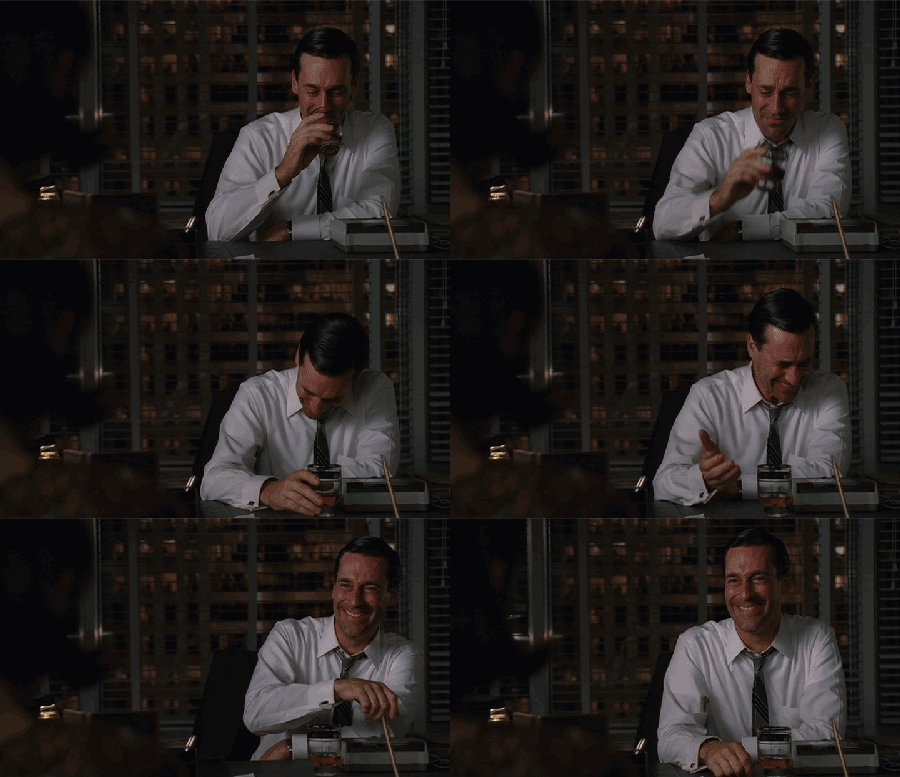
Me explaining my purchases to my wife:
-
The blotto lotto

The chaps at Master Of Malt had a lottery for the new Yamazaki Sherry Cask. Guess what? This:
Gif reaction:

All this because one man said the 2013 release was a great whisky. Madness.
-
Grand theft auto

I have plagiarised; and I have done it many times. I can give you excuses – I was young, I was stupid and lazy, I was under pressure, I lacked self belief – but really there are none. It is inexcusable. Plagiarism is theft, not just from another writer, but also from yourself – you are robbing yourself of the pleasure of writing, of taking full ownership of a piece of work, of the honour of having your work then read by thousands of people (even in this age of declining sales). I regret it, because it devalues all of the work I did back then; if you’ve done it once, your entire canon is basically bullshit. But what is most surprising about plagiarism is just how common it is.
I worked as a sub editor, a job that involves editing and rewriting a journalist’s work with two key aims – to conform to house style and, more importantly, to sharpen the text so no it is as tight as possible. The best writers were the ones whose work was nearly impossible to cut – they could weave an untouchable tapestry that took a considerable amount of time to unpick and edit. But not everyone had the skill – or, more commonly, the time – to craft their copy like that. In fact, time has a lot to do with plagiarism – journalists are expected to do more with less, so they have less time to write more copy, meaning that the temptation to cut and paste direct from the web is all the more alluring. But it is easy to spot. Every journalist has a voice in which they write, and plagiarised copy is like badly dubbed cinema; another voice suddenly chimes in, breaking the flow and disrupting the entire piece.
It was in my work as a sub that I discovered just how widespread it is. Whether lifting chunks from a press release and sticking your byline on it, or just lifting off Wikipedia, the print industry is rife with it. And beyond the cut-and-paste culture, there is the culture of regurgitation – and this is where the line between plagiarism and ‘research’ gets blurry. If you are writing on a subject and read all you can and then rewrite and condense it, is that plagiarism? Or a well-researched piece of writing? When is a credit to the original source needed, because this isn’t academia – this is a newspaper, where footnotes simply don’t work. At what stage do you need to credit a source? This is a good example of where one was needed. Read to the end for the link to the other piece ‘inspired’ by their work. It is basically a rewrite of work by an excellent blog, repackaged and sold to a paper who then charges the public for access to it.
But it’s really only when you get plagiarised yourself that you understand what an ugly thing it is to do – but there is so much of it going on that you actually feel silly for pointing it out. Or at least, that was how I felt. My dad was the person who spotted an article similar to one I had written for the Irish Examiner. It was about the same topic, so there was always going to be similarities. But it was when I spotted one of my own typoes in the copy that I realised it was actually lifted straight from my work. It wasn’t a huge amount, about six lines, but it was enough to tick me off. I posted on the blog about it, and tweeted my dissatisfaction. Nothing happened for a couple of days, then it ended up on Broadsheet.ie and it took off from there. An apology was offered, accepted, and a few lessons learned – including the age-old one that people in glasshouses shouldn’t throw stones. It may be well over a decade since I plagiarised, but I was still not in a position where I could sit in judgement on anyone for doing the exact same thing I did. I should have contacted the writer privately, rather than behaving like a total prick.
The most important lesson of all was about originality and creativity in general. If print media is to survive in any form, it has to take a zero tolerance approach to both plagiarism and its ugly sibling, churnalism. To have thousands of people reading your words is a privilege – one that most journalists take completely for granted. To be honest, if the weight of that knowledge was ever-present on your mind you would probably never write a word. But quality journalism – well-written, original content – is more important now than ever, as the lifting of content – be it written or otherwise – is becoming more and more of a problem. Platforms like Facebook/Pinterest/Tumblr are just making the problem worse. They enable you to reblog or repost or pin or share content that not only did you not create, you also have no idea who actually created it. One of the reasons I quit my local gym was their cavalier attitude to content – their Facebook page repeatedly posted beautiful photos of weddings lifted from Pinterest et al and passed off as their own. No credit was given to the models, the photographers, the stylists, the graphic designers. Anything they saw that tickled their fancy suddenly became fodder for their ‘digital marketing’ portfolio. They failed, just as I had, to heed the one commandment of content – respect the creator.
Nowadays I try to write every word, take every photo, record every talk, shoot and edit the videos, and generally do as much as I can, because nobody is going to read your blog for a load of press releases. I may run Ireland’s Least Successful Blog, but that is because I am Ireland’s Least Successful Journalist – but at least I can claim that I earned both those titles through my own inept work. To fail on your own merits is a far better feeling than achieving success at the expense of others. Or at least that’s what I tell my kids as I feed them cardboard for breakfast.
-
Money a lámh
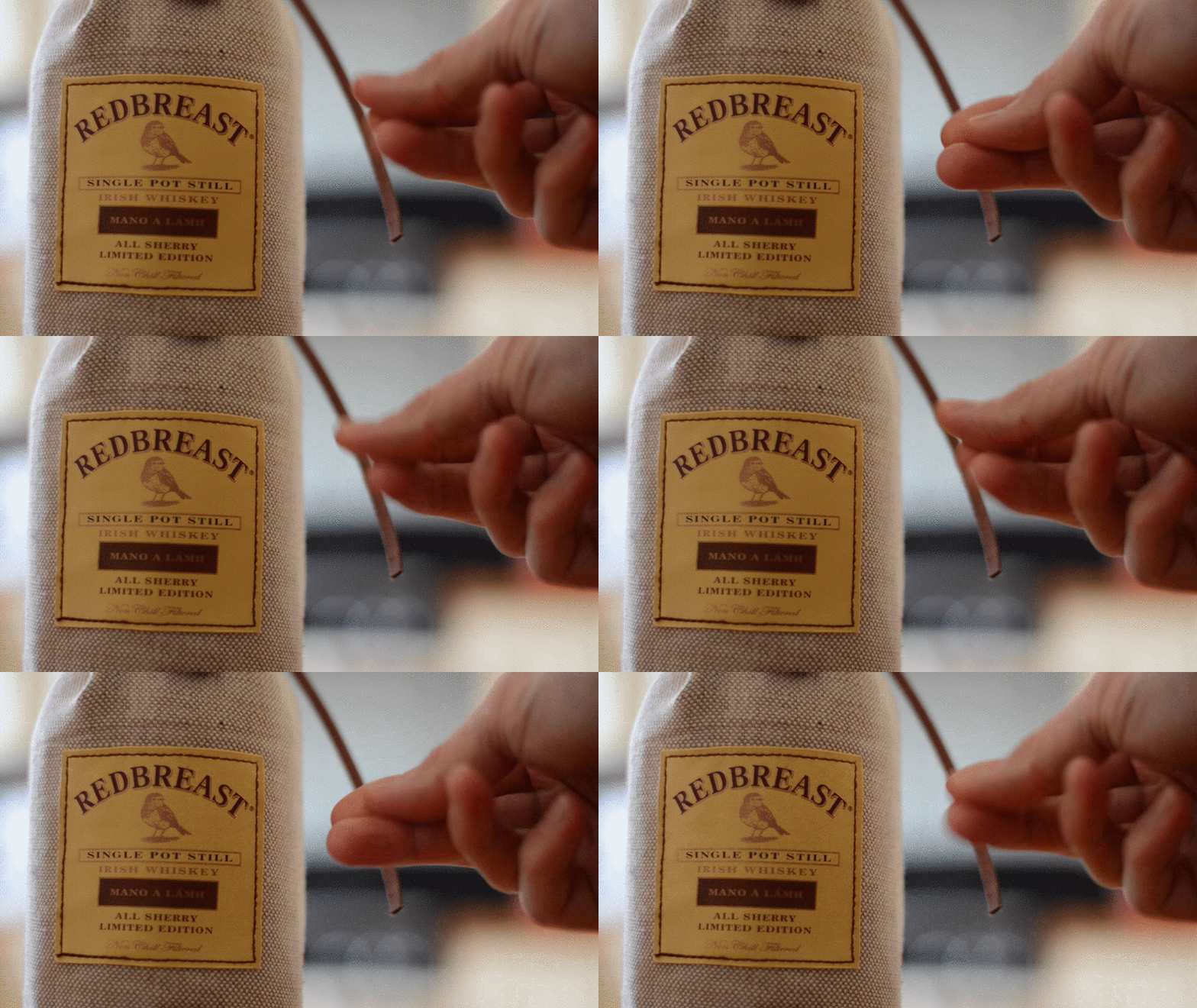
Mano A Lámh – one in the hand is worth two in the bush. The top performing investment last year was not gold or wine – it was whisky. As the Guardian reports:
The leading index for scotch whisky, the Rare Whisky Apex 1000, rose by 14% last year, outperforming wine, which fell by 0.4%, gold, which declined by 10%, and many of the world’s leading equity indices. The FTSE 100 index in London lost 4.9% in 2015, while on Wall Street, the S&P 500 edged up 0.7%. In China, the Shanghai Composite gained 9.4%.
The whisky market is booming: the total value of rare whiskies sold at auction in the UK last year was £9.6m, up from £7.6m in 2014, according to consultancy Rare Whisky 101.
So this begs the question, what defines rare? Is Midleton Rare actually rare? As time goes on and people consume more and more of each year’s releases, yes. And the editions signed by former Master Distiller Barry Crockett are now a diminishing number, so that adds to their specific rarity and thus to their value. But generally there is enough of it released each year that it won’t appreciate in value for some time. So when the guys in Midleton decided to release a special edition Redbreast, I was screaming ‘shut up and take my money‘. I bought four bottles, getting around the two-per-customer clause by purchasing two in my wife’s name, which in turn led to a recreation of the closing scenes of Se7en, as I begged her over the phone not to open the box that had just arrived with her name on it. Eventually she did open it, and realised that it wasn’t a lovely gift for her at all, but more fucking whiskey for her (then-unemployed) husband. Gif reaction:

‘It’s not even flavoured, like us ladies allegedly like it’ she sobbed. I got to sample the new release before I bought it, but haven’t actually opened any of the bottles I bought. I used three of them as gifts, and now have just the one left. There were only 2,000 released, so I waited and waited for them to sell out, as the value would (theoretically) go up. And lo and behold, this email arrives during the week:

Mano a Lámh, gone but not forgotten.
It’s true. We are writing to let you know that all two thousand bottles of our limited edition, all sherry, Redbreast Mano a Lámh are gone. Every last drop. But you can help us to begin a new tradition in its honour and be rewarded for your thoughts.
Did you have an opportunity to taste Mano a Lámh? We are eager to know what you liked most about it. In return, we are giving you the opportunity to win a further addition to your whiskey cabinet. And so, as a thank-you for filling out our quick survey, you will go into our members-only draw to win a bottle of Redbreast 21 Year Old Single Pot Still.
While Mano a Lámh is now gone and officially retired, there are new opportunities on the horizon. Our Master Blender Billy Leighton was truly inspired with your appreciation for this all sherry whiskey. So he is now working on a new project that we will be excited to share with you soon. Which is why your views today may help us to craft a new whiskey in the future and keep the collaborative spirit of Mano a Lámh alive.
Translation: We have sold out, there is now only a finite amount of them available, and none through normal retail outlets; in other words, they are now rare.
My immediate reaction was: Shall we start the bidding at one million billion euro?
And then later, my reaction was: No, we shall not. This is why:


Two auction sites there giving you an idea of the prices it is reaching. Even the 150 is probably a bit optimistic, given that this is a non-age statement whiskey. The whole debate over the NAS movement is akin to the weed droughts of my youth – someone alleges there is a drought, prices go up and product quality and availability goes down. In the whiskey world it simply means that we are being sold younger whiskey at older whiskey prices. The move towards NAS is not necessarily a bad thing, as age statements are often misleading and bear no relation to quality. I won’t bore you again with the tale of the seven-year-old Adelphi bottling of a Glen Rothes that blew my mind, or my opinion that the seven-year-old Glendalough is preferable to the 13, but I assure you I’m no ageist snob. But if you want an investment whiskey, an age statement is sorta important. Or, failing that, for the distillery to be obsolete, which is the case with a present I got this Christmas:

The one on the left is the valuable one. The distillery at Dumbarton is long gone, and the stills sat idle at Bruichladdich for years – with one of them sitting in the front garden with a welly boot sticking out of it. But then Mark Reynier set up down the road from me in the sunny south east, and brought his sense of terroir – exemplified in Bruichladdich’s Islay Barley release, above on right – and the Inverleven stills to Waterford city, where he is now operating a distilling powerhouse (here’s Mark talking about the Inverleven stills in a recent interview).
The whisky made by the Inverleven stills is finite – their Scottish life ended long ago, and the Cadenhead bottling of their single malt ticks all the boxes for investment; the distillery is silent – not just mothballed, but gone – so no more product; the age statement is a fairly profound 27 years, and it is bottled at a shitkicking 53.9%. The stills that made this malt are now making Irish whiskey in Waterford, so the value should increase. So much as I would love to crack it open and try to get a glimpse of where Reynier is going with his spirit, I’m not going to. Neither am I going to sell it, as I like the fact that it has a (somewhat obscure) link to a place not that far from me. Perhaps when Waterford’s product matures in fives years we can open it and compare and contrast. Because no matter how rare the whiskey, no matter how expensive it becomes, it was made to be drunk. An undrunk whiskey is an unplayed piano, a car up on blocks, an unloved child. It needs to live and breathe and have somebody talk about it and say ‘this was the best’ or ‘I’ve had better’ or ‘this tastes like photocopier ink’.
I tend not to buy expensive whiskey, as I prefer variety over exclusivity. I like to try as many drams as I can, rather than chuck away 200 bucks plus on something that may or may not be the emperor’s new clothes. Snobbery is the action of the insecure, and to pooh-pooh any malts, blends or grain is to deny yourself some cracking drams. I’m about as far from an expert as it is possible to be – to be honest, I’m not even sure how whiskey is made – but I know what I like. I like something I can obtain again with relative ease, and without remortgaging my home or selling a kidney to an Albanian to pay for it. I don’t want to drink unicorn blood, because what if I like it, where will I get more? Those goofy bastards are almost extinct you know.
-
That’s the spirit
The Spirit Of Speyside whisky festival is awesome. I spent a week there last year and had the time of my life, and it seems many others did too, as this year’s ticket sales are booming. Here’s the deets:
Ticket sales for the 2016 Spirit of Speyside Whisky Festival have set new records, with over 2,700 tickets valued at almost £75,000 being bought within the first hour of their launch this week.
Just 10 minutes after the website went live on Tuesday (February 2) transactions reached the same level that took an hour to achieve in 2015, while the same amount of sales in an hour took 24 hours on last year’s opening day.
Over 60 events in the packed programme taking place in whisky’s spiritual home from April 28 to May 2 have already sold out, and many more have limited availability. The events attracts thousands of visitors to Speyside to raise a glass to Scotland’s national drink.
Visitors from the UK, Europe and North America have been the driving force behind the sales, with whisky lovers from as far afield as Bahrain, Australia, Japan and India also snapping up tickets on the opening day.

Festival manager Pery Zakeri, above, says the phenomenal demand has taken everyone surprise, and there seems no sign of sales slowing down.
She adds, “We have had ticket sales from a total of 22 different countries and in the first 24 hours of going live we had reached a sales value of over £91,000.
“I think this just goes to show how eagerly anticipated the Festival is this year. We have garnered a fantastic reputation for putting on a world class event, and people are making sure they get in early to get tickets for the activities they really want.
“As with previous years, the exclusive distillery tours have sold out first. The real whisky aficionados are always looking for very special experiences that are only available at the time of the Festival, so tours of distilleries not normally open to the public, such as Strathmill and Dalmunach, were snapped up within minutes.
“However, with 467 different events on the programme from whisky tasting and blending experiences and from heritage walks to traditional ceilidhs, there are still plenty of tickets available.
“The beauty of the Spirit of Speyside Festival is that it is small enough to be incredibly friendly and welcoming, but big enough so that there is something for everyone. But we’d urge anyone thinking about coming to book their events soon as tickets are selling very quickly indeed.”
The Festival is taking part in Scotland’s Year of Innovation, Architecture and Design, and many of the events are focused on the theme. There will be the chance to enjoy drams against the background of stunning architecture, and visitors will learn about the innovation born in the region which is home to the world’s best-loved whiskies.
Paul Bush OBE, VisitScotland’s Director of Events, says, “The Spirit of Speyside Whisky Festival is always a massively popular event with visitors from around the world and we are delighted to see so many people eager to take advantage of the opportunity to sample this unique aspect of Scotland’s history and culture in 2016.
“Much more than simply whisky tasting, the Festival celebrates Scotland’s national drink with an exciting and innovative programme of events, and we’re confident that the hugely encouraging sales over these first 24 hours will be maintained ahead of the Festival over the coming months.”
Along with helping whisky fans organise their itineraries and finalising details of the Festival, organisers are balancing that with planning their new mini-festival in the autumn.
It takes place from September 9 to 11 at Elgin Town Hall, and will bring many of the region’s whisky producers together under one roof on their own doorstep fromSeptember 9 to 11. Tickets for that event are due to go on sale after the main Festival in May.
Tickets for all events in the 2016 Spirit of Speyside Whisky Festival programme are available to buy now at www.spiritofspeyside.com The Festival is also active on social media – facebook.com/WhiskyFestival and @spirit_speyside on Twitter and on Instagram.
I’ve posted and reposted links to the blog post I wrote on the festival and the Irish Examiner article, but here they are again, just in case you need more convincing. Book your tickets, brings your mates and have a blast – you won’t regret it.
2001 drams: A Spey odyssey – a swear-filled blog post.
Kindred spirits – the unedited version of the Irish Examiner article.
-
The gallowglass is half empty

In the late Nineteenth century, the Scots adulterated our whiskey because it was better. They passed their own off as Irish because our whiskey was better. They savaged our industry and tarriffed it out of business because our whiskey was better, and they bought up and shut many distilleries in Ulster because our whiskey was better.
The Scotch industry’s products I like a lot. Their history I despise.
The Irish and the Scots have had their disputes. Over the centuries we have slaughtered each other on the battlefield, sometimes at the behest of the same cruel master, sometimes just for the hell of it. But the truth is that for two nations divided by water, we are effectively the same people. Our histories are intertwined to the point that it is hard to tell which where we begin and they end. Many of our names, such as MacSweeney and MacCabe came from the gallowglass, elite aristocratic mercenaries who settled here in the 13th and 16th centuries. Not long after this second influx of exiled gallowglass, the plantation of Ulster began – and Bushmills distillery was founded. And this brings me, as almost everything does, to whiskey. The quote above was taken from the Irish Whiskey Society forum and it encapsulates an attitude that pervades the Irish whiskey scene. There is a feeling that the Scots stole our thunder – we invented the drink, they became known for it and built a magnificent industry on ‘our’ idea. They are Zuckerberg, we are the Winklevoss twins. We are Woz, they are Jobs. We created something, they made it their own. Of course, this is a reductive approach to it – this incredible product deserved to be shared with the world, it was the same Irish monks who discovered distilling that then brought it to Islay, the little island that lies between Northern Ireland and Scotland. But any yah-booing does us both a disservice, for just like our people, history and culture, our variations on this one theme are more alike than they are different. Yet I’ve felt the hot rush of resentment when Scottish friends tell me that they think John’s Lane is ‘pisswater’ or that Irish whiskey ‘isn’t really whiskey at all’ – not to mention the classic line “you need that third distillation, but we get it right the second time”.
But we can focus on the differences or we can focus on the similarities; our communal glass can be half empty, or it can be half full. The divisions that plague the community of Northern Ireland are an example of people looking to make ‘others’ of their neighbours, seeing only difference. But they are, effectively, the same – be it Protestant or Catholic, whisky or whiskey, ultimately everyone is worshipping the same holy spirits.
In the Scots spirit world, few have had the evangelic appeal of Charles MacLean. An author, presenter, bon viveur and raconteur, to me he personifies all that is great about Scotch whisky – a passion for good food, good fun, a good story, and a great dram. I had the pleasure of meeting his bewhiskered and bekilted self at Strathisla last year, where he hosted a dinner accompanied by some cask strength drams.

A masterful speaker, his tasting notes are made up more or less on the spot, and change constantly, moving from random comparisons to vegetal notes, to bath salts, to soft leather, to detergent; and he is usually right.
So when the IWS arranged for him to speak in Dublin in the significant venue of Wynns Hotel, I had to be there. Granted, it clashed with the Cork IWS branch’s tasting with the aforementioned Bushmills, but this was an opportunity to celebrate our shared heritage with some fantastic drams drawn from the vaults of the Scotch Malt Whisky Society.
It was booked out, as the current president of the IWS, Peter White, told us. Peter is what whisky geeks call a peathead – he makes a pilgrimage to Islay each year for the whisky festival, and obviously loves the briney, smokey drams – ironic, given that he is a firefighter. We had an introduction by Peter, and then a few words from Fionnan O’Connor, author of A Glass Apart. It was Fionnan’s book that inspired MacLean to speak in Dublin, having written to him to congratulate him on such a fine work. In fact, if you want to pick a single Irish text to read to learn more about Irish whiskey, it is now the go-to.
And so MacLean – wearing his trews, as is the tradition for a Scots gentleman abroad – took the floor. He spoke for a little over two hours, we had six great drams, lots of laughs, a brief chemistry lesson, and some great stories both from Maclean’s life and from whisky lore. I won’t go into the details, as I recorded the whole thing. You can listen to it below.
The audio isn’t the best thanks to my ailing iPhone, but hopefully MacLean’s velvety tones will not be swamped by lo-fi hiss and my occasional yawping.
And here are some pics of the various bottlings:
I popped into the Celtic Whiskey Shop last week whilst killing time before a funeral. The staff member I spoke to made this point about Scotland’s famous whisky regions – region really doesn’t exist any more; we live in a post-whisky region world. He said that, apart from the bonfire of congeners that is Islay, most Scotch styles are not dictated by geography. Longitude and latitude no longer figure as controlling influences on flavour profile – if they ever did. The same obviously goes for here – on a small island, the difference between whiskey from Cooley or Dingle will be minimal. Ingredients and production methods are the ultimate decider. It’s not in the where, but the how. And so it holds that really, the difference between Dingle whiskey and Scapa ultimately isn’t something worth fighting over – both come, as the Celts do, from the same traditions, the same rugged landscapes, the same sad and beautiful history. The idea that one nation’s product is the ‘best’ is incredibly limiting – to claim our’s is best or their’s is lesser is to deny yourself the full epicurean experience, and makes us sound bitter. Maybe it’s time to let the past go. After all, when the world’s number one whiskey is Canadian, and the Asian whisky markets are booming, it might be time to recall our gallowglass ancestors and unite under one flag…until March 19th in the Aviva, of course. Then it’s hammer time.
-
Couldn’t Hackett

Midleton is a bastardisation. The name actually comes from the notion that it was the middle town between Cork city and Youghal. Not the most flattering name for a place – the sole distinguishing fact about is that it lies between two places that have names with local meaning. But its actual name goes considerably farther back. In around 1100AD, Cistercian monks from the Burgundy region of France built a monastery in the town, located where the Church Of St John The Baptist sits now (next to the Mad Monk craft beer pub, if you need a more secular landmark).
A hundred yards past this site, the Owenacurra river runs, and, just on the other side of the river, I sit typing this in my kitchen. The name Owenacurra comes from the Irish ‘Abhainn Na Cora’ – The River Of The Weirs, for betwixt my home and the site of the monastery, there was one of several weirs. And this was where the town took its name – Mainistir Na Corrann; The Monastery By The Weir.
It seems fitting that in a town built around a monastery, the area’s most famous product was invented by Irish monks. For it was they who discovered the alembic still on their travels across Europe. Moorish alchemists used it to distill essential oils – but Irish monks, dab hands at brewing, saw another potential use. They distilled their ale into what we would now call new-make spirit, and then once it started being stored in casks, whiskey was born. The Irish monks brought this incredible knowledge across Europe, most famously when they landed at Islay off the coast of Scotland – where the Scots claim whisky was first created. Of course, they are not the only ones with a loose grasp on history – even here in Midleton, few people remember that there used to be two distilleries in the town. In the 1800s, the Owenacurra river was the engine that drove Hackett’s distillery, located close to Avoncore and the hulking presence of the Erin Foods silo.

The Hackett’s didn’t have the best of luck, as local historian Tony Harpur points out in his excellent blog, Midleton With 1 D:
The other establishment producing alcohol in Midleton was Hackett’s Distillery, which must have been in operation in 1824 in order to be included in the Pigot’s list. Called James Hackett & Co, this was run by a number of brothers who were descended from a family of leather tanners in Cork. The Hacketts took advantage of the 1823 Excise Act to found their newly built distillery on a plot of land between the Mill Road and the banks of the Owenacurra, just north of Midleton. But they got into difficulties for some reason – presumably Fr Mathew had something to do with it. Another issue was a family row – one brother withdrew his share of the capital and went off to Van Diemen’s Land (now Tasmania in Australia) and set up a distillery there!
Given that Tasmania was then the principal dumping fround for all sorts of criminals convicted by the law courts in Britain and Ireland, the establishment of a distillery there did not bode well and eventually the authorities took fright and closed the distillery down. The government also delayed in paying out compensation for the closure so the brother returned to Ireland virtually penniless. By 1850 the Hacketts had put the premises up for sale on the instructions of the Encumbered Estates Court (a new court established by the British government to sell off bankrupted Irish landed property). It was later acquired by the Hallinans who ran it as a grain mill.
Sadly, nothing remains of this distillery, which, bizarrely, seems to have been built from stones removed from the site of the medieval Cistercian monastery of Choreabbey (Midleton). Even the stone from the old St John the Baptist Church of Ireland seems to have been incorporated into Hackett’s distillery – the authorities were building an new church at the time! It gives a whole new meaning to the Irish phrase ‘holy water’, a euphemism for whiskey and poitin!
The downfall of the Hacketts saw them slump into poverty – quite a fall for merchant princes who once lived in Lotamore House, which also was once home to Sir Anthony Perrier, one of the first inventors of the continuous still – later to become the Coffey Still.
This book gives a sense of the Hacketts’ decline:


The point about them preferring to eat sheep’s head and wallow in poverty rather than turn to the nearest distillers for help was brought to my attention by another local historian, Barry Crockett. Barry is born of distilling lore – literally. His father Max was master distiller in Midleton distillery, and lived on-site in the Distiller’s Cottage (ironically, a rather large building with a couple of dozen rooms). It was here that Barry was born, and he grew up to be in charge of Midleton distillery, and played a very large role in the rebirth of Irish whiskey we are now seeing. With a lead-in time of ten to 20 years for premium stocks, it was in Barry’s time in charge that the plans were laid that are now coming to fruition. He is retired now, but still plays an active role in the distillery – last year he gave a talk on the history of the distillery, and it was during this that he spoke of the Hackett’s and their loathing for the Murphy brothers, who ran Midleton distillery with a keen business instinct. He said that the Murphy ledgers and papers held almost no records of the times, other than business data. One exception was the request by the brothers to their insurer to be allowed to use their mill to grind flour for locals during the Famine. They were refused. In contrast, Bartholomew Hackett was a poor businessman but an obsessive diarist, and his colourful papers – of which there are several volumes – are kept in the city and county archives in another distilling heritage area, Blackpool.But back to Midleton: The Hacketts used the Owenacurra to distill, but the Murphys used the second river in the town, known as the Dungourney river (actually named the Roxboro). It rises in Clonmult, site of a War Of Independence-era massacre, and passes through the village of Dungourney, very close to the woodland area where Irish Distillers have built a large maturation complex: If we get another winter like those in 2009/2010, it will be interesting to see if the whiskey aging up there in the snow-bound hills is any different from the maturing stock in the town where milder temperatures prevail. That said, any difference will be so minor that it would take a considerably more forensic palate than mine to discern any difference.
But the Dungourney river isn’t the only water source that Midleton distillery takes water from.
The whole town of Midleton is built on limestone. This makes the water hard, and perfect for distilling. It also means the porous rock beneath our feet is riddled with caves. Roughly halfway between the site of Hacketts and the Jameson Heritage Centre lies the town’s award-winning SuperValu. When it was being built, it was said that more steel and concrete went into the ground as was over it, as the site previously hosted a hotel which slowly came asunder as the ground beneath it gave way. In fact, in the last couple of years, three cottages on Park Street, to the rear of the SuperValu, started to subside.
Through some of this sprawling network of caves, a small river runs. Mostly underground, it makes a rare appearance in a dip on the grounds of Midleton College, a spot where we used to smoke, and sixth years used to prove their manliness by sneaking through the chest-deep, ice-cold waters in total darkness to get into Midleton Distillery via another sinkhole on the other side of the wall. Here is a terrible map:

The cluster of foliage right below the all-weather hockey pitch is the college sinkhole, while the tree just below it on the other side of the wall is where the distillery side access point is. The white rectangle is the beautiful Garden Still House. Here’s a couple of photos of the dip down to the water from the distillery side:


There is a point to all this waffling I’m doing – and it all comes down to the recent floods here in Midleton. Both rivers burst their banks – an event which hasn’t happened in about 40-plus years. The weir in the gif at the top – located at the site of the Hackett distillery – was totally submerged as the Owenacurra burst its banks at Avoncore and also broke downriver into my estate. My house was spared, others in my estate were not so lucky. The Dungourney river also burst, flooding the lower half of the town, including the Jameson Heritage Centre. But the real damage was past the new distillery, as the water above and below ground reached capacity and flooded the area. The rugby pitch was flooded, Lauriston estate was flooded, and the back of the distillery warehouses was hit too.
This image shows that side:
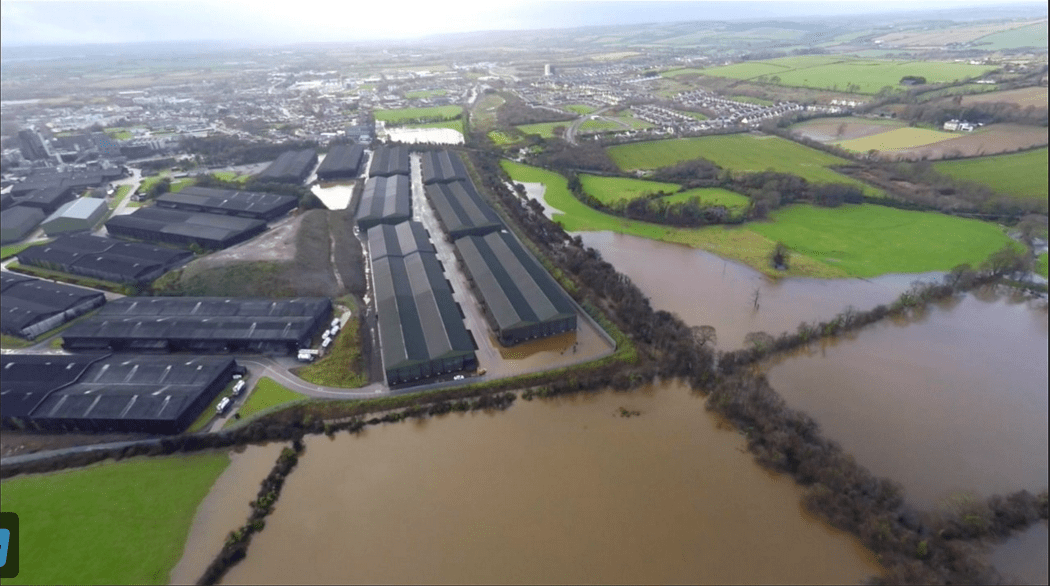
Or this helpful gif:
What you can see there is a small portion of the 28 acres of farmland that was under up to three feet of water. If the distillery warehouses weren’t there, the whole town would have been hit by that water. And yet there are some who blame the warehouse complex, in classic luddite style. The phrase ‘now I’m no engineer but…’ now causes as much anguish in me as ‘now I’m not a racist but….’. Invariably what comes next is some incredibly stupid theory about how the warehouses caused the waters to back up. Did they fuck. If the distillery wasn’t using the water from the river and underground, we would be flooding every winter. Apart from that, when floods did come, it was IDL who brought in private contractors to clear the flooding from the whole area – the estate across the road, the rugby club, and their own site.
This video show just how far upriver from the town the flooding goes:
Throughout human history, we have built on floodplains. They have the fertile soil, the trade routes, the water – they are the obviously place to build settlements. But sometimes, as the term ‘floodplain’ suggests, they flood. Midleton has one of the world’s greatest distilleries because we live on a floodplain – fertile ground to grow lots of high-grade barley, plenty of water to make whiskey, and plenty of people settled nearby to work there. As a final denouement and debunking of the musing of a ‘non-engineer’, the basement of the town hospital flooded days after the waters had subsided. The hospital is on a raised area, overlooking the town; meaning the water came up from underneath. This hospital was also once the town Poor House – the same Poor House overseen by Bartholomew James Hackett, before he slipped into obscurity and became the Midleton distiller that time forgot.
-
From unenjoyment to employ-a-Bill: My eight months on the dole

It’s never easy to lose your job. Actually, strike that – it’s incredibly easy to lose your job. It’s finding another one that’s the hard part. I had been with the Evening Echo from 2003 to 2014 and had seen the massive changes the digital age had brought. Gone were the days when sitting in the Mutton Lane Inn supping pints of Beamish and musing about life were considered a career in journalism worthy of 80k a year. Declining print sales and a fall in advertising revenue meant that newspapers simply couldn’t afford to pay the old salaries anymore. Most organisations in Ireland have hit that Year Zero reformation already – lay-offs, early retirements, and a massive shift in production systems; they got rid of the old-school hacks and brought in digital natives who can navigate the zeitgeist with ease (and require less remuneration for doing so).
The pattern was the same in almost all papers – before all others, the sub-editors were the first to go. The subs belonged to that bygone age, when the permanence of print meant that things needed to be checked and rechecked, house style needed to be adhered to as part of the brand, and journalists needed to be held to account – because sooner or later, everyone fucks up.
These days, with diminished reserves in the average paper’s war chest, the old adage of ‘print and be damned’ means exactly that – if somebody does fuck up and you get hit with a massive lawsuit, it will quite possibly end your publication. So print outlets have become even more selective about what they cover, journalists have become more cautious, and subs are a thing of the past.
In the design of print editions, templates were the new world order. They are a great idea – they bring a uniformity to the product which can be lacking if the creative fingerprints of the individual page-drawers are on every page. But from my own personal point of view, design in print is more important now than ever. If you expect people to buy your publication, you can’t simply sell it on content alone – it needs to look like a product worth investing in.
I loved being a sub – I excelled at art and English in school, and am naturally a curmudgeonly old goat, so it suited me perfectly. I spent ten years wearily sighing as I eviscerated press releases, came up with witty headlines that never made it to print (like the terrible one in this post title), and worked on features pages during my lunch simply because I loved the free rein I was given with them. There were many aspects of the media that didn’t sit comfortably with me – nobody should be operating under the illusion that the Fourth Estate is anything other than a business – but on the whole, I had a blast. I worked with some great, whip-smart people, I learned a lot, and I made some great friends. But I knew the end was coming – I can’t remember the last time I actually bought a paper, or delved any deeper than skimming the headlines on Google News.
I was the youngest of those to go, with the shortest tenure. Many had lived much of their lives with the paper. Their fathers and grandfathers were there before them, and they had built much of their lives around the place. For them it was difficult. For me, it was very easy. I applied for redundancy well in advance, got accepted, and picked up my cheque and P45 on New Year’s Eve 2014. I got the bus home to my heavily pregnant wife and three kids, stopped and wondered ‘WTF am I doing with my life?’ This was probably the point where it started to feel like the closing scene from The Graduate, that ‘what now?’ look on their faces as the dream has been fulfilled and now reality comes crashing in.

And if you want a massive dose of reality, try ringing in the new year with a visit to your local dole office. They still had dusty Christmas decorations up, and the clock in the waiting room was broken, meaning the second hand clicked forward, then back, then forward. I’m not sure if the local office has an ironic name policy, but the fact the girl who dealt with me was named Eden would suggest they might.
I had heard so many horror stories about dole claims and how long you would be waiting that I was somewhat surprised to hear that it would only take a week or so for my claim to be processed. But how would I survive on the dole? How would I pay the bills? For years all I had seen in the paper was stories about how the dole was not enough to live on, endless tragic stories about people feeding their kids cardboard boxes for breakfast. What would we do? We’d do fine, apparently.
I was assessed by the dole office, and despite the fact that I have no mortgage, pay no rent, and received 25k redundancy, I was entitled to a 432 a week. So basically I was down about 100 a week on my wages, but with 25k in the bank. Somehow it’s hard to buy into the ‘poor mouth’ when those are the figures. I had spent more than a decade in the newspaper reading hard-luck stories about unemployment and poverty, so it was hard to reconcile that with what I was experiencing. But being on the dole isn’t just about money. The same goes for work itself: It’s about a sense of self worth, a sense of purpose, structure, value. Work is an important part of being human – it isn’t just where the money comes from, it is what distracts us from ourselves. Without it, we only have the insides of our own heads, or watching Jeremy Kyle and those insidious ads for payday loans. Since the dawn of time, we had to do things to survive, be it foraging for berries or working in a newspaper. I tend to sound like a Soviet era propaganda film when I talk about work, extolling the virtue of toil, but I believe that work is good for the soul. During my time on the dole I found myself slowly succumbing to a depressed stupor; I could feel my brain slowing down. The first example of this came when I turned up to a talk on ‘employment activation’ 30 minutes late. I firmly believed i had the time right, but had got it completely wrong. For 11 years i had worked to tight deadlines, and yet somehow I was now the dullard who can’t show up on time for a meeting despite having nothing else to do.
I just waited for the next meeting and imagine my joy when I realized that the jobs liaison officer and I went to school together. Oh, the chagrin. In the meeting myself and a group of other job seekers were told about the supports available to us – from courses, to back to work support, to just about everything you could want to turn your professional misfortune into a golden opportunity.
As the meeting went on a few more late comers drifted in, slumped into their chairs and started playing with their phones. Suddenly I wasn’t particularly envious of my old school friend and her plum job with the Department Of Social Protection. Because there clearly are people in this country who are utterly unwilling to work. They are a tiny minority, but they are there, just as they are throughout life; it’s just as easy to find the indignant workphobic slob in the workplace as it is on the dole queue. But most people on the dole don’t want to be there, because it fucking sucks. And it’s not just your mental state that suffers – your prospects do too. As the time drags on, you have to aim lower – your expectations need to be reset, as the longer you spend out of work, the less appealing you are to employers, the more desperate you become, and the more blank space there is on your CV. Thankfully I worked in an industry where you are never ‘unemployed’, merely ‘freelance’. I did a few pieces for the paper, so at least I had that point to if somebody said ‘what have you been doing with your time?’
And time is something you suddenly become aware of – you go from working and never having the time to do the things you want, to suddenly having nothing but time. Without the defining parameters of work, time is not something to be cherished, but to be put down. Your week is just a random series of days and nights, occasionally punctuated by trips to the dole office to sign on, or to the post office to pick up a wad of cash that other people earned. Reading excited tweets on a Friday or depressed ones on a Monday you feel up like the dowager countess in Downton Abbey, asking ‘what’s a weekend?’ They mean nothing to you because you don’t have the spare cash or inclination to go anywhere or do anything – the weekend, like the money in your pocket, is something you didn’t earn.
Adjusting to the income on the dole wasn’t hard for us – my salary wasn’t far off what I was given by the Irish social welfare system, but we still made adjustments. The most satisfying of these was getting rid of Sky TV. It’s hard to fathom how anyone talks about struggling to survive while paying for the pure bilge that satellite TV supplies your home with. We cancelled Sky, and the boxes kept working as free view sets, saving ourselves about 400 a year in the process. We also shopped around for the best deals in utilities, and in health insurance – despite the fact that we were now entitled to a medical card. We didn’t apply as we didn’t need one, and besides, healthcare is one thing worth spending your money on. We made a few more tweaks here and there, nothing drastic, and carried on. With four kids, we were never bored. And that was one of the positives of losing my job. I got to spend eight months at home with my family, something most men never get to do. With zero statutory paternal leave in my former workplace, i wonder how much time I would have been able to get – a week at best.
Obviously my months on the dole were often depressing, and difficult for both my wife and our kids, but I have no regrets. I got out of an industry that is facing a difficult future, and I see my departure as part of a process of creative destruction that needed to happen. At some point in their history, newspapers started to believe they were the source of information, rather than simply a conduit for it – and when another conduit came along – a free, open, democratic one – they struggled to cope. Newspapers still have something that blogs don’t – accountability. Because they will get sued over just about anything. I once drew a page with a photo on it of Gerry Adams visiting Shandon Street in Cork. He was shaking hands with a man, who was not named in the caption, but was described as a supporter. The man sued, claiming the caption suggested he supported the IRA. He lost his case, because clearly Sinn Fein has nothing to do with the IRA, but he did win some minimal amount because he had been affiliated with a different political party in the past. So that is what you are up against. People will sue anyone over anything. So when there is an outcry over papers being disinclined to take on litigious moguls, whilst blogs have no problem doing so, you need to consider what each side has to lose – a newspaper could be hit for millions, meaning massive job losses or the end of the title, whilst a blog can say what it wants – because who would bother suing a blog? And a faceless blogger is altogether less trustworthy than even the most scurrilous hack. So newspapers are still important – whether the next generation feels the same way remains to be seen.
In the end, I got a job. Early in the year I took the public sector exams online. The results placed me 143rd. I thought I would hear nothing else, but then a call came to attend a screening interview in Dublin. It was very informal, just ten minutes of chatting about my career, such as it is. The person also told me not to feel crestfallen about coming 143rd, as that was out of the 20,000 people who sat the exams. So not too bad really. I was placed on a panel for temp posts in the public sector in Cork, and began the long wait. Eventually I made it to the top of the queue, and for the last four months I have been an admin worker in one of the busiest emergency departments in the country. The work is exhilarating, challenging, humbling, and incredibly difficult, but I love it. The period I spent on the dole seems like a world away, but I can still remember the malaise that had started to set in. I stopped getting up at 5am and going running, started sleeping later, finding more comfort in food than normal, and just being fed up.
The experience taught me that the pleasures and sorrows of work have a lot less to do with money than we think. In his book Outliers, Malcolm Gladwell talks about success and how we measure it. He makes this point – if you were offered a job as an architect for 75k a year or a job in a tollbooth for 100k a year, which would you take? You’d most likely take the first, because even though it offers less money, it has autonomy, creativity, and challenge. I had spent ten years doing the same job – after two years, I excelled at it, after another few, I could do it in my sleep, and for the last couple of years, I just wanted out. People need challenges, stimulation, and though we might resist it, we need change. One year ago today my fourth child was born, I was on the dole and facing an uncertain future. Now, I do a job that has a level of meaning that few jobs do: It is actual life and death. Change is good, and money is one of the least important aspects of being human.
Early on in my time on the dole I had an interview with a jobs specialist who works with the Department of Social Protection. She told me that many men cry in that first interview with her, as they have been pretending to everyone else that everything is going to be fine, but they are terrified about the future, about not being able to provide for their families. She also told me about a talk she attended earlier in the week, given by a mental health expert. He talked about his family, how his parent were doctors, he became a psychologist and he expected his children to excel professionally. His eldest son was slacking off in school and he was really trying to push him to do well in the upcoming Leaving Cert. One morning a neighbour arrived at their door to tell them their son was hanging from a tree across the road. They raced to him, cut him down and he survived. He did the Leaving, just about passed, but that was enough – because he was alive and they were together. The man talked about his own childhood, growing up with a bipolar mother and the troubles they faced – all privately – and he made the point that the poor have problems, while the rich have secrets. His experience with his son taught him that professional success isn’t necessarily the most important thing in life, and nobody has the perfect life.
A few years back there was one of many suicides in my home town. At the funeral, the father of the deceased said to a friend of mine ‘I just don’t understand it – he pulled in 60k last year’. It’s hard to know what to say to that. Money isn’t happiness. What I do now drives this home to me on a daily basis – if you have your health, a loving family, and a job that fulfills you, you are one of the lucky ones.
I didn’t think that I would spend so long looking for work (a period extended by my extreme aversion to nepotism) but it made me a better person. I saw that Ireland is a great place to live, to raise a family, to work, or even to lose your job. I’m not sure I would want to repeat the experience, the frustrations, the grimness of it all, but I certainly don’t live in mortal fear of it ever happening again. This is all just my experience, my circumstances – there are many unemployed people out there who are slowly being crushed by debt and poverty. But I just wanted to say that, for me, it was an eye-opener; not just about Ireland and how it supports people, but about myself, and my own need for work. To quote Dicky Fox in Jerry Maguire, ‘I don’t have all the answers. In life, to be honest, I failed as much as I have succeeded. But I love my wife. I love my life. And I wish you my kind of success.’

 Triple Distilled Communications