Local mom-‘n’-pop operation Irish Distillers have released their results, sans mention of the alleged new plant they are planning. However, you can see from the figures that they are going to struggle to keep up with the demand at this rate, so it would suggest to me that they need to expand beyond Midleton. All idle speculation on my part of course. Anyway – here are the stats:
Irish Distillers Results Year ending 30 June 2018
Jameson is the No. 1 Irish whiskey in the world with sales of 7.3 million cases with value growth of +14% and volume growth +12%
Innovation sustaining growth across Irish Distillers’ portfolio with sales of Jameson Caskmates reaching 300,000 cases in 2017/2018, driven by the launch of Caskmates IPA Edition in the United States
Irish Distillers Prestige range, including Redbreast and Midleton Very Rare, experienced 12.8 % volume growth
USA and South Africa continue to be the biggest markets for Jameson, with emerging markets starting to grow
Irish Distillers celebrate 30-years since joining Pernod Ricard, gaining access to unprecedented levels of investment and an extensive global distribution network
Wednesday, 29th of August 2018: Irish Distillers, the makers of the world’s most enjoyed whiskeys and Ireland’s leading supplier of spirits and wines, experienced another strong financial year in 2017/2018, accelerated by the continued growth of Jameson Irish whiskey which is now in double or triple-digit growth in more than 80 markets across the world.
Jameson is one of Ireland’s most recognised brands worldwide, enjoying years of exponential growth with 7.3 million cases sold in 2017/18, up from 500,000 cases during the mid-90s. As these results demonstrate, Jameson continues to spearhead the renaissance of the Irish whiskey category with the brand reaching its 29th year of consecutive growth with value growth of +14 percent and volume growth +12 percent.
Irish Distillers has a long history of innovation within the Irish whiskey category, and its commitment to creative experimentation has been key to the company’s sustained growth. In 2017/2018 sales of Jameson Caskmates reached 300,000 cases. This was primarily driven by the launch of the latest addition to the range, Jameson Caskmates IPA Edition in the United States, supported by strong performances in duty free and travel retail in Europe as well as growth in South African and Irish markets.
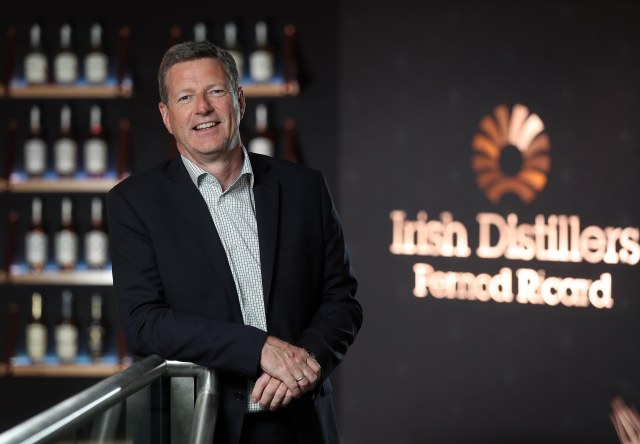
Commenting on the performance of Irish Distillers’ 2017/18 results, Conor McQuaid, above, Chairman and CEO said: “Irish whiskey is the fastest growing premium spirit in the world. Sales of Irish whiskey now account for more than one third of all Irish beverage exports, and we are immensely proud of the strong performance of our full portfolio of Irish whiskeys cementing our position as the makers of the world’s most enjoyed Irish whiskeys.
“Our continued dedication to innovation has allowed us to penetrate markets and grow Irish whiskey sales across our portfolio. The continued global growth of Jameson Caskmates is testament to this, with +86 percent growth in the US market compared to last year. Growth of our prestige range led by Redbreast which grew by +14 percent in volume, reflects the growing consumer appetite for premium Irish whiskeys and the resurgence of the time-honoured single pot still Irish whiskey. Powers, regarded as the classic and quintessential Irish whiskey, had a strong year with value growth of +8 percent.
“Our largest markets continue to be the USA, South Africa and Russia, followed by Ireland and the UK. It is very positive to see Jameson starting to generate interest in markets such as Nigeria, India and China.
“The Republic of Ireland spirits market generated volume growth of +6.1 percent and value growth of +4.9 percent. Against this backdrop, our premium spirits brands have recorded strong net sales growth during 2017/18: Jameson (+9%), prestige Irish whiskeys (+23%).
“Growth of Irish whiskey sales in Ireland is in part due to increased interest in Irish whiskey tourism. As Jameson continues its phenomenal growth story, with 29 years of consecutive growth, the redeveloped Jameson Distillery Bow St places storytelling at the core of the visitor experience bringing the 230-year history of Bow Street to life. As is evidenced by the incredibly strong visitor figures recorded over the past year, the new-look Jameson Distillery Bow St has fast become the must-visit whiskey destination in the world. When combined with the Jameson Experience Midleton, we welcomed over 475,000 from more than 70 countries to our brand homes.
“The growth of Irish whiskey on the global stage could not have happened without the investment and focus brought by Pernod Ricard. This year, we are celebrating 30 years since joining the Pernod Ricard family and it is no coincidence that Jameson is also nearing 30 years of consecutive growth, experiencing double-and triple-digit growth in 80 markets across the world since gaining access an extensive global distribution network.”
Wrote this for the Indo about getting druunkish on cake –
The Kerry TD Danny Healy Rae once said that eating a big meal before driving could be a factor in causing accidents. It came as a surprise, not only to the scientific and medical community, but also to the people he was addressing at the Oireachtas Committee on Transport,as they were discussing drink driving, not dinner driving. Deputy Healy Rae – who is a publican – said that after he finishes work he won’t eat a large meal because he knows it would make him sleepy on the drive home.
There is, however, a perfect storm brewing between both the facts on alcohol – it is a factor in 38% of all road fatalities in Ireland – and Deputy Healy Rae’s folksy musings: What about food with booze in it? Granted, cooking removes most of the alcoholic content in food, but there is one course that is the final bastion of boozy dining – dessert. Desserts like tiramisu or sherry trifle are famous for their drink content, so the question posed here is – can eating desserts put you over the drink driving limit? According to a study by All Car Leasing, the answer is yes – two portions of tiramisu can put you over the limit. Their study also covered lesser known foods like orange juice, which can contain tiny amounts of alcohol which is produced as the orange ferments – but boozy desserts are the most direct way to inadvertently go over the line. So this was the test – just how easy is it to get over the drink driving limit by eating treats?
The initial step in any scientific endeavour is to seek the advice of an expert. The first warning sign that this might not be the most important piece of investigative journalism since Watergate was that the medical expert I consulted didn’t wish to be named. “I just don’t see the merit in what you’re doing,” they said. I took this as a sign that I was on the right track – if the medical community was against me eating desserts until I was hammered, then there was something here that was just waiting to be blown wide open, either a looming war on liquor-laden desserts from the neo-prohibitionists, or possibly just my belt. My so-called medical advisor pointed out that as I am six foot and weigh 13 stone, I would need to consume a very large amount of dessert to actually get that much alcohol in my system, and would possibly just make myself sick in trying. Challenge accepted.
The first time I got drunk, it was on sherry trifle. The story became family lore, of how after my dessert I was singing, waving out the window and trying to open door while the car was moving. I was 11. The lesson I took home from this is that sherry trifle is wonderful, and that booze makes me hilarious. So I set about finding a sherry trifle with which to start my test. It turns out that most modern sherry trifles now don’t have sherry in them, but rather have sherry flavouring. After a pathetic trek asking various supermarket staff if any of their desserts had booze in them (‘I’m a journalist’ I told them, as if this explained my tragic quest), I tried Midleton’s The Farm Gate, where the local petit bourgeoisie go to get sozzled on cake. I was relieved to find they had a delightful sherry trifle which had a decent whack of sherry. After that it was off to Aldi and Lidl – the Germans know how their booze, and they also know their desserts, and there I picked up any dessert that had an alcohol warning on the front label. Then it was off home to gorge.
First up was the Aldi Irish Cream Liqueur Cheesecake, which contains an impressive 15% of Irish cream liqueur. It’s meant to serve four to six people, but as I hadn’t eaten all day, I downed it all in about five minutes. I used my AlcoSense breathalyser – which, at 80 euro from Boots, is a solid purchase for any dessertaholics – and it told me I was still well under the limit for learner or new drivers, which is 0.02% blood alcohol concentration (the level for full license divers is 0.05%BAC).
So it was on to two portions of Aldi profiteroles, which still failed to take me over the lower limit. It was time to take a more direct route – a box of Aldi Mister Roth Whiskey Truffles, eaten in the most joyless way possible. At this stage I was wondering if this was all a terrible mistake, but I knew that this was being done in the name of science. I waited half an hour and tried the breathalyser – I was at a solid 0.029%BAC, easily over the limit for learner drivers. I didn’t feel especially under the influence of anything other than the sugar screaming through my bloodstream, but the breathalyser doesn’t lie – I would have been unfit to drive.
I knew that if I was to cross the upper limit, I would need to go to Defcon One – with a Marsala wine-soaked tiramisu from Aldi. Meant to serve four to six people, I sat there alone, forcing down its rich creamy goodness as I broke a mild sweat. I waited, puffed into my breathalyser and saw that I had pushed myself to 0.037%BAC, a worthwhile return for the horror of gulping down a platter of tiramisu. Next was a box of Lidl Deluxe Cocktail Truffles, ten chocolate malty balls infused with spirit. Eating them was akin to the boiled egg challenge in Cool Hand Luke, but I got there in the end, and while I was still able to sit upright in my chair, I shoved a number of Marc De Champagne truffles down my throat, and another portion of Aldi profiteroles just to be certain. With the last wheeze left in my bloated, corpse-like form, I huffed into my breathalyser, which gave me the warning beep I was praying for – I was at a decadent 0.058%BAC, over the limit for driving in Ireland. I was also yearning for the cold embrace of the grave due to the amount of treats I had consumed, but the facts were clear – it is possible to get over the drink driving limit by eating a large amount of desserts.
There were two take-homes from this – one is that the majority of Irish people understand that drinking and driving is not acceptable. The staff in The Farm Gate said that many diners will deliberately avoid any dessert that has alcohol in it, so the days of getting trolleyed on desserts appears to be disappearing fast. Alcohol is rapidly becoming an indulgence that we enjoy in the comfort of our homes, and there is nothing wrong with that.
The second takehome was that it was easier to get over the limit than I thought – I never would have considered tiramisu was being something that could possibly influence my ability to drive, or to consider it as a potential unit of alcohol – but it is. There are, as Deputy Healy Rae pointed out, many factors that can influence our ability to drive safely – tiredness being one of them – but the days when we can pretend that consuming alcohol in any form and getting behind the wheel is an acceptable practise are gone. Anyone who does it and ends up in a motoring mishap of their own creation is simply getting their just desserts.
It’s the greatest tournament on the planet – we’ve waited and waited for it to come round and now here it is, and it is better than we could have anticipated. We may not have a representative of our country at it, but we are all there in spirit, as this is about skill, determination, passion and the strength of the human spirit. I speak of course of Love Island, the reality show that dropkicks a dozen failed eugenics experiments into a sunny Mallorcan villa in a sort of Battle Royale where you have to shift your way to being last couple standing. The sole aim of the show is to get the young lovelies hooking up with each other and winning 50k, or possibly just some notoriety, which in today’s world of micro-celebrity is almost better than the prize money. Who knows what commercial opportunities await the contestants after they leave the island – who will land that lucrative deal as the face of Canesten, who will end up flogging off-brand vodka in the drinks aisle of their local Tesco, who will be forced into shame-filled public appearances in nightclubs in hotspots like Manorhamilton or Fermoy? Basically, all of them, because a fame based on embarrassment only lasts so long. Just ask Donegal’s Bernard McHugh, who touched hearts when he went on Blind Date, and then went on to become a stripper, albeit a very Irish one who never took his trousers off.
Love Island, much like the World Cup, is one of the few things that will get the teens back watching terrestrial TV. The football is just like FIFA 18 only the players look less realistic in real life, while Love Island is like Call Of Duty, only it’s the call of booty that is being answered by the players on TV3. Some would say that the idea of strategic, competitive romance on a reality TV gameshow is a further sign of the decline of western civilisation, but it really is no different to Les Liaisons Dangereuses: The cast of too-perfect, allegedly 20 somethings all try to seduce their way to becoming the perfect TV couple, winning hearts, minds and other organs, and hopefully then going on to win the public vote. Along the way there has been subterfuge, deception, manipulation, and a lot of very tanned people telling each other that they ‘really rate each other as people’ when actually they mean to say that they want to get freaky naughty.
In between all this are odd party games, like the one where they had to smash watermelons with their arses (a slow-motion montage that made VAR look like a functioning system), or challenges like the time they had to pass ingredients for cocktails through each others mouths. Anyone from a medical background watching the show – including contestant Dr Alex, an emergency doctor who you would hate to have dithering in the resus room during an actual emergency) must be counting down the minutes until there is an outbreak of conjunctivitis or scabies.
But part of what makes the show so watchable is just seeing how terribly awkward we are as a species. These people are mostly great looking, young, fit and healthy, and for the most part they are intelligent human beings. However, the fact they are what we would consider to be perfect people is in stark contrast to how bumbling they are when trying to mate. It’s bliss to watch them fail and to feel better about yourself as a result. Consider Adam Collard, who looks like a Greek god, yet here is his profile quote: “I would say I’m a ten out of ten. Maybe a nine out of ten… I’m not good at washing the dishes.” It’s like Bret Easton Ellis scripted an episode of Eastenders.
Love Island is the perfect companion piece to the World Cup: Drained by all the intrigue, big name clashes and shameless overacting/fake crying on one channel? Why not tune into the exact same format on another? Enjoy knockouts (all of them), fit tanned people running rings around each other (Megan’s nimble dance around the blokes), spectacular own goals (Wes’s series of unfortunate events), fouls (Dani being shown the footage of Jack’s ex entering), maybe even some hand ball (all the various episodes of duvet twitching)? Then Love Island is the perfect place to find your comfort zone during those brief interludes when the footie isn’t on.
32-year-old Redbreast Dream Cask, with the land that produced it in the background. Up Cork.
Between 1924 and 1932, a series of studies were carried out in Hawthorne Works, a Western Electric factory outside Chicago. The aim was to test if workers were more productive in brighter or dimmer lighting. Over the course of the study, a pattern emerged. When the lights were raised, the workers were more productive than they were previously. The lights dimmed, and the workers were also more productive than they were previously. In fact, the only time the work rate slumped back to its average was when the workers were not being studied. Soon it became apparent that the light levels had little to do with the results, and what was motivating the workers was the fact that they were the subjects of a study. This became known as The Hawthorne Effect, or the observer effect – whereby the act of study changes elements of what is being studied.
I find it hard to understand how the more productive bloggers manage to rattle out reviews at the pace they do, or how they maintain their enthusiasm. Images of bloggers’ sample hordes just make me sad – dozens or hundreds of miniature bottles just sitting there undrunk, because once your blog starts getting traffic, you will never keep up with the influx. Obviously, I am mercifully unburdened of traffic, so mine is an open road, bar the odd sample from the neighbours at IDL, such as this:
There are two schools of thought on tasting notes – one, you taste a whiskey, and then you tell people what it tasted like in the plainest possible terms. Or two, you use the opportunity to get creative. I quite like the latter – I love the SMSW tasting notes as they are generally batshit – wild, freewheeling notes that pull you into times and places you will never be, sensations you will never have. I love the more esoteric notes, which go beyond simple descriptives and instead operate more like poetry, giving you an oblong view of the whiskey, a code to be broken, a riddle to be solved. Because while I would always say in public that, hey, it’s just a drink, in my head I always know that it’s more.
A whiskey is about time, place and memory – it’s great if you think it tastes like custard, but I’d be more engaged if you told me it reminds you of the desserts of stewed apple and rubbery custard your nan gave you, because it evokes memories unique to you. It’s that little reveal that I like, clearly because I am a nosey shit, but also because, while there may be some objective tasting notes that the majority of people could agree on, it’s the uniqueness of an individual’s notes that are most interesting. So fuck objectivity.
Blair Bowman was a student at Aberdeen University when he happened to be in Barcelona for World Gin Day. As a whisky lover – Bowman was the founder of the Aberdeen University Malt Whisky Society – he decided to find out when World Whisky Day was. There wasn’t one, so he decided there should be. Fast forward three years and Bowman sells the World Whisky Day concept for an alleged six-figure sum. He is still involved, and it goes from strength to strength, with Irish whiskey makers getting over the spelling of it to join in the (promotional) fun.
To mark World Whisky Day 2018, IDL released a 32 year old Redbreast in a 50cl, €500 bottling. All 816 bottles sold out in hours. It seemed fast – even though there 2,000 of the Mano A Lamh bottles back in 2015, the customer quotas of two per buyer meant that despite being an incredibly reasonable €65, it didn’t sell out for weeks. But Mano wasn’t that old, nor exclusive, nor did it come at a time when the Irish economy is picking up almost at the same speed as the global interest in Irish whiskey. But still – the Dream Cask sold out in hours. It wasn’t long before it became clear why.
Whiskey is many things – delightful beverage, social lubricant, chrism of the soul – but it also happens to be a relatively solid investment. The Dream Cask was an old whiskey, with an age statement, in a uniquely Irish style (single pot still), that was limited to less than 1,000 bottles. The flippers – those who buy bottles purely to sell again at a profit – were always going to swarm around an item like this. However, what must have sent them into a feeding frenzy was the realisation that, thanks to a glitch in the IDL website, customer quotas were not applied. The results were spectacular:
I got sent this earlier. 17 bottles of Redbreast Dream Cask. All perfect condition. The owner hopes to get €20000 for them. pic.twitter.com/UB6lBpcWgJ
— ℙ𝕠𝕥 𝕊𝕥𝕚𝕝𝕝 𝕎𝕚𝕝𝕝 🥃+🍺 (@PotStillWhiskey) June 21, 2018
Now, this isn’t to suggest that all 800 bottles were sold in lots of 17 to flippers; after all, how many people would have had eight and a half grand laying about? But if you were one of those who had €500 or a grand to buy one or two, and discovered they sold out, partly thanks to some folks buying dozens, then you would be pretty unamused. Also, while harcore whiskey nerds might do bottle shares or sell you one for cost, the flippers are simply going to flip. And, as John Egan pointed out, having so many bottles in the hands of the flippers skews the value – they will be in it for a decent price, not to simply hook another whiskey pal up. They are like ticket touts, forcing the ordinary fan to fork out above normal prices for access to an exclusive event – the tasting of a very old Redbreast whiskey.
So was the Dream Cask worth €500 for 50cl? Before I get to that, here are some of the finer points:
Billy Leighton at work, but what the fuck is going on in the bottom left of this pic?
Redbreast Dream Cask is a limited edition, 32 Year Old single pot still Irish whiskey – a single cask that was hand-selected last year by Master Blender, Billy Leighton, as his favourite Redbreast whiskey. The cask was chosen for having the perfect balance of pot still, Spanish oak and sherry flavours, which can usually only be achieved through blending – bringing to life Redbreast’s signature sherry style.
The whiskey was originally unveiled during a Facebook LIVE tasting to mark Redbreast’s World Whisky Day 2017 celebrations. Participants and viewers praised the quality and rarity of what is now the oldest Redbreast Irish whiskey ever to go on sale, with many requesting that the whiskey be made available to buy.
Redbreast Master Blender, Billy Leighton, commented: “In almost 40 years as a blender, Redbreast Dream Cask is a real highlight as I am able to select my own, personal dream Irish whiskey and share it with the world. Our inaugural tasting in 2017 was by far the largest whiskey tasting I have ever held, and the feedback we have received from the whiskey community on the liquid has been phenomenal, so it’s an honour to see it bottled to mark World Whisky Day 2018 – and watch this space for our 2019 plans.”
The Redbreast Dream Cask represents the perfect contribution of flavours through a careful maturation journey rounded out by a particularly sublime sherry butt. The original date of bonding goes back to 31st October 1985, with single pot still Irish whiskey filled into re-fill American Oak ex-Bourbon barrels. Then, on 8th March 2011, the whiskey was re-casked into a first-fill Oloroso Sherry-seasoned butt. The resulting whiskey is luxuriously smooth with wood resin notes reminiscent of well-polished antique furniture, lots of ripe fresh fruit flavours and an extremely balanced finish that slowly fades.
Redbreast Dream Cask is bottled without the use of chill-filtration at 46.5% ABV and is available in very limited quantities through Redbreast’s online private members’ club, The Birdhouse, for €500 per 50cl bottle.
Back to my musings:
Nose: The old classic quote about Redbreast returns – this is Christmas cake in a glass, but with Christmas pudding, brandy butter and some sherry trifle in there for good measure. Absolute decadence. I’ve had some heavily sherried whiskeys recently that just over-egged that cake – too sweet, too paxarette-esque – but this is just that rich, balanced sherry note that you want in a whiskey, where it never obliterates the fact that this is whiskey, not an actual sherry. Honeycomb, cappuccino, a little roasted tomato and Ballymaloe relish, that slightly tart acidity tingling the sinus. It’s the power of the scent here – not overpowering, just deep. This is what I wanted from the Bow Street Jameson 18 and the 2018 Midleton Very Rare – a nose that was a prelude to something.
Palate: All those stewed fruits from that festive dessert trolley, jam sponge, sherry, glacé cherries. Christmas pudding scorched with burning whiskey. There is a dryness here that I wasn’t expecting – but that tartness on the nose gives way to a tongue-smacking, mouth-coating, oily liquid. This whiskey reminds me of the cask we opened when I did the Irish Whiskey Academy back in 2014 – at the time I remember it was so good my ears popped. Just that wallop of flavours, and you find yourself smacking your lips for some time after. Spices, tobacco – the usual suspect, and more.
Finish: On and on and on – a mouthful of slowly dissolving hopjes, ripe banana, figs, the tail end of a Fisherman’s Friend, Lyons’s Black Treacle, peanut brittle. By now you have probably guessed that I have a sweet tooth, but there is a lot more in this whiskey – the TCP mouthwash dryness and the tart, bitter fruits built into the back end mean this is more than a shortcut to sensory diabetes. I could easily match this with some pitch dark chocolate or some patient zero level blue cheese – it operates on multiple levels.
Overall: So was it worth €500? If you bought one, then yes it was. But if you didn’t get one, and tried to, your yearning for it is probably more to do with the human condition than the actual liquid. We always want what we can’t have, and that longing gets worse the more elusive the item becomes. That said, I am one of the assholes who bought four Mano A Lamhs.
If you didn’t get a bottle of the Dream Cask, and are disgusted with how it played out, it’s worth pointing out that it is highly likely that World Whisky Day 2019 will probably see another release very much like this. This event was a first for IDL, so I’d give them a pass on the customer quota SNAFU and also on the poor packaging, as some purchasers found their tumblers smashed when they opened the box (replacements were sent). At least we can console ourselves with the mental image of the flippers opening box after box, filled with broken glass, slicing their greedy little hands open.
The Dream Cask is an incredible whiskey, but €500 for 50ml, not at cask strength, is a lot. Maybe you earn €60k+ and have no kids. Then for you it is well worth it. Even if you earn less than that and this is a real luxurious treat for yourself, then go on, spoil yourself, you’re worth it. But for me, almost no whiskey is worth more than €200. I know there are conditions that affect price, like rarity and demand, but as I said before, it is still just a drink (and also so much more).
Whiskey is about moments – I drank this sitting at a computer in my kitchen. If I had been at a whiskey festival, sharing it with friends, I would probably feel it was well worth the money. But this is part of the observer effect – I am studying this whiskey, rather than just enjoying it for what it is, and that changes the results. But I’m privileged to have tried it, especially in a generous 10cl sample, that came with a tumbler, pen, lapel pin, and coaster. If I had any sense I would have kept it closed and stuck the lot on eBay for €200. Je ne regrette rien.
Shift work is inhuman. There is something utterly unnatural about being awake all night. There are some who thrive on shift work, but they are a minority – most of us do it for the money, or because it suits our homelife, but very few do it because they like it. I only did nine months shift work in my life and I nearly lost my mind. Part of it was my age – I was in my forties and had four small kids, so the combination of little sleep by day and a shift pattern that was all over the place, meant I had to get out. I can still remember the odd feeling of being at my desk in the wee hours. You’d look at the clock – it’s 3.15am. You’d look at it an hour later – it’s 3.25am. Time becomes a pliable entity as your exhausted mind starts to play games with you – it becomes a loop – it becomes a loop – it becomes a loop. Half the time I wasn’t even sure if I was still awake, and would forget entire conversations, or imagine they were dreams. But at least I wasn’t alone in there – in an emergency department, you are never alone.
I like the idea of distilleries that can practically run themselves. Many of the modern ones do – as one distiller pointed out to me, machines make the best whiskey, and humans are really surplus to requirements for modern operations like Dalmunach. But there are older distilleries that spearheaded this drive to remove the human element from distilling. Sat on the slopes of the Ben Rinnes range, the wonderfully named Allt-A-Bhainne was built by Seagrams in 1975 to create malt for blends, primarily for Chivas Regal, but it does appear in indie bottlings from time to time.
I was in a mini-bus with a group of German whisky retailers as we tooled past the strangely modernist building. They, being massive whisky nerds, asked the driver to turn around so we could go back and have a look around. And so we did.
The distillery is quite modern in comparison to some of the chocolate-box scenes at places like Strathisla. Allt-A-Bhainne has no warehouses, and it rattles out 4.5 million litres of spirit per year. Water comes from the Ben Rinnes, and the distillery’s name translates from Gaelic as Burn Of Milk. While bhainne has the same meaning in both Irish and Scots, the way we would pronounce the name of this distillery is different – ollt-err-vane seems to be the common way over there, while we would go with alt-a-vonya.
The similarities between the languages were the sole reason I bought this bottling of Allt-A-Bhainne a year or two ago, but I felt more inclined to open it after being to the distillery. It was a curious place – nobody was around, and those vents are like something from an old sci-fi B-movie, when set and prop designers thought that angular aluminium would be all we would ever need in the future.
So Allt-A-Bhainne has an ancient name, retro-futuristic design and one poor operator stuck on shift in that one big room where everything happens. My bottle came from Douglas Laing’s excellent Provenance range. Distilled in 2008 and aged in refill hogshead, this was bottled in 2015 at 46% and is non-chill filtered. No pressure in reviewing this one, as it was cheap as chips – 40 euro from Master Of Malt.
Nose: Sulphur. Sulphur to the point that I actually thought it might be the glass (it wasn’t). It has all those ester notes – nail polish remover, must, bananas, white pepper, an astringent blue cheese note that isn’t entirely unpleasant. Like Sex Panther, it stings the nostrils – although not in a good way.
Palate: After the general brimstone of the nose I was ready for something unpleasant, but this is pretty uneventful. I can see how this would provide balance in a blend, but something tells me I would prefer to be drinking its counterpoint rather than this. There’s a little caramel, a little bit of the aspartame sweetness of a Creme Egg, and a lot of fuck-all.
Finish: Mercifully brief.
I seem to live my dramming life in a state of almost constant disappointment. So many whiskeys I have tried recently have just let me down – but at least this one was a cheap punt and worth a shot. It’s hard to know why this bottling isn’t as impressive as I had hoped – maybe I should just spend another ten or twenty euro and get something with more weight.
I loved A’Bunadh – now completely out of my price range – and the Laphroaig Quarter Cask, so perhaps I do just need something bolder than this also-ran. I was keen to try it due to its odd name, interesting design and the fact that the distillery has no bottlings of its own, only under indie labels. Now I can see why. I’m not angry, just disappointed, which is why I am washing away the taste with a drop of the sourced seven-year-old single malt bottled by the recently completed Boann distillery. Bourbon aged, sherry finished, this is nothing new, or shocking, or weird, but is just a nice whiskey. I also love the sourced seven from Glendalough. I assume both seven year olds come from the same source (Bushmills?), as they both have a similar citrus note, although it’s worth remembering that this is coming from someone who had operations on his sinuses as a kid and thus has the olfactory capacity of Selma Bouvier.
The Whistler Blue Note – for that is what Boann are calling this – is rich and creamy, lots of coffee, toffee, hints of aniseed, that citrus, a little Oxo cube on the nose, and a lot of smooth warmth, as opposed to the ugly heat from the Allt-A-Bhainne. It’s a reminder that while we don’t have the variety of distilleries here, and all our older stock comes from three places, at least those three places generally made – and make – great whiskey. That said, I do look forward to a dystopian day down the road when we have our own version of Allt-A-Bhainne – an odd, lonely distillery that produces odd spirit that exists purely to make other elements in a blend look better.
The new Jameson Bow Street 18-Year-Old sits atop Krass Clement’s Dublin.
I loved Dublin. It’s the city of my birth, where my wife and I fell in love, and where we became parents. I spent four great years there from 1999-2003 and it broke my heart to leave. But I had to face the fact that I am a culchie. Like the salmon swimming back upstream to spawn, once we had a child, we wanted to get home. If I had stayed I could have had a better stab at a career, given that 90% of the national media is based there, but we took our chances and headed south.
In the first few years after the move we went back to Dublin five or six times a year. Now we rarely go back, and when we do we see more and more decay, more addiction, more poverty, more problems. You can say it’s because life in the country has made me soft, that I’m just a nervous bogger, or you can look at the bodies in doorways, the child beggars, the aggressive junkies, the alleys you walk past and see, out of the corner of your eye, a heroin addict with his trousers down, injecting into his inner thigh. Watching the Dublin edition of The Layover last week reminded me of all that I loved about Dublin, but what I see when I go back is a world away from Bourdain’s frenetic, joyous journey through the city and more like Johnny’s nocturnal odyssey through London in Mike Leigh’s Naked. This ailing city was never somewhere I could call home.
My house now overlooks Midleton distillery. It’s the first thing I see when I get up in the morning, and the vapours from the chimney are a good indication of how the weather is outside. There are warehouses around the distillery itself, and more warehousing out past my house in the woods of Dungourney, not far from where the whiskey river rises. At least once a day, either on the way to or from work, I will meet a grain truck, a lorry loaded with casks, or a spirit tanker on the roads, because Midleton distillery is a whiskey super producer. Just as well, as the demand for what they make is rocketing. I’ve no doubt that Midleton, Bushmills, Cooley, West Cork and Dingle could probably sell every single drop in their warehouses right now, but that isn’t going to happen as this is a long game. Besides, it’s Jameson that the world is screaming for, and Midleton is the Klondike of this liquid gold rush. John Teeling’s recent warnings of a whiskey shortage made for a great headline, but when someone who is making and selling whiskey to third parties is telling you that there is a looming shortage – thus encouraging greater demand and prices – you need to engage the critical faculties a little bit more. I’ve been hearing various reports about dwindling mature stocks for years, but it would appear that if you have a good working relationship with one of the big three, then you are good. I digress.
It irks me that Jameson labels still bear the address of Bow Street, a location that may be home to their biggest tourist attraction, and is a very central to the history of the brand and Irish whiskey itself. But as I pointed out previously, Bow Street is a phantom limb – it has no real bearing on the production of Jameson today. Or, at least, that’s how it was.
The massive refurb of Bow Street by the team behind the Guinness Storehouse cost 11m and saw Bow Street take tours to the next level. However, one of the most interesting additions to the venue was an actual functioning warehouse space – the first in Dublin in decades. And so it was that IDL relaunched their 18-year-old premium blend as Jameson Bow Street 18-year-old – the first Jameson in decades that had the right to put Bow Street on the labels. And if this wasn’t enough, they have lodged plans for new labels for standard Jameson that remove Bow Street from the address.
As a proud Midletonian, this is great news. The question now is – will this matter to America? That is, after all, where it is all happening for Irish whiskey, with those insane growth figures being largely centred on the US and largely centred on Jameson sales therein. So how discerning those drinkers are remains to be seen – Jameson has triumphed as the easy-drinking, beer-and-a-short everyman. Could a slight change to labels get people wondering that is going on? Or is it likely that the loss of the Bow Street address on the labels will make little difference, especially given that they will have Midleton distillery’s address on there? But the change on the standard Jameson labels certainly amplifies the Bow Street address on the 18 year old – it highlights that this is the first whiskey in decades to spend any time in Dublin at all (Teelings et al age their whiskey elsewhere).
Midleton distillery, as seen from my gaf.
So the Bow Street address is back, not just as a nod to history but as a live maturation site. As for the whiskey itself, here is a breakdown:
Jameson Irish whiskey, which is produced by Irish Distillers in Midleton Distillery, has today announced the launch of Jameson Bow Street 18 Years Cask Strength; the first cask strength Jameson to be available globally, which finishes its maturation in Dublin’s only live Maturation House in the Jameson Distillery Bow Street. A reinterpretation of the revered Jameson 18 Years, the new expression celebrates Jameson’s Dublin heritage by returning part of the production process to the brand’s original home in Smithfield for the first time since 1975.
Distilled and matured at the Midleton Distillery, Co. Cork, Jameson Bow Street 18 Years Cask Strength is the new head of the Jameson family. After spending 18 years in a collection of bourbon and sherry casks, the blend of pot still and grain Irish whiskeys has been married together and re-casked in first-fill ex-bourbon American oak barrels for a final six to 12 months in the Maturation House at the Jameson Distillery Bow Street.
‘Marrying’ is a traditional method of re-casking batches of vatted whiskey and re-warehousing it to ensure infusion before bottling. The first batch is presented at 55.3% ABV without the use of chill filtration and will be available in 20 markets from July 2018 at the RRP of €240.
Billy Leighton, Master Blender at Midleton Distillery, commented: “I’ve long had the unique luxury of being able to taste Jameson straight from the barrel at cask strength. With this first ever global launch of a cask strength Jameson, I’m thrilled that Irish whiskey fans around the world can now experience the full intensity of our whiskey or add a few drops of water to enjoy it at their own preferred strength.
“As a tribute to John Jameson’s distilling legacy in Smithfield, we’ve introduced some methods that would have been employed in days past. The final maturation period in Bow Street is our nod to the traditional “marrying” method. We’ve put our own Jameson stamp on it by using first-fill bourbon barrels, whereas the traditional approach would be to use casks multiple times. I like to think of the whiskey getting engaged in Midleton and then “married” in Dublin!”
Clearly, no one is going to think that the period spent in Dublin has anything to do with how it tastes. I have a shit Dub accent, but that’s because I spent four years living there and wanted desperately to fit in, before realising I preferred agricultural shows to teenage riots, wide open spaces to packed Luases, and the rolling hills of Midleton to the Liffey at low tide. Besides, it is unlikely that anyone would want to detect notes of Dublin city centre – packed DART on a rainy day, methdone on the top deck of the 29A, spicebags at dawn, sticky paving on Grafton Street in summer, and an urban sprawl that needs to appoint Ra’s Al Gul as Lord Mayor. When I die, Dublin will be written on my heart, but every time I go back I am more and more convinced that I did the right thing by leaving. My time spent there, much like the time the Bow Street 18 spent in the city, was an enjoyable interlude, but we are both from Cork, and better for it.
The big news item in the press release was not that this was the first cask-strength Jameson, nor was it the Bow Street maturation period, but rather the price. Jameson 18 used to be about €130, although when they cleared it out in Tesco a year or two ago before the relaunch, it went for €85. Salutations to anyone who got it then.
Obviously, this being cask strength makes it worth more – let’s say €180. The remaining €60 is presumably for those who like the Dublin finish, and also the premium packaging. The presentation is a lot more like its updated cousin, Midleton Very Rare, as these blurry photos show – basically, there is a lot more wood and copper than the old 18:
But wait – there’s more:
Jameson Bow Street 18 Years Cask Strength is presented in a premium bottle design that truly reflects the quality and rarity of the liquid within. The bottle features 18 facets, one for each year of maturation, and the wooden presentation box celebrates the traditional pot stills used during the production process. In addition, a unique copper coin located underneath Jameson Bow Street 18 Years Cask Strength bottles provides Jameson fans with access to an exclusive online portal where they can delve deeper into the story of the whiskey which bears the Bow Street name.
This, I presume, is aimed at the travel retail and tourist market. Nobody else really gives a fuck about portals, unless they lead to another realm populated with Lovecraftian abominations and free booze. It reminds me of Irish Distillers’ tourism project, The Cork Whiskey Way. It is/was a series of classic Cork pubs – and (ugh) SoHo – with four premium Midleton whiskeys in each of them, and the pubs were linked by QR codes. I can’t even remember how it was meant to work (here is an explanation), and doubt very much that it did, but this was four years ago when whiskey didn’t just sell itself and elaborate gimmicks were sometimes required. As an aside, if you want to do a trip around Cork that is whiskey based, Eric Ryan – a distiller, whiskey collector and history buff – does a brilliant whiskey walk around the important sites of Cork distilling. I did it last year and it is a great way to spend an afternoon, with great whiskeys, good food, interesting chat and a lot of craic.
Back to the Bow Street 18, and on to some typically incoherent tasting notes.
On the nose – expecting serious blowback from the strength, but this really is rather mellow. A lot of toasted pine nuts, vanilla, maybe a little smokey bacon lurking in there somewhere. I need to work on the nose with this one – nothing jumps out at me here, all very nuanced, very mellow. Not sure I enjoy that, as I’m really more of a sturm und drang kind of guy. Furniture polish, and, oh fuck it, the inside of a grand piano. Please, kill me now.
On the palate – it’s clobberin’ time. So bizarre having any Jameson at cask strength – if only Midleton Very Rare came in a CS edition. But in the meantime, this will do – smooth, with a wallop. Banana, those toffee notes I always look for, loads of vanilla, that slight acetone element carried over from the furniture polish detected on the nose. I like this. The finish is long and lingering, but that is the least you would expect from an 18 year old cask-strength whiskey. I should probably add some water, but life is short so you need to take large bites out of it. I’ll dilute when I’m dead.
It comes down to this – is the Jameson Bow Street cask-strength whiskey worth €240? Yes and no. For whiskey nerds, I would tend towards a no. You could buy a Redbreast 21 and a Redbreast 12 for that money, or three Redbreast CSs, or a load of John’s Lanes, or any number of absolutely beautiful, diverse whiskeys from Midleton, because this isn’t just one distillery, it is really four distilleries that happen to be placed on one site. A Scottish friend was staying at my house some time back and when I pointed out the distillery to him, he said it was a pity it was so unsightly. I felt quite insulted. It’s as simple as this – without Midleton, Irish whiskey would be fucked. They consolidated the old firms and created a glistening machine that creates multiple expressions and helped keep a category alive. I bristled slightly when I heard him tell me that the distillery isn’t pretty enough – it was, for a long time, Irish whiskey’s last hope, a distilling Noah’s Ark, keeping the category going through those cruel years in the Seventies and Eighties when nobody, and I mean nobody, wanted anything to do with Irish whiskey. Midleton distillery may not have the aesthetics of a UNESCO world heritage site, but it is a working distillery, one that has been thumping out the whiskey for four decades and shows no sign of slowing.
The new Bow Street 18 has a little bit of added value in packaging and narrative, and would make an ideal gift for the returning tourist, eager to bring a little piece of Dublin back home with them. But this isn’t one for the hardcore whiskey fan, or the guy who earns sod-all PA. If this is the jumping off point for premiumisation, so be it – the oligarchs are welcome to whatever else Midleton can rattle out. For my money MVR is a better value dram, despite its uninspiring 40% bottling strength, while the Dair Ghaelach, at €260, continues to be vastly superior to both MVR and BS18.
Finally, I hate to be the ignoramus who keeps saying a drink is ‘just a blend’, but that is, in the end, what this is. However, perhaps it is just too subtle for a culchie like me, that if I was a fey flaneur wracked with galloping consumption and urbane ennui I might be able to dig its subtlety, but for me there are many, many other superior, better value whiskeys from Midleton that the world needs to drink before they start throwing down €240 on a history lesson.
On that note, I’d like to thank my neighbours in Irish Distillers Limited for giving me this bottle for free. Awwwwwwwkward.
It’s a curious thing to be adopted. You are a stranger in your own skin, in your own family, like a cuckoo that suddenly appears and everyone tries to pretend that you’re not different. But the difference is there every time you look at a family photo, or in the mirror – where did I get my eyes, where did I get that mouth, whose face is this? To grow up adopted is to live in a constant state of unknowing, of unanswered questions – who am I, and why am I here?
The recent revelations about St Patrick’s Guild and their litany of misregistrations should come as a surprise to no-one. The entire adoption system was inherently cruel. It wasn’t about helping parents who couldn’t afford to keep a child, or whose circumstances were such that they just were not capable of looking after it; it was about shame, abuse, and treating human beings as chattel. It’s difficult for adopted people to talk about the experience without sounding like they are bitter, or that they are angry at their parents, adoptive or biological, but in reality adoption made victims of us all – young parents were shamed into giving their children away (or they were simply taken from them), children grew up feeling abandoned or worthless, adoptive parents raised children who often grew up with emotional problems not of their making. But the church’s adoption system was a product of a colder time. In the cruel Ireland of the 1950s-1980s, if you had money, and were a good Catholic, then that was meant to be enough. Emotional wellbeing was a later invention.
My voyage of self discovery started with St Patrick’s Guild in 1996. I found the guild to be most helpful, a fact perhaps related to the then-recent reports into how the clergy was actually treating the children in their care. They knew their world was changing. The nuns reached out to the only address they had for my biological mother, and we waited. They found her, and she was keen to meet. And so it was that in the late Nineties in the basement of the guild’s premises in Dublin I met the woman who gave birth to me and found out where I came from. It came as quite a surprise to discover that I am from Dublin’s north inner city, Sheriff Street to be precise – home to Luke Kelly, Stephen Gately and Mattie’s sweet shop, eulogised by Peter Sheridan as the best sweet shop in Dublin. Mattie’s was owned by my grandparents, and is there that my mother lived until aged 19 she became pregnant, and was shipped off to a home for unfortunate girls in Meath. She gave birth to me in Holles Street in August 1975, and handed me over to the nuns three days later. For 22 years she thought of me every day. She was able to tell me all about my father, who was from Kildare, how they met, fell in love but when she became pregnant his family were not happy with the notion of them marrying. He came to visit her once when she was pregnant and that was it, she never saw him again. She showed me photos of him – I look a lot like him – and told me how to contact him. But I left it too long, and he had died at a young age by the time I got in touch. All those questions I had for him would never be answered. My biological father’s family also informed me that I might be distantly related to Jedward. So a time of mixed emotions generally.
I’ve only been down Sherriff Street once. For my fortieth birthday, my biological mother drove me around. It is not unlike the Baltimore of The Wire. She showed me where Mattie’s was – now a Chinese takeaway – and told me stories about the people she grew up with. While we sat in the car a kid shot a pellet gun at the bonnet and I thought – is that me? Is that my other life? Because there is no part of my story that isn’t affected by privilege. My dad was a bank manager, my mum was CFO of a holiday centre, I went to a private school, they put me through college three times, they supported me no matter how I screwed up my life, and when they left this earth, they left me asset rich. This isn’t just about economics, but about stability, security and opportunity: There is no version of my story where my mother keeps me and we live happily ever after. This wasn’t The Snapper, it was 1970s Ireland, and all the love in the world would not have given me the opportunities that I have had in this life. It seems a curious thing to admit, but for me, adoption worked, despite being a flawed system that came from a flawed ideology. However, I can see all the gifts it gave us: Adoption also gave my parents the ability to raise a family, and my biological mother an opportunity to build a career, find love, marry and have a family. It left us all damaged, but even that brought its own gifts – the anger gave me wit but kept me poor, it made me creative and compassionate, and taught me that there are no easy choices in life.
I have spent the last 20 years coming to terms with who I am and where I come from, what a family is, and where to call home. Home, in the end, is where my dead lie, and not far from where I live lies the family plot, and one day it is there I will go. I love my biological family, but it is that – family with an asterisk, with an explanation, with a confusing story of who and how and why. My mum and dad were the ones who raised me, who suffered with me as my state of unknowing made me self destruct, they were the ones who contacted the guild about finding my birth parents, and they were the ones who ultimately saved me. I wasn’t a very good son, too lost and damaged to see all they did for me, and now it is too late to tell them how much they mean to me. I used to yearn for a family I didn’t know, now I yearn for the one I took for granted. But perhaps this too is just a side effect of being adopted – to live your life rotten with loss.
I can still say that the life I live is the best life possible, that all the sadness was worth it, because I am one of the lucky ones, who knew he was adopted, who found his biological family, and who, in the end, found some peace. Others are not so lucky.
The hunt is on to find someone to blame for the Irish adoption system – the church, the faithful, the politicians, the power vacuum left by the British, the republicans who used religion to forge identity and make their fight for freedom into a holy war: Perhaps we should just rebrand St Patrick’s Day into a national day of mourning.
The current trend is to blame everyone and thus no-one. But while we point fingers, time is running out for those us of who came through the old adoption system. Biological parents are getting older, chances at reconnection are being lost, and so many people on both sides of the story are scared to reach out, scared they will be rejected, scared they will be hurt. I know other adopted people who have had doors shut in their face, rejected a second time by their parents, who ended up alienated from both biological and adoptive family, people who discovered they were the result of rape, or abuse, or those who still exist in that cruel limbo of not knowing anything at all about themselves and where they came from.
There is a quote from Alex Hayley, author or Roots, on the Adoption Rights Alliance website that captures the strange experience of being adopted: “In all of us there is a hunger, marrow-deep, to know our heritage, to know who we are and where we have come from. Without this enriching knowledge, there is a hollow yearning . . . and the most disquieting loneliness.”
The race to assign blame is not going to lessen the hurt of those who long to find who they are and where they came from, or those who lost children and wish to find them. Perhaps we should focus on that, rather than trying to hold the past to account.
This article appeared in the Irish Independent on Saturday last, 2/6/2018, albeit in slightly edited form – the reference to Mattie’s was taken out, at the request of my biological mother. While I’ve written about her in the past and said that we have an excellent relationship, the truth is that it has been deteriorating over the last decade or so. I spent the first ten years after I met her idolising her and denigrating my parents, and the latter decade learning a lot of hard lessons about what it is to be a parent, and what constitutes family. This article is the sum of what I have learned – it is my truth, and it was my story to tell. If it brings comfort to even one adopted person, then I will consider it a story worth telling. If you are adopted and are wondering about whether to go looking for your biological family or not, I would say this – it will be wonderful, it will be traumatic, and it may be a Pandora’s Box that you wish you had never opened. But I know that I could not have lived without finding out where I came from, and that I am a better person for what I found. The joys have always outweighed the sorrows, and I have no regrets. I just wish it could have been the same for all adopted people.
The American songwriter Nick ‘RAS’ Furlong was in a Galway pub when he dreamed up his biggest hit. Surrounded by the sounds of a sing-song, laughter and clinking glasses, he was inspired to write what he would later describe as a classic Irish drinking song – or, as he also called it, a “pirate-y fight song”. The Nights would go on to be a worldwide hit, and while Furlong provided the vocals, it was the producer Avicii who worked his magic touch on the song and made it the anthem it became.
Tim Bergling’s death at the age of 28 was startling, not just because of his youth but because he was ‘living the dream’ – his music was hugely popular, full of upbeat party tunes like The Nights, and all we ever saw of him was playing at massive festivals to adoring throngs, grinning into the camera. He had it all – youth, talent and money; lots and lots of money, earning up to twenty million dollars a year at his peak. Somehow we think that these are the things that matter in life, to have the big house, the big car, the best of everything. But time and time again we are proved wrong, and are shocked that somehow people have inner worlds that the general public are not privy to, demons that drive them to self destruct. For DJs it must be even harder, as they don’t have the close network of a band to help them out or tell when to stop. For all the adoration, Bergling seemed completely alone.
The video for The Nights featured Rory Kramer, who describes himself as a ‘professional life liver’. It featured him larking about, jumping off things, wakeboarding, and generally enjoying life, which seems to be his stock in trade. Kramer always wanted to be famous – as a youth he emulated his heroes in Jackass, filming himself falling off things as opposed to his more refined work – jumping off things – in his later years. But despite all his efforts he ended up in a dead end job, drinking heavily, smuggling vodka into work in water bottles and lost in a fog of depression. He was living in his parents basement, and his father – who features in the video for The Nights – finally decided enough was enough; he drove Kramer three thousand miles across America to California, told him to follow his dreams, and after that everything changed. Kramer went on to be the official videographer for superstar DJ Martin Garrix, The Chainsmokers and Justin Bieber. Kramer also directed the video for Bieber’s I’ll Show You, which, unsurprisingly, features a lot of footage of the Biebs jumping off things. Kramer even landed his own show on MTV. But as Kramer’s career took off, Avicii was cancelling tours due to ill health caused by his alcoholism.
Late last year, the documentary Avicii: True Stories was released. Unlike many tour videos which feature all the fun and frolics of life on the road, it showed just how grim Bergling’s life had become. There are times when he is trying to cancel shows and his entourage are pressuring him into going ahead with them. He is seen in hospital in Australia after his drinking caused his pancreatitis to flare up, being told he will need to have his gallbladder removed. Footage from the following day shows him in the back of a car, barely coherent, as one of his management team pressures him to do some phone interviews. He looks like a doped-up child coming back from the dentist, his boyish face slack-jawed and eyes half closed as he struggles to understand what is being asked of him. Watching it when it came out, it was hard not to feel a sense of impending doom. He was signed to a management firm at 17 and dead 11 years later. There are people who could have helped him and didn’t, but in the end he just couldn’t save himself.
When Nick Furlong was inspired by that Galway pub to write The Nights, it’s hard to imagine he could ever envision his lines about living a life to remember would have such a tragic meaning for one of dance music’s biggest stars. Towards the end of Avicii’s life it became clear that he just wanted to make music – he didn’t want fame, or fortune, just to create.
Although published in 1950, Ray Bradbury’s short story The Veldt summed up a lot of very modern anxieties about children and technology. It told the story of a family who live in The Happylife Home, an automated house that does everything for them. The children have a virtual reality space called the nursery which creates almost-real worlds from their imaginations. The parents discover that inside the room is a scene from the African plains, with lions in the distance eating a carcass, and the odd scream wafting on the dry winds. Concerned that their children are spending too much time in the nursery, and that it is affecting their behaviour and attitudes towards their parents, a decision is made – the nursery will be switched off. The children protest, and ask for one last turn in the room. You can probably guess what happens next, as this is a fear in the heart of most parents – that technology is alienating our kids from us – and vice versa – with bleak, dystopian results.
Do you know where your kids are? If you don’t, they are probably upstairs in their room playing Fortnite: Battle Royale, the latest threat to your kids and – by extension – the fabric of society. Fortnite is an online shooter, much like the vastly successful Call Of Duty franchise, which pits you against a hundred other people, and you have to use almost anything as a weapon to survive. It sounds grim, but it has one major edge on its competitors – there is no blood or gore. That, combined with beautiful, cartoon-style graphics mean that it is hugely popular with kids from age ten upwards, and thank god for that, as it had been a while since parents had something to fret about. Granted we thought Pokemon Go was going to make all our kids chase non-existent creatures into the middle of the dual carriageway, fidget spinners were going to give them all carpal tunnel syndrome, and smartphones – or phones as they are generally known – were going to invite the childcatcher from Chitty Chitty Bang Bang to come round your house for a playdate, but all those fears just fizzled out after a while.
Dr Jane Rigbye, from GambleAware, says that Fortnite could be turning our children into gamblers, as there are aspects of Fortnite that are similar to gambling and thus could normalise the habit for them. Dr Rigbye’s concerns centre on the fact that Fortnite allows players to buy in-game add-ons which allow them to upgrade their weapons and improve their chances of survival, in much the same way coin-slot arcade games worked three decades ago – the more you spend, the longer you play and the better you do.
The idea of normalised gambling is, of course, terribly worrying, as it could lead to the dread scenario of betting shops on every street, apps that allow you to gamble on your phone, or even the normalisation of horseracing, which without gambling would simply be a few horses running in a circle. But while we are deleting Fortnite from our PS4s, maybe we should clear out a few more games that might have negative effects – Monopoly simply teaches kids how to run a vulture fund, Risk gets them addicted to risk, Buckaroo teaches them animal cruelty, Trivial Pursuit teaches them that being a smartypants allows you to eat all the cake, and Game Of Life teaches them that human existence is boring and goes on far too long.
Gambling is already everywhere because risk is everywhere. Every day we run risks that no machine would, partly because we are oblivious to our own ill fortune, and partly because we like it. Everything from falling in love to buying a house to getting a dog carry various elements of risk and are very human gambles, so it is hard to tell kids they can’t play Fortnite when they see us shouting at the TV during the Grand National, doing scratchcards or idly musing about what we will do once we win the Euromillions.
Perhaps our fear of technology and its effects on our kids really has more to do with the idea that, as with the autonomous house in The Veldt, we too will one soon be obsolete and fed to the lions. As the father of a child who plays Fortnite – who has been caught buying in-game bonuses using my credit card – I can safely say that the amount of time he spends playing it isn’t the problem, but rather the amount of time I don’t spend with him. If he grows up to have a gambling problem, or any other kind of mental health issues, I can always blame the PS4 – or I can admit that I made myself obsolete.