Month: August 2018

  • The perfect Finnish

    Four years ago I interviewed a Corkman making whiskey in Finland – this originally ran in the Evening Echo in 2014, but as their whiskey is hitting the market I thought I’d dig it out. 

    IRELAND and Finland have more in common than you’d think. Despite being on opposite sides of the European Union, we both punch well above our weight culturally — they gave the world the great composer Sibelius (and Eurovision metallers Lordi), we gave the world James Joyce (and Johnny Logan). And we both enjoy a warming drink during those long winter nights; we have whiskey, they have vodka. But one Corkman is about to change that, as he brings Irish distilling wisdom to what will be Helsinki’s first whiskey distillery in more than 125 years.

    Séamus Holohan is one of three people behind The Helsinki Distilling Company, and he, along with two Finns, is bringing one of Ireland’s oldest traditions to the far edges of Europe. So how does a man from Mitchelstown end up across the continent?

    “I’ll cut a long story short here but it was basically that I met my future wife in Paris many years ago, while studying and working after graduating from UCC with a BComm degree. When I finished studying in France, I wanted some more adventure and Sigrid, a Finn, had moved to Stockholm to study. So I headed up there with the intention of seeing what it would be like for six months or so. Eighteen years later — having started and sold three IT security companies — and after having three kids, I felt like it was time for something new.”

    That something new was a world away from IT — the ancient art of distilling whiskey.

    “For the past 10 years, I had a running discussion with two Finnish friends regarding starting a distillery and now it was good timing for all of us. The idea progressed from a fun idea to a concrete plan over the years. Eventually, having found a building to house the distillery, I moved over to Helsinki with my family and we started the business over a year ago.”

    Séamus’s own interest in distilling was part inspired by another Corkman who left Ireland and created a drinks empire. In 1765, Killavullen mercenary Richard Hennessy founded Hennessy Cognac in France.

    “My own interest in distilling started on a trip to Cognac during a summer holiday break during secondary school. With some friends, we visited the Hennessy factory and then went to see a small producer. The small producer, Balluet, was fascinating — everything from the raw materials to the distillation equipment, I found extremely interesting. And just as interesting was the manner in which the owner was really proud of what he was doing. To me, it seemed like something that would be great to do — to produce something concrete, a real product that you could take pride in. That desire never left me.”

    But this isn’t the reckless pursuit of a dream — Séamus and his two partners have put a lot of work and research into this venture: “Mikko Mykkänen is our Master Distiller and has been involved in the production of alcohol for many years. I have experience of starting companies and we have a third partner, Kai Kilpinen, who is helping on the marketing side. Before launching The Helsinki Distilling Company, Mikko and myself embarked on a road-trip in Sweden to see many of the small distilleries that have appeared there making whisky over the last decade. It was inspiring to see the amount of energy that the owners had and it confirmed for us that there is a viable market for premium craft distillates.”

    The whiskey renaissance back home also fuelled the vision: “I was also inspired by a radio interview on RTÉ that John Teeling gave a number of years ago, where he said many interesting things about the global whiskey industry, and also the Cooley distillery was a fantastic story.”

    Despite the renewed interest in whiskey back home, Séamus knew that his family now had their roots down in Scandinavia: “It was never really considered to start the distillery in Ireland for family reasons.My kids love going to Ireland and have even spent some time attending school in Ballygiblin, but are more accustomed to Sweden and Finland. And since I have been working in the Nordics for so long, I know more about doing business here than at home.

    “In addition my partners are Finns and living here. Finland has very few distilleries so it is something new and exotic for the Finns to have one producing whiskey and gin in the capital. In Ireland, we would be one more distillery in addition to those already in existence and starting up. I’m sure it would have been easier to complete the administration in Ireland, as there is more distilling knowledge there and we did have to cope with a good deal of scepticism and red-tape before starting the distillery. But now we have it running and have been producing premium gin and our whiskey is starting its maturation.

    “We are also lucky to have the distillery very close to the city centre and in the middle of the food culture capital of Finland, Teurastamo, which means ‘abattoir’ and is the old slaughterhouse area for Helsinki.”

    Setting up a distillery here in Ireland is more straightforward, but so is our language — Finnish is notoriously difficult to learn. So did Séamus struggle with it?

    “Coming from Sweden, I suppose it wasn’t as much of a culture shock as coming directly from Ireland. I had visited Finland many times with my wife during the years and have many friends here. Having said that, it is one thing to visit somewhere and another to live there.

    It is true that you can get by quite well with English and Swedish here, but it would be great to speak some Finnish.

    “However, Finnish is a fenno-ugric language, quite difficult to learn, and there are very few similarities with any of the Indo-European languages. My aim is to start a night course next year and, hopefully, pick up enough to get by doing everyday things — that will be the fourth time I have started a Finnish course and I hope I make more progress this time. Our kids attend Swedish school as Finland is officially a bilingual country. This makes it possible for me to help with homework, attend parent-teacher meetings and the like.”

    The language wasn’t the only stumbling block: “On the cultural side of things, Finland is very different to Ireland. But I really like the sauna culture. I’m no longer amazed at people being naked, hitting themselves with birch twigs, while sweating profusely in really hot saunas, before running outside to temperatures of less than -25°C, to roll in the icy snow, or take a dip in a hole in the ice. And it’s a good idea to take up winter sports here, to help get you through the long, cold and dark winters.”

    Those long, dark winters are contributory factors in the regulation of the drinks industry in Finland — to the point that the state actually controls the sale of liquor.

    “Yes, the government does really control the alcohol industry. Until 1995, it was illegal to have a distillery with the distilling only done by the state monopoly of Altia. Today, Alko is the state monopoly for the sale of stronger alcohol (above 5% vol.) to private persons. It is now possible to sell directly to restaurants and bars, however. And the prices are kept high with duty and taxes.”

    So that much we have in common — in Ireland about €17 of the cost of a bottle of whiskey goes to the taxman, and while the Government here hopes to crack down on below-cost selling by the large retailers, the Finns found another way to bypass the excise and get cheap booze — the ferry to Estonia. Although Séamus is quick to point out that this practice is dying out.

    “People still get on the ferry to Estonia but perhaps not as often as they used to, due to some price harmonisation taking place some years ago.”

    As for the whisky they are making: “As elsewhere, there is a growing number of people who are willing to pay more for better quality products and also there is a growing interest in locally produced goods. We are making gin, whiskey and apple- jack. Where possible, we are using local ingredients so our gin, for example, has a Finnish lingonberry twist. Our applejack is made from apples from Salo, which is about an hour’s drive from Helsinki.”

    As for the market, it seems like there is an appetite there, despite a crowded market: “The Finns consume approximately two million litres of whiskey per year — 1.7 million litres is sold through Alko. Most of the whisky consumed is Scotch blends, with Canadian whiskies in second place. Irish whiskey is sold to the tune of 145.000 litres through Alko.

    “Other whiskies, including Finnish, amount to less than 6,000 litres so there is some room for growth. There is a growing interest in whiskey in Finland. And, as in Ireland, the Finns are looking to try new products and the product range is excellent in many bars and restaurants.”

    Seamus reveals what Finland — and the world — can expect from the Helsinki Distilling Company: “For our whiskey we are using Finnish malt from Lähti. The malt is not peated but we may experiment in the future with peated malts. Some of the best rye in the world is grown in Finland so, from the start, we were determined to make a Finnish whiskey and use Finnish raw materials without simply trying to copy an Irish whiskey or to make Scotch.

    “There is no reason why excellent whiskies cannot be made here. For the rye whiskey, we include some barley in the mash, to help with the process. “Our ingredients are chosen from the best local ingredients available, with the rye being custom malted for our requirements. We are using both American and French new oak barrels that are medium-toasted. The French oak comes from the areas of Alliers and Limousin. Both American and French are offered to cask-owners and, so far, the French have proven more popular. Later on, we will be using different barrels, including old sherry and port casks, for finishing. We are working with a local cooper from outside Turku to source the barrels.

    “We are using a pot-still that has an attached column. This allows us to use either the pot-still and produce that kind of whiskey or to use the column. Our final products will resemble more American Rye whiskies than Irish or Scottish.”

    So that was four years ago – and now their whiskey is ready. Made from the finest Finnish rye, the Helsinki Whiskey prelude was awarded 92.5 points in Jim Murray’s Whiskey Bible 2017. Up Cork.
  • Set the controls for the heart of the sun

    Local mom-‘n’-pop operation Irish Distillers have released their results, sans mention of the alleged new plant they are planning. However, you can see from the figures that they are going to struggle to keep up with the demand at this rate, so it would suggest to me that they need to expand beyond Midleton. All idle speculation on my part of course. Anyway – here are the stats:

    Irish Distillers Results Year ending 30 June 2018

    • Jameson is the No. 1 Irish whiskey in the world with sales of 7.3 million cases with value growth of +14% and volume growth +12%
    • Innovation sustaining growth across Irish Distillers’ portfolio with sales of Jameson Caskmates reaching 300,000 cases in 2017/2018, driven by the launch of Caskmates IPA Edition in the United States
    • Irish Distillers Prestige range, including Redbreast and Midleton Very Rare, experienced 12.8 % volume growth
    • USA and South Africa continue to be the biggest markets for Jameson, with emerging markets starting to grow
    • Irish Distillers celebrate 30-years since joining Pernod Ricard, gaining access to unprecedented levels of investment and an extensive global distribution network

    Wednesday, 29th of August 2018: Irish Distillers, the makers of the world’s most enjoyed whiskeys and Ireland’s leading supplier of spirits and wines, experienced another strong financial year in 2017/2018, accelerated by the continued growth of Jameson Irish whiskey which is now in double or triple-digit growth in more than 80 markets across the world.

    Jameson is one of Ireland’s most recognised brands worldwide, enjoying years of exponential growth with 7.3 million cases sold in 2017/18, up from 500,000 cases during the mid-90s. As these results demonstrate, Jameson continues to spearhead the renaissance of the Irish whiskey category with the brand reaching its 29th year of consecutive growth with value growth of +14 percent and volume growth +12 percent.

    Irish Distillers has a long history of innovation within the Irish whiskey category, and its commitment to creative experimentation has been key to the company’s sustained growth. In 2017/2018 sales of Jameson Caskmates reached 300,000 cases. This was primarily driven by the launch of the latest addition to the range, Jameson Caskmates IPA Edition in the United States, supported by strong performances in duty free and travel retail in Europe as well as growth in South African and Irish markets.

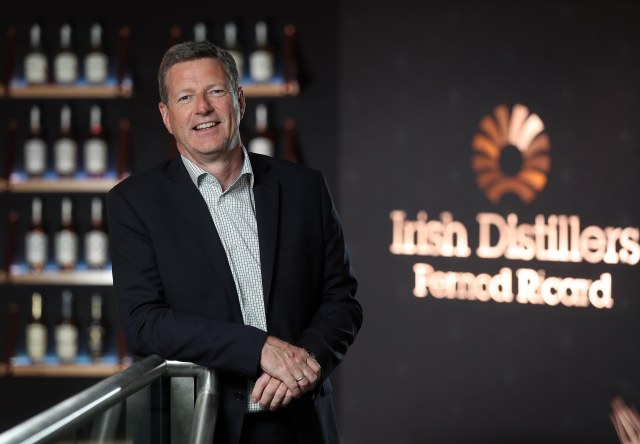
    Commenting on the performance of Irish Distillers’ 2017/18 results, Conor McQuaid, above, Chairman and CEO said: “Irish whiskey is the fastest growing premium spirit in the world. Sales of Irish whiskey now account for more than one third of all Irish beverage exports, and we are immensely proud of the strong performance of our full portfolio of Irish whiskeys cementing our position as the makers of the world’s most enjoyed Irish whiskeys.

    “Our continued dedication to innovation has allowed us to penetrate markets and grow Irish whiskey sales across our portfolio. The continued global growth of Jameson Caskmates is testament to this, with +86 percent growth in the US market compared to last year. Growth of our prestige range led by Redbreast which grew by +14 percent in volume, reflects the growing consumer appetite for premium Irish whiskeys and the resurgence of the time-honoured single pot still Irish whiskey. Powers, regarded as the classic and quintessential Irish whiskey, had a strong year with value growth of +8 percent.

    “Our largest markets continue to be the USA, South Africa and Russia, followed by Ireland and the UK. It is very positive to see Jameson starting to generate interest in markets such as Nigeria, India and China.

    “The Republic of Ireland spirits market generated volume growth of +6.1 percent and value growth of +4.9 percent. Against this backdrop, our premium spirits brands have recorded strong net sales growth during 2017/18:  Jameson (+9%), prestige Irish whiskeys (+23%).

    “Growth of Irish whiskey sales in Ireland is in part due to increased interest in Irish whiskey tourism. As Jameson continues its phenomenal growth story, with 29 years of consecutive growth, the redeveloped Jameson Distillery Bow St places storytelling at the core of the visitor experience bringing the 230-year history of Bow Street to life. As is evidenced by the incredibly strong visitor figures recorded over the past year, the new-look Jameson Distillery Bow St has fast become the must-visit whiskey destination in the world. When combined with the Jameson Experience Midleton, we welcomed over 475,000 from more than 70 countries to our brand homes.

    “The growth of Irish whiskey on the global stage could not have happened without the investment and focus brought by Pernod Ricard. This year, we are celebrating 30 years since joining the Pernod Ricard family and it is no coincidence that Jameson is also nearing 30 years of consecutive growth, experiencing double-and triple-digit growth in 80 markets across the world since gaining access an extensive global distribution network.”

    *Nielsen June 2018 figures

  • Let them drink cake

    Wrote this for the Indo about getting druunkish on cake –

    The Kerry TD Danny Healy Rae once said that eating a big meal before driving could be a factor in causing accidents. It came as a surprise, not only to the scientific and medical community, but also to the people he was addressing at the Oireachtas Committee on Transport,as they were discussing drink driving, not dinner driving. Deputy Healy Rae – who is a publican – said that after he finishes work he won’t eat a large meal because he knows it would make him sleepy on the drive home.

    There is, however, a perfect storm brewing between both the facts on alcohol – it is a factor in 38% of all road fatalities in Ireland – and Deputy Healy Rae’s folksy musings: What about food with booze in it? Granted, cooking removes most of the alcoholic content in food, but there is one course that is the final bastion of boozy dining – dessert. Desserts like tiramisu or sherry trifle are famous for their drink content, so the question posed here is – can eating desserts put you over the drink driving limit? According to a study by All Car Leasing, the answer is yes – two portions of tiramisu can put you over the limit. Their study also covered lesser known foods like orange juice, which can contain tiny amounts of alcohol which is produced as the orange ferments – but boozy desserts are the most direct way to inadvertently go over the line. So this was the test – just how easy is it to get over the drink driving limit by eating treats?

    The initial step in any scientific endeavour is to seek the advice of an expert. The first warning sign that this might not be the most important piece of investigative journalism since Watergate was that the medical expert I consulted didn’t wish to be named. “I just don’t see the merit in what you’re doing,” they said. I took this as a sign that I was on the right track – if the medical community was against me eating desserts until I was hammered, then there was something here that was just waiting to be blown wide open, either a looming war on liquor-laden desserts from the neo-prohibitionists, or possibly just my belt. My so-called medical advisor pointed out that as I am six foot and weigh 13 stone, I would need to consume a very large amount of dessert to actually get that much alcohol in my system, and would possibly just make myself sick in trying. Challenge accepted.

    The first time I got drunk, it was on sherry trifle. The story became family lore, of how after my dessert I was singing, waving out the window and trying to open door while the car was moving. I was 11. The lesson I took home from this is that sherry trifle is wonderful, and that booze makes me hilarious. So I set about finding a sherry trifle with which to start my test. It turns out that most modern sherry trifles now don’t have sherry in them, but rather have sherry flavouring. After a pathetic trek asking various supermarket staff if any of their desserts had booze in them (‘I’m a journalist’ I told them, as if this explained my tragic quest), I tried Midleton’s The Farm Gate, where the local petit bourgeoisie go to get sozzled on cake. I was relieved to find they had a delightful sherry trifle which had a decent whack of sherry. After that it was off to Aldi and Lidl – the Germans know how their booze, and they also know their desserts, and there I picked up any dessert that had an alcohol warning on the front label. Then it was off home to gorge.

    First up was the Aldi Irish Cream Liqueur Cheesecake, which contains an impressive 15% of Irish cream liqueur. It’s meant to serve four to six people, but as I hadn’t eaten all day, I downed it all in about five minutes. I used my AlcoSense breathalyser – which, at 80 euro from Boots, is a solid purchase for any dessertaholics – and it told me I was still well under the limit for learner or new drivers, which is 0.02% blood alcohol concentration (the level for full license divers is 0.05%BAC).

    So it was on to two portions of Aldi profiteroles, which still failed to take me over the lower limit. It was time to take a more direct route – a box of Aldi Mister Roth Whiskey Truffles, eaten in the most joyless way possible. At this stage I was wondering if this was all a terrible mistake, but I knew that this was being done in the name of science. I waited half an hour and tried the breathalyser – I was at a solid 0.029%BAC, easily over the limit for learner drivers. I didn’t feel especially under the influence of anything other than the sugar screaming through my bloodstream, but the breathalyser doesn’t lie – I would have been unfit to drive.

    I knew that if I was to cross the upper limit, I would need to go to Defcon One – with a Marsala wine-soaked tiramisu from Aldi. Meant to serve four to six people, I sat there alone, forcing down its rich creamy goodness as I broke a mild sweat. I waited, puffed into my breathalyser and saw that I had pushed myself to 0.037%BAC, a worthwhile return for the horror of gulping down a platter of tiramisu. Next was a box of Lidl Deluxe Cocktail Truffles, ten chocolate malty balls infused with spirit. Eating them was akin to the boiled egg challenge in Cool Hand Luke, but I got there in the end, and while I was still able to sit upright in my chair, I shoved a number of Marc De Champagne truffles down my throat, and another portion of Aldi profiteroles just to be certain. With the last wheeze left in my bloated, corpse-like form, I huffed into my breathalyser, which gave me the warning beep I was praying for – I was at a decadent 0.058%BAC, over the limit for driving in Ireland. I was also yearning for the cold embrace of the grave due to the amount of treats I had consumed, but the facts were clear – it is possible to get over the drink driving limit by eating a large amount of desserts.

    There were two take-homes from this – one is that the majority of Irish people understand that drinking and driving is not acceptable. The staff in The Farm Gate said that many diners will deliberately avoid any dessert that has alcohol in it, so the days of getting trolleyed on desserts appears to be disappearing fast. Alcohol is rapidly becoming an indulgence that we enjoy in the comfort of our homes, and there is nothing wrong with that.

    The second takehome was that it was easier to get over the limit than I thought – I never would have considered tiramisu was being something that could possibly influence my ability to drive, or to consider it as a potential unit of alcohol – but it is. There are, as Deputy Healy Rae pointed out, many factors that can influence our ability to drive safely – tiredness being one of them – but the days when we can pretend that consuming alcohol in any form and getting behind the wheel is an acceptable practise are gone. Anyone who does it and ends up in a motoring mishap of their own creation is simply getting their just desserts.

  • An ode to Love

    Wrote this feature for the Indo –

    It’s the greatest tournament on the planet – we’ve waited and waited for it to come round and now here it is, and it is better than we could have anticipated. We may not have a representative of our country at it, but we are all there in spirit, as this is about skill, determination, passion and the strength of the human spirit. I speak of course of Love Island, the reality show that dropkicks a dozen failed eugenics experiments into a sunny Mallorcan villa in a sort of Battle Royale where you have to shift your way to being last couple standing. The sole aim of the show is to get the young lovelies hooking up with each other and winning 50k, or possibly just some notoriety, which in today’s world of micro-celebrity is almost better than the prize money. Who knows what commercial opportunities await the contestants after they leave the island – who will land that lucrative deal as the face of Canesten, who will end up flogging off-brand vodka in the drinks aisle of their local Tesco, who will be forced into shame-filled public appearances in nightclubs in hotspots like Manorhamilton or Fermoy? Basically, all of them, because a fame based on embarrassment only lasts so long. Just ask Donegal’s Bernard McHugh, who touched hearts when he went on Blind Date, and then went on to become a stripper, albeit a very Irish one who never took his trousers off.

    Love Island, much like the World Cup, is one of the few things that will get the teens back watching terrestrial TV. The football is just like FIFA 18 only the players look less realistic in real life, while Love Island is like Call Of Duty, only it’s the call of booty that is being answered by the players on TV3. Some would say that the idea of strategic, competitive romance on a reality TV gameshow is a further sign of the decline of western civilisation, but it really is no different to Les Liaisons Dangereuses: The cast of too-perfect, allegedly 20 somethings all try to seduce their way to becoming the perfect TV couple, winning hearts, minds and other organs, and hopefully then going on to win the public vote. Along the way there has been subterfuge, deception, manipulation, and a lot of very tanned people telling each other that they ‘really rate each other as people’ when actually they mean to say that they want to get freaky naughty.

    In between all this are odd party games, like the one where they had to smash watermelons with their arses (a slow-motion montage that made VAR look like a functioning system), or challenges like the time they had to pass ingredients for cocktails through each others mouths. Anyone from a medical background watching the show – including contestant Dr Alex, an emergency doctor who you would hate to have dithering in the resus room during an actual emergency) must be counting down the minutes until there is an outbreak of conjunctivitis or scabies.

    But part of what makes the show so watchable is just seeing how terribly awkward we are as a species. These people are mostly great looking, young, fit and healthy, and for the most part they are intelligent human beings. However, the fact they are what we would consider to be perfect people is in stark contrast to how bumbling they are when trying to mate. It’s bliss to watch them fail and to feel better about yourself as a result. Consider Adam Collard, who looks like a Greek god, yet here is his profile quote: “I would say I’m a ten out of ten. Maybe a nine out of ten… I’m not good at washing the dishes.” It’s like Bret Easton Ellis scripted an episode of Eastenders.

    Love Island is the perfect companion piece to the World Cup: Drained by all the intrigue, big name clashes and shameless overacting/fake crying on one channel? Why not tune into the exact same format on another? Enjoy knockouts (all of them), fit tanned people running rings around each other (Megan’s nimble dance around the blokes), spectacular own goals (Wes’s series of unfortunate events), fouls (Dani being shown the footage of Jack’s ex entering), maybe even some hand ball (all the various episodes of duvet twitching)? Then Love Island is the perfect place to find your comfort zone during those brief interludes when the footie isn’t on.

  • Edinburgh 2018

    The zoo, museum, and Royal Mile.