
-
A Suir thing

The best interviews are the ones carried out over a period of time, across a series of encounters. A mutual understanding is achieved, a certain level of trust established – a basic human connection made (the incredible R. Kelly piece in GQ recently is a good example). I had intended to try and interview Mark Reynier since I first heard he was after buying the site in Waterford – but time passed, and, after a few nationals gave him small bits and pieces of coverage (the exception being the excellent piece in the Sunday Times), and I felt there wouldn’t be much opportunity.
So I shelved my plans and instead just invited myself down to Waterford to see the distillery and have a nose around. I didn’t expect to meet him, not to mind spend a couple of hours chatting with him, and so it was on the way back I started to scribble down some notes and somehow ended up with five thousand words of overblown, pretentious waffle. I wondered what the hell to do with it, contemplating flogging it to one of the Sundays in a tighter form. But one of the points Mark made struck a chord with me – a lot of whisky writing, a lot of journalism generally, is bought and paid for by big firms. Everyone has a bias, an agenda, be it dedicated self interest or just paying the bills, and ultimately everyone compromises. So I thought, fuck compromise – I can write something for Average Joe Newspaper Reader, with lengthy explanations of malt tax, alembic stills, and grain spirit, or I can write something that assumes a certain amount of knowledge on the part of the reader, in my own pretentious style and in my own self-indulgent way, with my choice of images and on my own blog. Granted, almost nobody will read it, but fuck it, at least it will be done my way. And so it was, and although it really is far too long, I was happy enough with it. It reminded me of why I loved blogs, and was also a timely reminder I was blogger first (on MySpace, no less) and a journalist much later.
Recently I’ve seen quite a few bloggers claiming to be journalists: If you ever worked in a newspaper, you would know that really being a journalist is not a whole lot of fun, nor something you would aspire to be. You will spend your career compromising, constantly seeing your work cut up and pulled apart over fears of litigation, business interests or simple personal grudges. At least bloggers get to speak in their own voice (albeit to a tiny audience) and have a certain amount of autonomy. Of course, they also suffer from a lack of accountability, but at least having worked in a newspaper I have a fair enough grasp on the difference between truth and fact.
I digress. There are a few other posts around the web I’d like to point to if you’re interested in reading more (tightly edited) pieces about Waterford Distillery. First up is the post by David Havelin of Liquid Irish, which I tend not to even think of as a blog anymore. Read by industry and consumer alike, it is consistently excellent – insightful, balanced, thought provoking; really it is so much more than a blog. His piece on Waterford has some incredible detail on the plant site, and is a great read.
There are also a couple of interviews with Mark Reynier you should read – I like this one in particular, as he tells the story of how he finalised the deal on Bruichladdich the day his son Ruari was born. If you’re wondering why his son has such an Irish name, it’s possibly because Mark’s wife Maureen is from Sligo. Another factoid I discovered when I was with him was that his maternal grandmother’s family came from Cavan, which in turn might explain why he is a Catholic who was educated by Benedictine monks. No doubt the monks would be delighted to know their former pupil is distilling a few hundred years from Ireland’s oldest Catholic cathedral. All this info sorta threw my ‘mysterious stranger’ angle on him into a cocked hat, and I was tempted to rewrite the whole piece as ‘local lad Mark O’Reynier comes back to the old country’. But I stuck to my guns and hammered out a load of existential nonsense instead. Hooray for blogging.
The excellent Malt Review also interviewed Mark not so long ago, and that is well worth a read, mainly as it is considerably more tightly edited than my post. Malt Review is one of the better whisky sites, and is fantastically, brutally honest at times. There is a storm raging at the moment about bias on blogs, with brands being seen as having too much influence. But again, this is something that has been a problem in the media for years, but especially so now that most print titles are haemorrhaging money – consider the housing crisis here in Ireland. It was bizarre to see editor after editor of national titles turning up at the recent State inquiry into the banking crisis, all claiming that property sales had no influence on their editorial stance. The only thing you need to know in this regard is that the Irish Times – the paper of record, the benchmark of Irish journalism, the title by which all others in this country should be judged – splashed out 50 million euro on a property sales site. If they were hooked on property supplement revenue, everyone else was already at a Rick James level of addiction, and no one wanted to call the cops to the party and have their dealer busted.
Like I said, we all operate on a certain amount of dedicated self interest – if something makes your life better or even just a little easier, it can be very easy to blind eye to the ethics or the morality of it – be it flogging overpriced property to the working poor, shilling products on your blog, or pretending that lying to the public is really just ‘clever marketing’. Let’s all just hope that the Age Of The Influencer is coming to a close and blogs can get back to being what they were always meant to be – an angry jerk’s shortcut to getting fired.

Although my trip to Waterford had many highlights – meeting Lisa and Mark, seeing the distillery, eating my first Blaa (above) – there were a couple of disappointments. Firstly was the fact that Henry Downes pub was not open. They have their own brand of whiskey which they claim to blend in the basement of the pub. I was keen to get in there and see this blending space, as frankly I wanted to call bullshit on it. Surely modern health and safety law would prohibit such odd carry on? However, one of the locals said it was highly likely the did actually do the blending in there, as ‘nobody would tell the Downes what to do’. That said, my source on that was no less credible than ‘the guy working in Tully’s pub’. He also told me that Waterford brewery was bought for seven million euro. Sher I could have bought that meself with my confirmation money.
Tully’s is nice, so here are some terrible photos:
Second on my list of Pedantic Disappointments was that I never got to see the Bilberry goats. There is something so bizarre about a load of feral French goats living on a rock overlooking a distillery that I really had to see it for myself. Fun fact: The hilly area just beyond Midleton distillery’s warehouses is also called Bilberry, and it is where I was from, which led me to introduce myself at parties as ‘Bill from Bilberry’ when I was a kid. Thankfully I didn’t get invited to many parties.
However, I did get to take this photo:

That’s my bottle of Dumbarton single malt, in front of one of the stills that made it. Dumbarton really was hideous, and is no less hideous now, so it’s great that Mark saved the stills from extinction, and finally found a use for them. And he really is fantastic company – he held court on so many subjects, and he gave me plenty of food for thought. I didn’t necessarily agree with all his points, and I don’t think he would want me to. But he was spot on about a lot of things, specifically a tightening of the regulations governing labels and sourced whiskey. There are so many firms now who are selling sourced whiskey and trying to create some grand illusion about its origins that the mind boggles. It’s fine for the geekier whiskey fan, who knows that they are all Cooley, but what about the novice who is trying to expand their tastes? How will they feel when they discover that all those different brands they were trying all came from the same distillery? Cooley make some great stuff, but Jesus there is too much of it floating around in various ridiculous forms – it is basically Count Olaf from A Series Of Unfortunate Events, randomly showing up all over the place with a fake beard, terrible accent and shit backstory.

Arr I’m Cap’n Sham, and I be westing by sextant to the land of marketing makebelieve. A little bit of honesty would go a long way – where the whiskey came from, what was done to it to make it that colour, was it chill filtered; these things don’t really matter to the average consumer, so they won’t hurt sales – but it would mean a lot in terms of trust with the more devoted fans. It’s unlikely that this is going to happen, but with a new era of whiskey making here, newcomers are bringing fresh ideas – you can read whiskey bonder Louise McGuane’s fantastically vitriolic post about a similar subject here. It raises some important points about ethics – mainly that what is best for Irish whiskey producers might not necessarily be best for Irish whiskey, or its consumer. It’s great to hear a growing chorus of dissenting voices in the sector – individuals like Louise McGuane and Mark Reynier who are willing to shout ‘no pasaran’ – because accountability is never a bad thing. And that’s coming from someone who once almost got fired over a blog he had on MySpace.
-
L’Étranger

As a species, we have become completely estranged from what we consume. Over the last few centuries we have transitioned from living on locally grown, native foods to barely being able to tell what we are eating, where it came from and what has been done to it. The quote that inspired William S Burroughs’s Naked Lunch hold a lesson for us – it suggested a frozen moment when every person truly saw what was on the end of every fork for what it was. Burroughs was suggesting a moment of existential dread, but he might as well have been talking about what we eat and drink – we currently have no clue what is on the end of every fork, and, perhaps even more so, what is at the bottom of every glass.
The whiskey world is awash with the smoke and mirrors of marketing – terms like artisan, small batch, craft; they mean absolutely nothing, yet are attached to each new brand as though they are reinventing the wheel. All over Ireland and the UK there are brands that are making misleading and often false claims about what they are, who made it and where. All of this is seen as simply being part of ‘the game’ – a comfortable untruth that most of the industry goes along with. However, there is one man who has been battling for more than a decade in his attempts to reconnect us with the origins of our spirit.

Mark Reynier was a third generation wine merchant on a cycling holiday in Scotland when he decided to visit the home of one of his favourite whiskies – Bruichladdich distillery on the island of Islay. Reynier cycled up to the gates of the distillery, only to find them locked with a sign reading ‘plant closed – no visitors!’
Spotting a security guard patrolling the yard, Reynier waved to him and asked if they could have a look around. The guard’s reply was a succinct ‘fuck off’. And off Reynier did fuck – but when he returned, he came with investors, capital, the keys to the plant and a dream to bring the distillery back to life using 200-year-old methods. Enlisting the help of local distilling legend Jim McEwan, he created one of the most iconic whisky brands of the modern era – a spirit born of centuries old distilling methods, yet fresh, brash, brave and bold.
However, the most revolutionary ethos of Bruichladdich was its dedication to terroir – a term previously used mostly in wine circles, meaning the microclimate that leads to differing flavour profiles of different vineyards. Reynier experimented wildly with Bruichladdich, but it was his celebration of the humble barley grain and the land that bore it that was the most memorable of all.
Bruichladdich’s legend grew and grew, and eventually the fiercely independent brand was sold to drinks giant Remy Cointreau. But, in typically contradictory fashion, Reynier voted against the sale – even though it made him a wealthy man. He wasn’t ready to sell, he said at the time; he still had more to do, more to give the distilling world. Shortly after the sale he disappeared, like Kaiser Soze, with no one knowing if the whisky world had seen the last of him. That he reappeared some time later was not the big shock; it was rather, where he reappeared that caused the most surprise.

Photochrom of Waterford in 1900 via the Library Of Congress. Nestled on the south-east coast of Ireland, Waterford is the country’s oldest city. A compact and bijou urban space situated above the confluence of the Three Sisters, it is a city of outsiders: Settled by the vikings in 932AD, its name is derived from the Nordic ‘Vadrarfjordr’ – the fjord of the rams, a fitting name given that this city is home to its own indigenous herd of feral goats. The goats do not go back that far, but rather came with the Huguenots three centuries ago, along with the city’s legendary Blaa, a type of doughy roll. The goats live on Bilberry Rock, a high outcrop overlooking the city, and right beneath their hooves lies Mark Reynier’s new project; Waterford Distillery.

Reynier bought the old Waterford Guinness brewery from Diageo for a sum that is rumoured to be considerably smaller than the 40 million it was worth. What he got for his money was a recently renovated brewery, which he then converted into a distilling powerhouse in a few short months, rehiring some of the staff who had been laid off by Diageo. On his Twitter he posted regular updates from the redevelopment, and proved that his success with Bruichladdich had not lessened his ability to be an uber enfant terrible. In interviews he bemoaned the lack of ‘mindfuckery’ in Irish whiskey, slammed the monopolies by massive firms, and generally rattled cages and ruffled feathers in a scene that was previously rather chummy. Just as he did on Islay, Reynier revelled in his outsider status – like Camus’s anti-hero Meursault, he came across as a man who had enough of the lies, the deceit and the conceits. But beneath all the bluster, there was a very serious plan being put in place.
As the plant was being re-engineered, Reynier was out walking through fields and talking to farmers about grains, soils, yields and dreams. He put in place a network of farms along the east coast who would supply him with barley for his spirit, taking his twin ethos of terroir and provenance to an almost forensic level. But which came first – the desire to make whiskey in Ireland, or the lure of the deal of the century?
“Ireland,” he says immediately; “and I’m enjoying every minute of it here. It was two things that brought me – one was an old boy at Bruichladdich, Duncan McGillivary. I can vividly remember him sitting on a wall on a sunny afternoon, saying that the best barley he ever saw in his career – and he had been there for 35 years – came from Waterford port. And it always stuck in my mind. Of course, here you are two hundred miles nearer the equator than Islay – Cambridge is on the same latitude. The climate is milder, so barley was the big draw.
“Scotland, whisky-wise, I had been there, seen it, done it. So there was a chance to make a mark in Ireland, because the whisky industry seems to me to be just all over the place. So all that was intriguing and seductive – and at least it’s not like the 110 major distilleries in Scotland.
“Finally, of course, it was to do with this extraordinary place being available. It took us just a year and four days to get going – it would take three years at least to set up a distillery from scratch. But I came here for the barley primarily.”
And as for the culture shock of moving to Ireland, he was well prepared: “Having dragged my wife and son from Sussex up to Bruichladdich, on the remote, wild and windy Hebridean island of Islay – a Gaelic island – not Scottish, Gaelic – that was pretty difficult; an extreme contrast. The parameters which define oneself, the habitat, the ecosystem, friends – they all go out the window; we basically said goodbye to our previous life.
“The way I explained it once was, it is a bit like you have been invited as the star guest appearance on Eastenders, and you turn up on set, but you have never watched Eastenders, you have no idea who’s having sex with who; who was murdered, beaten up or shunned, who is cohabiting, or has those ‘extended family’ connections with who, because you have never seen the previous episodes, let alone the last series. It’s of course one-sided because everyone knows everything about you.
“And it’s not just a few months but hundreds of years. One time, I wanted something delivered to my house, and it never got delivered and I couldn’t understand why. It turned out that the delivery guy, his grandfather had once an argument with the person who owned the track to my house, and he wouldn’t travel down it. And this was a hundred years later. I still have a house there in Islay and I love being there, we all do.
“But one of the best things about here is that I have had so much fun with these guys, where one can just talk and joke without fear of offence. And that has been a really rewarding experience. We started here implementing what we wanted to do, right from day one, with an enthusiasm, open-mindedness and alacrity.”
Reynier has now started distilling individual spirit from individual farms, and can track the differences accordingly; in a scene filled with obfustication and untruths, he is now in the unique position of being able to say ‘this is the field, this is the grain, and this is the spirit they created’.

Lisa Ryan, head brewer at Waterford Distillery, with a sample of barley from the farm of Leonard Ashmore. To emphasise the focus on barley, Waterford Distillery has no master distiller – but it does have a master brewer. Lisa Ryan was one of the staff laid off by Diageo when the brewery closed, and her rehiring meant Reynier brought in someone not just with experience of high-end brewing, but who would be a system native; there would be no learning the ropes, just down to work from day one. Reynier says his structure is a more realistic, practical arrangement: “We have a distillery manager, head brewer, chief engineer and head distiller. Each relies on the other – buildings, barley, machines, spirit – and the responsibilities are equally divided.”
The plant had been used by Diageo to create the concentrate from which overseas Guinness is made, so it obviously needed some adjustments – the largest of those adjustments being the acquisition of stills. But this was another piece of the puzzle that slotted into place. When Reynier was in his early days with Bruichladdich, a friend of his known as Demolition Dave (a slight misnomer as he is now one of the investors behind Waterford Distillery) tipped him off about something special lurking within the soon-to-be-levelled Dumbarton grain distillery.
Secreted away inside this massive industrial grain-distilling operation were two small pot stills – known as the Inverleven stills. Reynier saw an opportunity, bought the stills and shipped them to Islay, where he intended to use them to revamp and restart Port Charlotte distillery, close to Bruichladdich. They never made it there, but one did adorn the front garden of Bruichladdich – with a pair of wellie boots sticking out the top. So when he bought Waterford, he knew where to get two stills to skip the potential three-year wait for Forsyths of Rothes – the Rolls Royce of still makers – to create new ones. Forsyths did play a hand, upgrading and mending the stills, and then they were installed, and brought to life, in the south east of Ireland, all ready to make a spirit that reflected their design – elegant yet full-bodied, delicate yet strong.

The Inverleven stills in situ in Waterford. “Every distiller likes to have their own-designed stills, it’s the personal flourish of any new distillery, but we know what these stills can do – we know what the style will be we can determine what goes in, of course, how the stills are run, but the weight of the spirit is determined by that still shape.
“If you have very tall, narrow-necked stills, you will produce a very floral, elegant spirit. If you have very short, dumpy stills you will have a heavy, oily spirit – and there is nothing you can do about it. Laphroaig, for example, can never ever ever produce a light, floral spirit because they have short, dumpy stills. You can’t change it. That is how it’s going to be. We know that these Inverleven stills are going to produce a floral spirit, because of their shape. So then the question is – how are you going to run them? And we have the facilities here to produce very, very good-quality wort and wash, clinically the best – you can’t do anything better. So then it is a question of how slowly we run those stills, and because we have all this space and the control we can run everything exactly as we please.”
That space may be getting a little smaller, as there are plans to order four more stills from Forsyths over the next five years. Clearly, this is not a short-term venture.

The main gates; the old brewery is on left, the new distillery on right. What strikes you first about Waterford Distillery is the scale of it – on approach it is dwarfed by the hulking, quartz-riddled presence of Bilberry Rock. But once you get close, you begin to grasp just how massive it is. A modern, elliptical frontage houses much of the current operation, while to the rear is an old brewery, crying out to be transformed into a visitor’s centre.

The inside of the old brewery. Beyond is the Barley Cathedral, where the grain from each farm, each field has their own storage space. This allows Waterford to create a single field, single farm, single cask, single distillery, single malt. You could probably throw ‘single master brewer’ in there too, given that one of the farmers supplying them is Lisa Ryan’s father. And as they have the capability to propagate their own yeast, you might as well throw in ‘single single-celled fungus’. Although that might not look so appealing on the label.
Along with all those capabilities, they also have an evaporator – with which they can make single grain spirit. So is he going to?
“No.”
Definitely not?
“No. Single malt is what I want to do – single malt, single malt, single malt.”
And no pot still whiskey, or as he calls it, mixed-mash: “Why would you want to mix the mash, when you’ve got the greatest barley in the world? Why on earth do you want to compromise it?”
Maybe as a nod to Ireland, or even just as a cash-in, I suggest.
“Who says it’s a nod to Ireland?”
Isn’t it an Irish tradition, a traditional style of whiskey made here?
“A tradition which they also use in Canada, America, and all over the world. So there is nothing unique about it at all. The fact that Pernod say this style of whiskey ‘is’ Ireland, is purely for their marketing, they want to own it because they have most of it. There’s no real evidence that this is the definitive Irish style, we know that people were making single malt back in the 19th Century too. Besides, the terminology is a nonsense; internationally, what does “pot still” mean to a whisky consumer? It means an inanimate, dumpy copper vessel used for distilling whisky rather than a mix of malted and cheaper, unmalted barley with some maize or rye bunged in.
“But it’s an intellectual proposition – why do you want to make a dumbed-down version? Why?”
So that is how he sees pot still whiskey – a dumbed-down single malt?
“Single malt is the most complex spirit in the world, flavour compound wise. If you drink a blended whiskey, all that flavour you get isn’t the grain whiskey, the grain is there to stretch the flavour. Analytically, we know that single malt is the most complex spirit. It is the reason why kids, when they drink spirits when their parents are away when they are 16 and get hammered, they never touch whiskey ever again. They will drink vodka again; they drink cognac again; they drink calvados again; but they won’t touch whiskey because the flavour – their brain remembers it, because there was so much of it. You don’t see winos hoovering down single malt whiskey – or whiskey. You see them hoovering down vodka.”
So if he had been offered a third still for free, so he could triple distill – again, in the Irish style – would he have taken it?
“No, no, but you can triple distill with two stills too. We might do a bit for fun. But by distilling up to 80% rather than 70% you are just losing more body and flavour. We triple-distilled a bit at Bruichladdich and several Scottish malts are triple-distilled. Anyone can do it.
“In Ireland you have that habit of beer and chaser – that’s how whiskey was enjoyed – so the more straight-forward, accessible it was, the better. Perhaps the lowland Scottish distilleries got the custom of triple distillation from 19-century Irish immigrants? Whereas you don’t see people in pubs drinking single malt, even in Scotland – unless they’re tourists. It is a more elite, expensive thing. But it used to be primarily a component of blends. Very few people back then drank it as a single malt and if they did it was as new spirit straight off the still.”
So the evaporator may not be used for single grain; it will be used another way – to reduce the pot ale for shipping as pig feed. Less water in it means less weight, ergo less cost.
“We have a fancy vacuum-operated column still called a Sigmatec. I didn’t really know at the time I bought the place what it was. Guinness used it to de-alcoholise – or strip – stout. Talking with engineers I asked if it could do the reverse and they said yes. With a few tweaks and adjustments, some re-piping, and voila: a state-of-the-art column still. But my interests don’t lie there. This project is intellectually and financially focused on single malt. However, it’s a reassuring back-up to have up your sleeve.”
Likewise there will be no white spirits, and definitely no selling sourced whiskey under his own branding, a tactic used by the majority of new distilleries in Ireland to generate revenue. However, it is also a practise that has been abused, with some independent bottlers playing fast and loose with their marketing material, and striving to create the illusion that they distilled the product themselves.
“Well this is Ireland’s big problem. And it isn’t going to solve itself, I fear. There isn’t the interest or the will within the industry it seems to me to do anything about it. There isn’t the money to enforce regulations, even ones for the common good, because at present you have only Pernod Ricard, Jose Cuervo, William Grant and that’s it. The IWA (Irish Whiskey Association) isn’t anywhere near as powerful as the Scotch Whisky Association (which incidentally represents the whole spirits industry, not just Scotch). I don’t see it having the mandate or the power to bring much-need discipline to labels, presentations, marketing material and claims, that will build the much-needed credibility of the Irish whisky sector.
“Abroad, if you ask whisky drinkers about Irish whiskey I’m afraid you’ll find there is not a great deal of trust. That confidence has to be earned. Sure there is a huge enthusiasm now in the Irish whiskey sector, but there is also perhaps, shall we say, a certain naivety, too. In the absence of clearly defined, acceptable practices, there are some bottlers that play fast and loose if not with the actual rules (there aren’t yet many) but certainly the spirit of them.
“If you go to the duty free at Dublin Airport and they have more than 100 Irish whiskeys, but they are from just three distilleries, but you’d swear blind with all the master distillers listed on those labels there were at least fifty distilleries producing all that hooch.
“But I’m a libertarian at heart. Look – to a degree I can understand all this wild-west approach, after all I used to be an independent bottler myself once. Ours is a heads-down, get on with it no nonsense operation and sod ‘em all.
“In Scotland, an authoritative SWA provides the necessary guidelines to protect the reputation which every one for the greater good follows. It isn’t onerous or police state stuff; it is common sense. I certainly had my run-ins with them when we didn’t see eye to eye. But here it is a wee bit more freestyle, more individualistic shall we say, and I don’t really see it changing any time soon. But it needs to.
“I can already hear the “coming over here telling us what to do” complaints, but there is a truly great opportunity for Irish whiskey. A reset button has been pushed. These are exciting times. But equally a regulatory framework needs to be constructed too, to guide, to keep us all on the straight and narrow. It isn’t onerous; it’s not finicky; it ain’t Big Brother. It is for the greater glory of Irish whiskey.
“Some of the marketing spin is mere over-exuberance, some of it is deliberately disingenuous, and some of it is naivety. Some of it is outright fraudulent. But I don’t see anybody having either the will, the foresight, the authority or the money to challenge it. That’s why I am focussed on what we are doing here, doing my own thing.”

But given that Ireland is in a ‘wild west’ state – being as it is in a state of rapid rebirth and expansion, a new frontier for this generation – Reynier has some suggestions on what a new sheriff might look like.
“The Irish Government should say ‘right, we shouldn’t get involved, because we are short-term politicians, here today, gone tomorrow; equally, the industry should not be involved because they have got interests that are non compatible – remember the banks and self-regulation? – but we should do what France does with Champagne; create an apolitical body in between the industry and the politicians which is a civil servant-run to represent the long-term interests of Ireland and not powerful industry players nor biddable politicians’.
“It says ‘Product of Ireland’ and “Irish Whiskey” on the label, so somebody should be representing Ireland’s interests.
“This council would agree with the Irish Whiskey Association with a set of guidelines and procedure – the SWA has it all already – which should be applied to the whole industry, It is important to get this sort of thing sorted now it will be much harder to retrofit once the horse has bolted.”
Given the startling quality of his barley network, it comes as no surprise that his wood policy is equally ambitious – and just as honest.
“We don’t need to experiment with casks, I know exactly what is needed. We have the same policy for every farm, so again it is experience – I know what works. At Bruichladdich we had to do a lot of remedial work because when we first started we couldn’t afford good oak and our accountant undervalued the influence of the oak, or rather good-quality oak, and if you haven’t got the money to buy the barley then you haven’t got the money to buy good oak – it’s an industry-wide issue. Wood is the first thing that gets cut from a struggling budget. And of course wood values in recent years has doubled. The importance of good quality oak is now more important than ever.”
Important – yet expensive, and across the industry there are plenty of ‘innovations’ in the area of wood that no one dares talk about: “Ultrasound, music, heat, oak essence, de-charr, re-charr, tannin injection – all sorts of remedial shortcuts are available – and caramel of course.”
You can assume he isn’t going down that route: “Certainly not! So we set this company up with a very healthy budget for wood – almost the same as the barley. Now if you go back a few years ago, wood represented 10% of production costs, it is more than 40% for us, and I defy you to find anybody in the whole whiskey industry that has that budget ratio. I know from experience there is no shortcut for great quality raw ingredients and time. And that includes the wood.
“We are investing this huge sum because I know that if you are going unplugged, making natural whiskey, then there are no shortcuts – you’ve got to have good quality wood. We are making an artisanal, natural product, hence we have total traceability, beyond parallel, to prove everything we do. There is no compromise: What we say is what we do. We mean it.”
But all this dedication to the product is an added expense: “Of course it is. But by the time it gets into bottle, in five or ten years time, it is a relatively small amount; it has cashflow repercussions now, but by the time we get to market it will not make a difference in the bigger scheme of things.”
Looking into the future brings up the subject of just how many distilleries Ireland can take before it hits full capacity – clearly the full number touted by the IWA will not make it to production, many were pipe dreams that are already falling by the wayside. But there are currently roughly 20 either operational or getting there. So how many is too many? How many more can one island take?
“No more, in fact there are too many. There will be tears before bedtime. Some people optimistically think ‘oh wouldn’t it be nice to have a distillery’ but the cheap bit is building it, the expensive bit is running it, and the even-more expensive bit is bringing it to market. That’s where there will be a big reckoning: I wonder if the marketplace is big enough to handle not just Ireland’s start-ups but more from the US, the UK and other countries too.”

For anyone interested in the highs and lows of starting a distillery, they can look no further than Reynier’s Twitter feed. With typically caustic honesty, it presents the failures alongside the successes; if equipment broke during the refit, it was tweeted, along with information about disappointing yields from some grain, disagreements between head brewer and distillery manager over the characteristics of new-make spirit – all there for the world to see. His messages are the antithesis of the sanitised, corporate message from most distillers.
“Well you can’t separate the good from the bad, when things go right they go right, and then sometimes they don’t. For example, we were tasting some new spirits the others day, and some of them were good, some were very good, and some were a bit dull – well that’s fine and that is out there in the world.
“If you’re going unplugged – I can’t see how you can just go a little bit unplugged; you either are or you are not. Everything I have ever done has been unplugged – whether it was in the wine industry or Bruichladdich, so I think philosophically it is where I am happy at.
“I also think that globally there is an anti ‘big food, big drink’ thing going on; people have got too bored. You go out the door here to a pub and there is no-one in there, and you have no choice; either a stout or a lager, and you have to ask – why bother, if they are all selling the same thing, the same way? In the old days it was the craic that got the people in, but there is nobody in the pubs now.”
And just as the Irish pub has been struggling against a generational shift and the decline it has wrought, distillers lament the duty laws here, claiming they are crippling the industry. Not so, says Reynier: “It is higher than Scotland but it is the same for everybody – whether it is gin, vodka, poitín, it is the same. So you are only in a comparative field. It is what always makes me laugh every time there is a budget the SWA go on about duty and stuff and you think ‘well hang on a second, 90% of it is exported, so nobody pays duty on that at all’.”
Mark Reynier is extraordinary company, a complex spirit full of seemingly contradictory elements – profound yet profane, combative yet charming, witty and deadly serious all at once. He comes across as a man utterly frustrated with the spirits world whilst still passionately in love with it. Throughout the couple of hours I spent with him, he did not sit down once; he paced the room, gesticulating as he made his points, constantly moving, forever restless.
Mark Gillespie describes the maverick Texan distiller Chip Tate as being the Steve Jobs of the distilling world. If that is the case, then Mark Reynier is that world’s Stanley Kubrick; an auteur who refuses to work within the system, a creative visionary who is utterly unwilling to compromise, who is almost obsessively dedicated to craft, to the pursuit of perfection. He is a man intent on destroying the status quo, compelled to point out that the emperor wears no clothes. His attitude to life reminds me of the motto of another outsider who came here from Scotland to build a distilling empire; sine metu – without fear. When I ask him if he thinks he might have ruffled some feathers since his arrival here, he smiles and says “Oh I certainly hope so. I certainly hope so.”
Ultimately, what makes Mark Reynier an outsider is not where he comes from, but rather that – like Camus’s weary homme du midi – he is simply a man who is no longer willing to play the game. This project is about change, disruption, evolution: Why should he doff the cap, bend the knee or even spell whiskey with an ‘e’? His is a singular vision – of Ireland being the home of the world’s greatest single malt, and his distillery is celebrating the soil and grain of Ireland, the farmers who work the land.
Reynier firmly believes he is fighting for the pride of Ireland, and that the honesty and transparency of his whisky, when released in five years time, will offer us a novel experience – a frozen moment when every Irish whiskey drinker truly sees what is at the end of every glass, knowing exactly where it came from, who made it and why – and, for the first time in a long time, we will be able to enjoy a truly naked dram.

-
Changing of the guard at Irish Distillers
More moves in IDL:
Dublin, May 12th, 2016 – Irish Distillers, Ireland’s leading supplier of spirits and wines and producer of the world’s most well-known and successful Irish whiskeys, has today announced the appointment of Louise Ryan as Managing Director – Ireland.
Louise’s appointment will come into effect from 1st July. Louise will be a member of the Irish Distillers Leadership Team and report to Jean-Christophe Coutures, incoming Chairman and CEO of Irish Distillers.
Louise holds a degree in Business Studies from Trinity College Dublin and an MBS from the University College Dublin Graduate Business School. Prior to joining Irish Distillers she held a number of senior marketing and sales roles, including that of Commercial Director, at Mars Ireland. In 2011 she joined Irish Distillers as Head of Business Development and most recently has worked as Strategy & Insights Director with dual reporting to the CEO and Marketing Director.
Louise replaces Pat Magee, who has been appointed General Manager – Florida at Pernod Ricard USA. Pat’s appointment is part of a Pernod Ricard USA business transformation project aimed at accelerating the group’s current momentum in the U.S. It has a simple objective: grow value market share in a sustainable way. Pat joined Irish Distillers in July 2007 as Business Unit Director – Retail. He previously held senior commercial roles with Reckitt & Colman Ireland and the Eason Group and has a Masters in Business Administration from the Graduate School of Business UCD. In July 2009 Pat was appointed Sales Director (Retail) and has been on the Irish Distillers Leadership Team as Managing Director – Ireland since September 2011.
I just pray that this new, hyper-sales focussed team won’t mean NAS releases as far as the eye can see. We live in hope.
-
Paddy’s day

With all the movement across the Irish Distillers stable – Powers rebrand and expansion, Crested rebrand, rumours of Jameson 12 and 18 making way for NAS releases – I had been wondering when they were going to get around to doing something with Paddy. Well;
IRISH DISTILLERS ENTERS INTO EXCLUSIVE NEGOTIATIONS WITH SAZERAC FOR THE SALE OF PADDY IRISH WHISKEY
Tuesday 3rd May 2016 – Irish Distillers, an affiliate of Pernod Ricard, has entered into exclusive negotiations with Sazerac regarding the sale of the Paddy Irish Whiskey brand, the 4th largest Irish whiskey brand in the world. The transaction, if completed, would involve Irish Distillers continuing to produce Paddy Irish Whiskey at its Midleton Distillery. There would be no impact on roles at Irish Distillers; all employees would remain in place under current terms and conditions.
Commenting on the proposed deal, Mark Brown, President and CEO of Sazerac, said: “In the global market, Irish whiskey experienced the fastest volume growth in the last five years, outpacing all other spirits categories. Consumers worldwide are seeing it as an alternative to other whiskies. If this deal goes through, we are confident that we will be able to take Paddy to the next level, building on its strong history and roots.”
Anna Malmhake, Chairman and CEO of Irish Distillers, stated: “At the heart of everything that Irish Distillers does is a desire to see Irish whiskey grow. This deal with Sazerac, if completed, would allow Irish whiskey’s reputation and footprint to grow further internationally. The proposed deal would ensure that Paddy would continue to be produced with the same love and care by our team in Midleton, Cork.”
The proposed divestment of Paddy Irish Whiskey is in line with the Pernod Ricard strategy to simplify its portfolio for growth and could facilitate, among other things, targeted investment in other key Irish Distillers’ whiskey brands including Jameson and Powers to support continued growth.
Paddy Irish Whiskey is the 4th largest Irish whiskey brand in the world, selling 200,000 9-litre cases in 28 countries worldwide annually. As the Irish whiskey industry is projecting 100% growth by 2020, an acquisition of the Paddy brand by Sazerac would ensure that the brand is positioned for sizeable investment to support its future growth.
Subject to pending negotiations, Irish Distillers and Sazerac expect to sign and complete the transaction simultaneously in the following weeks. An announcement will be made if and when the transaction is complete.
About Pernod Ricard
Pernod Ricard is the world’s n°2 in wines and spirits with consolidated Sales of € 8,558 million in 2014/15. Created in 1975 by the merger of Ricard and Pernod, the Group has undergone sustained development, based on both organic growth and acquisitions: Seagram (2001), Allied Domecq (2005) and Vin&Sprit (2008). Pernod Ricard holds one of the most prestigious brand portfolios in the sector: Absolut Vodka, Ricard pastis, Ballantine’s, Chivas Regal, Royal Salute and The Glenlivet Scotch whiskies, Jameson Irish whiskey, Martell cognac, Havana Club rum, Beefeater gin, Kahlúa and Malibu liqueurs, Mumm and Perrier- Jouët champagnes, as well Jacob’s Creek, Brancott Estate, Campo Viejo, Graffigna and Kenwood wines. Pernod Ricard employs a workforce of approximately 18,000 people and operates through a decentralised organisation, with 6 “Brand Companies” and 85 “Market Companies” established in each key market. Pernod Ricard is strongly committed to a sustainable development policy and encourages responsible consumption. Pernod Ricard’s strategy and ambition are based on 3 key values that guide its expansion: entrepreneurial spirit, mutual trust and a strong sense of ethics. Pernod Ricard is listed on Euronext (Ticker: RI; ISIN code: FR0000120693) and is part of the CAC 40 index.
About Irish Distillers
Irish Distillers Pernod Ricard is Ireland’s leading supplier of spirits and wines and producer of the world’s most well-known and successful Irish whiskeys. Led by Jameson, our brands are driving the global renaissance of Irish whiskey. Jameson is the world’s fastest-growing Irish whiskey, experiencing 26 years of consecutive growth and hitting sales of 5m cases in 2015. Our brands are exported to 130+ markets, with over 50 of those experiencing double- or triple-digit growth.
Irish Distillers was formed in 1966, when a merger took place between John Powers & Son, John Jameson & Son and Cork Distilleries Company. In 1988 Irish Distillers joined Pernod Ricard, gaining access to unprecedented levels of investment and an extensive global distribution network. In 2015, we completed a €220m investment which doubled our production and bottling capacity to meet global demand for our products.
We employ over 600 people across our operations in Cork and Dublin.
About Sazerac
Sazerac is one of New Orleans’ oldest family owned, privately held companies and has operations in New Orleans, Louisiana; Frankfort, Bardstown, Louisville and Owensboro, Kentucky; Fredericksburg, Virginia; Carson, California; Baltimore, Maryland; Lewiston, Maine; Manchester, New Hampshire; and Montreal Canada. For more information on Sazerac, please visit http://www.sazerac.com
So there is an Irish whiskey boom- it is the fastest growing spirit in the world right now, so surely you would want to hold on to all your stock and/or brands? Well, perhaps if you were an independent company – but less so if you are part of a global drinks giant that desperately needs to free up some revenue to pump into a brand that went from the toast of Wall Street in the 1980s and ’90s to being a ubiquitous non-event. Absolut’s misfortunes have been well documented, but with current Irish Distillers CEO Anna Malmhake being sent back to the brand she came from to work some of her magic there, Pernod will be looking to make as much money from their Irish operations as possible in order to turn Absolut around, in the hopes it becomes the magic brand it was in Brett Easton Ellis’s American Psycho.
So what are Sazerac getting? Well, this:


Two flavoured whiskeys, a standard release, and the pot still centenary edition, which is the best by a mile. Paddy is what one might call the more ‘robust’ dram in the IDL cabinet, which is a nice way of saying ‘smooth as sandpaper’. It’s a nice drink, with a big personality, and I would take it over standard Jameson on a night out – but then, I like grindcore and chili, so obviously I like my senses cranked up to 11. So what exactly Sazerac plan to do with it is going to be interesting – simply flog it hard to the American market, or expand and experiment (and then flog it hard)? Given that they own the elusive Pappy Van Winkle brand as well as the (anti-freeze spiked) Fireball, it could go either way. But as this is one of the true Cork whiskey brands, it’d be nice to see it thrive. Corcaigh abú.
You can read Mark Gillespie’s coverage of the news here.
-
Cork and barrel

There is a grievously mistaken notion abroad that Dublin, and Dublin alone, is the home of the best Irish whisky. We fear, moreover, that this heresy has been encouraged, in no small degree, by the brilliant pamphleteering of our greatest living journalistic writer, George Augustus Sala.
At least one county in Ireland (Cork) owes him a grudge, for he has written what our orthodox friends might designate a “tract” on the virtues of “Dublin” whisky, utterly oblivious of the fact that, if the pure and beneficent crathur is anywhere obtainable in a state of maturity and immaculateness, it is at Cork, the centre of a great whisky-distilling district, whose products in this line are characterised by virtues that cannot be surpassed in the whisky trade of the world.
The heresy then of which provincial Ireland has a right to complain is best answered by the assertion that Dublin is no more Ireland for whisky than Paris is France for clarets and other French wines, and this proposition has been abundantly sustained at all the great international exhibitions both at home and elsewhere.
From Stratten’s Guide to Dublin, Cork and the South Of Ireland.
Those words were written as part of a profile of the Cork Distilleries Company in Stratten’s Guide, published in 1892, but they were also meant as a reminder to a Dublin-based media that there is life – and great whisky – outside the Pale. Not a whole lot has changed – there are distilleries springing up all over Ireland, but it is ‘distilling returning to Dublin’ that seems to make the majority of the headlines. But Cork has always been a distilling powerhouse. At the time of Stratten’s Guide, Cork had several distilleries in operation, mainly on the heavily industrialised northside. But Cork Distilleries Company had their head office on Morrison’s Island, just off the financial and legal heart of Cork – the South Mall. The CDC eventually became Irish Distillers Ltd and moved production to east Cork (and head office to Ballsbridge) but the South Mall is still Cork’s Wall Street (in a good way).

The corner of South Mall and Grand Parade where Electric and the Peace Park are now located. 

On the corner of the Mall and Grand Parade lies Electric, which has been transformed from a dilapidated branch of ACC Bank to a beautiful Art Deco gastropub by Ernest Cantillon. Ernest is one of the people behind the Cork Whiskey Festival, which saw events in participating pubs across the city over the weekend. On Thursday last there were two events in Electric, and so it was I headed along there to soak up the last rays of a dying sun – and some great whiskey. First off was a free Nikka whisky tasting, held upstairs in the fish bar, which sits above the south channel of the divergent River Lee and provides incredible views of St Fin Barre’s Cathedral. The cathedral looms over what was once the site of Walker’s Distillery at Crosse’s Green, one of the earliest distilleries in the city. Not much is known of it, and all it warrants is this short passage in Brian Townsend’s Lost Distilleries Of Ireland:
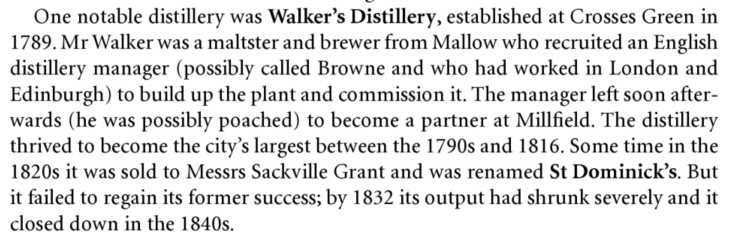
In the record of the letters to the UK Houses Of Parliament, there is this plea in relation to duty from the distillery owners in 1834:
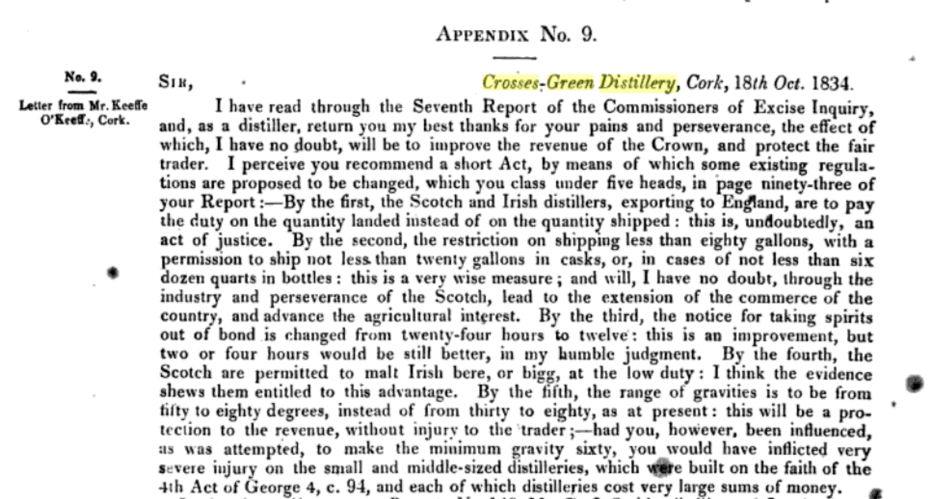
You can read the whole communication here, and the sadly succinct reply. They were doomed, and the excise on their product was not to be cut or modified. But taxation is the foundation of empires – the very first tax levied by the newly formed American government was one on whiskey, which led to the Whiskey Rebellion of Western Pennsylvania (a state was named after William Penn, onetime resident of east Cork).
But back to Electric and Nikka, a brand which previously boasted these two celebs as spokespeople – eat your heart out, Suntory and Bill Murray.
Paul Maguire was the host of the Nikka event, and as we chatted about whisky I told him that, much as I love visiting the Celtic Whiskey Shop in Dublin or Bradleys on North Main Street in Cork, buying liquor from retail outlets is just too pricey – so I shop online, where I can get a bottle of Redbreast for 12 euro less than it costs in the town where it is made. Again, the curse of duty (and the curse of rents and rates for high street retailers). As we chatted, a dozen or so whisky fans came and took their seats, and I slipped away back downstairs for the whiskey supper – but not before I took a few photos:
So to the main event. I feel torn when it comes to food pairings with whiskey – it really is a small, powerful drink, with a dynamic flavour profile that often needs to be savoured and explored on its own. Canapés work really well with it, as do chocolate, but large meals like the one I had in Strathisla last year can just overwhelm the palate. Thankfully, the meal in Electric was light enough to strike a good balance, but more importantly it served as a great introduction to whiskey for the average consumer – even my long-suffering wife, who is neither a fan of whiskey nor of my ‘worrying’ devotion to it – was able to enjoy all four drinks served with the meal, especially the opener; a fantastic Old Fashioned.


Hyde Whiskey were the sponsors. The brand is the brainchild of Conor Hyde, who runs a food marketing firm called Bullseye Marketing in Blackpool. Conor got his hands on some ten-year-old Cooley single malt, distilled and matured in County Louth, which he then finished in sherry casks in west Cork for nine months. Conor also helps organise Cork Summer Show, which is where I first sampled Hyde Whiskey. They were also selling it for 50 a bottle – a considerable drop on the 70 or so they charge now – so I bought one there and then. It recently won Best Irish Single Malt at the San Francisco Spirits Awards, and is a great example of the sheer variety and quality of Cooley’s output. Hyde Whiskey is a good enough dram to stand on its own – I understand that whiskey marketing dictates that there be some sort of historic narrative and loose geographical rooting with each brand, but it really does it a disservice – this is a quality whiskey, by any name. And so to the food:


I used to work as a chef in a place called Proby’s Bistro, right on the site of the old Walker’s Distillery in Crosse’s Green, and my three years there gave me an appreciation for good food and an aversion to food snobbery that I still have. If I was a food critic, everything would be awesome, all of the time. So you probably can’t trust me when I say that the meal in Electric was awesome, but it was. It was just the right amount of flavour and complexity to compliment the three whiskeys. I was especially impressed with the grain whiskey, served with the main course. Grain whiskey is made using a column still, a device that has its genesis in the creation of one Sir Anthony Perrier, a former Lord Mayor of Cork, who also ran the Glen distillery in Kilnap, which also features in Stratten’s Guide:

There is a memorial to Perrier in what is now the Triskel Christchurch, a stone’s throw from Electric:

Via http://triskelartscentre.ie/christchurch/famous-characters/sir-anthony-perrier/ Perrier’s first attempt at this type of distillation was not a success – but it was perfected some time later by Aeneas Coffey, whose family had their roots in Barryroe in west Cork. Grain spirit is another divisive issue in the whiskey scene – but then, what isn’t? Grain is seen as something of a diversion, an occasional distraction from the main event of single malt (or pot still whiskey, if you’re Irish). It has always been viewed with suspicion – even The Glen distillery poured scorn on it later in their life:


I can safely say that after having Hyde’s grain whiskey, I suffered no more delirium nor decrepitude than I usually do. It was a great compliment to the weightier flavours of the burger, and goes to show that grain is there for more than taking the strain in blends. The whole meal was great, as was the company – I was sat next to Mick Hannigan, who I had worked with on the Cork Film Festival about 13 years ago, the year that Song For A Raggy Boy premiered in the Opera House. I even got to hold a door open for Aidan Quinn. He said thanks. As celebrity stories go, it isn’t that great – but when I was a chef in Proby’s, Robert Plant came in for a bite to eat (specifically, a baby spinach salad tossed lightly in olive oil with cracked black peppercorns; I know this as I was the one who made it). After his meal one of the waitresses told him she was a huge fan, especially of his hit song, Addicted To Love. He said thanks. So at least my celeb encounter isn’t as awful as that one.
In Electric I also met Rebecca O’Keeffe, one of the people behind Taste Cork, a food branding initiative by local government. Their aim is to make Cork the foodie capital of Ireland – with so many great food brands based here and so many great events, such as the Ballymaloe LitFest, it should be a perfect fit. Dublin has the nightlife, Galway has the arts, and Cork has grub. Events like the Cork Whiskey Festival are a great way of highlighting our great tradition of food and drink – after all, the vast majority of the world supply of Irish whiskey still comes from Cork. It’d be nice to see more heritage events at the next festival – you could easily do a walking tour from the Porterhouse, located in the whiskey warehouses of bonders Woodford Bourne, down to the North Mall site of IDL/Wyse’s, to Kryl’s Quay where John Daly & Co. made and bottled Tanora as well as their lesser known bonded release, Sláinte Irish Whiskey. Then take a walk down John Street to the site of James Daly’s distillery, on to Blackpool where the New Furniture Centre still has one wall standing from the old Watercourse distillery, on then to Distillery Court in Blackpool, where a solitary archway is all that remains of The Green distillery. And then back into town to raise a glass to The Apostle of Temperance, Fr Mathew, whose memorial church stands just downriver from Electric. How he would feel about all this great whiskey being served up the road can only be guessed, but perhaps we remember him as something of a killjoy; consider this encounter William Makepeace Thackeray had with Fr Mathew in the Imperial Hotel on the Mall:
There is nothing remarkable in Mr. Mathew’s manner, except that it is exceedingly simple, hearty, and manly, and that he does not wear the downcast, demure look which, I know not why; certainly characterises the chief part of the gentlemen of his profession. Whence comes that general scowl which darkens the faces of the Irish priesthood? I have met a score of these reverend gentlemen in the country, and not one of them seemed to look or speak frankly, except Mr. Mathew, and a couple more. He is almost the only man, too, that I have met in Ireland, who, in speaking of public matters, did not talk as a partisan. With the state of the country, of landlord, tenant, and peasantry, he seemed to be most curiously and intimately acquainted; speaking of their wants, differences, and the means of bettering them, with the minutest practical knowledge. And it was impossible in hearing him to know, but from previous acquaintance with his character, whether he was Whig or Tory, Catholic or Protestant. Why does not Government make a Privy Councillor of him? — that is, if he would honour the Right Honorable body by taking a seat amongst them. His knowledge of the people is prodigious, and their confidence in him as great; and what a touching attachment that is which these poor fellows show to any one who has their cause at heart — even to any one who says he has!
Avoiding all political questions, no man seems more eager than he for the practical improvement of this country. Leases and rents, farming improvements, reading societies, music societies-he was full of these, and of his schemes of temperance above all.
As a keen supporter of local business, I think even The Apostle Of Temperance could see the importance of events like the Cork Whiskey Festival, not to mention the unifying labours of Taste Cork and the earnest endeavours of the staff of Electric and all the other venues that hosted events over the weekend – just as long as we don’t all end up suffering delirium and decrepitude tomorrow morning.
-
Booze coos

The Spirit Of Speyside Festival is urging cattle farmers to follow the lead of Japanese producers of Kobe beef, but instead of drinking beer, Speyside cattle will be fed draff from distilleries, drink whisky, and will have traditional Scottish music played to them. Pictured is Ann Miller, Spirit of Speyside Whiskey Festival.
(Photo: Ross Johnston/Newsline Media)It’s a tense time in the whisky field, with an increasingly bullish Japanese market milking their recent acclaim. But the Scots aren’t letting the grass grow under their feet and are out to prove they won’t be cowed. The farmers of Speyside – the most distillery-rich soil in the world, a veritable land of milk and honey for whisky fans – are planning to settle this beef once and for all by locking horns with their Asian rivals in the most Scottish way possible: By getting farm animals drunk:
Farmers on Speyside are being urged to lead a fight back for the Scotch whisky industry after a Japanese malt was named best in the world – by feeding their cattle a daily dram.
A nip of our national drink – coupled with a diet of high quality feed from distillery by-products – could produce meat so succulent and tender that it will rival Japan’s famous Kobe beef.
And it is thought that playing cattle upbeat traditional Scots music, in much the same way that Kobe herds enjoy classical sounds, will further enhance the quality of the beef.
Now there are calls from organisers of the world renowned Spirit of Speyside Whisky Festival for local farmers to help further trial the theory.
Thousands of visitors from all over the globe visit the annual Festival, and organisers are concerned about the level of attention being focused on Japanese whisky.
Ann Miller, a director of the Spirit of Speyside Whisky Festival, says, “We do not believe there is anywhere on earth that produces better malt whisky than Speyside – and millions of whisky drinkers agree.
“We were genuinely shocked and dismayed when Yamazaki was named the best whisky in the world, but we are firm believers in the old adage of don’t get mad, get even.
“And that is exactly what we intend to do. All the signs indicate that introducing Speyside malt into a cow’s diet and using animal feed created from distillery by-products gives the meat a lovely, whisky-tinged flavour.”
The incredible discovery was made by Speyside farmers Ali Rolfop and Joe King, who have a herd of Aberdeen Angus cattle.
They were mucking out a byre one evening on their farm, Ure Gullybale, near the distillery town of Keith and poured a bottle of single malt Scotch into a water trough.
Ali explains, “I’m a big fan of two of Speyside’s most famous products – malt whisky and traditional music – and so I decided to share these with our cattle.
“The next day, we noticed their coats were shiny and their eyes were bright. We’ve since been sharing a bottle of malt with them and we even have some local fiddlers come down to perform. We tasted the beef from the herd for the first time a couple of weeks ago and it is sensational – there is definitely a hint of whisky in the meat.”
The Spirit of Speyside Whisky Festival takes place from April 28 to May 2 and is one of the biggest events of its kind anywhere in the world. It comprises almost 500 different events, from distillery tours to whisky tastings, from ceilidhs to comedy nights, and from whisky themed dinners to outdoor events.
Ann adds, “With all this focus on Japan, I suppose we are a little worried that the thousands of visitors who fly in from all corners of the globe to enjoy our Festival might be tempted to go there instead.
“But while Japan may have been able to produce some decent drams, it doesn’t have the history and heritage of Scotch whisky. We’ve been producing the best whisky in the world for generations – no beef about it – and while they have learned how to make whisky from us, we’re now learning from their farming techniques.”
Tickets for all events in the 2016 Spirit of Speyside Whisky Festival programme are available to buy now at www.spiritofspeyside.com The Festival is also active on social media – facebook.com/WhiskyFestival and @spirit_speyside on Twitter and on Instagram.
Drunk cows should be an added bonus to this year’s event, as last year I really felt the festival could do with more cow tipping and bovine TB. Unless of course all this is some sort of April Fools – or April Coos, if you will. But given the Scots’ lack of respect for their own bodies, existing as they do on a daily diet of Scotch eggs, sausage rolls, Irn Bru and methadone, it seems altogether possible that they would get their farm animals pissed up in the name of national pride. So pull the udder one, as I’m with Ure Gullybale all the way!

-
The Long Good Friday Pub Review

The drinks industry has built itself on a desperate search for authenticity – every plywood flatpack bar claims to be the authentic Irish pub, every pub aspires to be the real home of Guinness, everyone wants to be the spirit of Dublin, everyone is on the quest for real ale, then there is the craft beer movement, the hipsters who were into every beverage before you, before it got big, before it became corporate.
So many brands try to root themselves in some pre-industrial Never Never Land, as opposed to proudly embracing modernity and the glistening chrome of computer operated production. But authenticity is something that really cannot be faked – contrast some of the Paddywhackery of Dublin tourist pubs with a place like Dick Mack’s in Dingle. The simple charms of The Pub That Time (Almost) Forgot has made Dick Mack’s the country’s greatest whiskey bar, and just a great pub in general. But places like that can be hard to come by.
In my hometown, there aren’t many that come close. But if you want an authentic Irish pub with a better-than-most whiskey selection, Canty’s is a fairly good place to start. It’s been on the Irish Whiskey Trail for a number of years, a tourist initiative started by Heidi Donelan, which saw her travel the country finding proper Irish pubs with a decent whiskey culture.
Heidi ran tours of the pubs, bringing them to Midleton year after year, including some well-known whisky personalities, such as Martine Nouet, a famous whisky-pairing chef and author who forsake her native France for the elemental dramatics of Islay.

Martine is the second from right at front. Also there are Mark Gillespie from WhiskyCast, Neil from CaskStrength Creative, the chap who runs GlenKeith, the chap who works in Aberlour, eh yeah I should have taken more names. The wonderful Ann Millar from Chivas is at the back next to your’s truly. The Irish Whiskey Trail website has a little bit of history about Canty’s and its links to the distillery in Midleton, but as a local I have to admit I have probably been in Canty’s twice in my life. It was seen as an auld fellas’ pub when I was a young jackaknapes, so maybe my recent appreciation for it is a sign that I have finally achieved auld fella status.
Canty’s is what an old friend of mine used to call a ‘great drinking pub’ – you could go in there at 10am and have a pint without being judged. When I popped in there recently at about 11am there were a dozen or more patrons, supping pints with the odd half one to follow. The place hadn’t changed since I was in there 20 years before. The current owner, Catherine, told me they mostly do a day trade, and the fact that their smoking area opens onto a lane connecting them directly to the bookies down the street meant that they had the best of both worlds – or a perfect storm of human vices, if you want to look at it that way. But Canty’s is a slice of the old world – a lot of the people in there were the old school drinkers; men in their 70s and up, supping pints and shorts, because that was what men did. There was no meeting the lads for a frappucino or going for a spinning class and sauna together, this was Irish Male V1.0: You drink to socialise, you go to the pub to get out and meet your pals, because they didn’t have brunch during the Civil War lads.
But the patrons in there were good craic, all bemused at me taking photos of their local, wondering what was so special about it. Here are a few of my photos:
The pub was really too busy to have a proper rummage through the dusty old bottles, but I did spot this number:


Catherine told me she wouldn’t feel right selling it to people as she was worried it had been there so long they might get poisoned from it. I told her to charge them so much they wouldn’t be able to afford a lawyer. Anyway, here are some details via this excellent site:
Sadly, this Whiskey is now a rarity as Irish Distillers decided in 2004 not to produce this fine blend any longer. It was first launched in 1960 by Cork Distilleries Co., the name being a hint at one of its founding distilleries: Watercourse Distillery in Watercourse Road, Cork, owned by the Hewitt Family. Strangely enough, the address on the label – North Mall, Cork – points to another distillery located there, which was owned by the Wise Family. However, the blend consists of two Malt Whiskeys – one from Midleton, one from Bushmills – and a Grain Whiskey from Midleton. It is bottled at 40 per cent abv. As Jim Murray notes, “if you ever see this on the shelf of a bar or store, get it.”
It also gets a mention in Brian Townsend’s excellent The Lost Distilleries Of Ireland:

Again, Hewitts was another whiskey yearning to achieve authenticity, pointing to a past it had little connection to, rather than standing on its own two feet and embracing its own oddness – apparently it is the only Irish Distillers blend that does not contain any pot still whiskey, it comes in 1.125 litre bottles, and then there is the fact it contains malt from Midleton – a comparative rarity. Although they did make a single malt many years ago, one that is best forgotten, if the awful title and label design is anything to go by:

At the other end of the main street from Canty’s lies the town’s newest pub in one of its oldest buildings. The former barracks in the town was designed by AW Pugin, known as God’s Architect because of all the churches he designed across the UK.

It is a stunning old building, previously run into the ground as McDaid’s, a pub that started so well as an excellent, atmospheric late bar and gradually turned into a teenybopper kip. Shut by the banks, the building was sold for a bargain 600k to the Lynch family of the award-winning Cotton Ball micro-brewery, and is leased to the two gents behind the incredibly successful Castle bar in Glanmire and Elm Tree gastropub in Glounthaune. It had its first night last night (the official opening is tomorrow), so naturally I sauntered along to see what sort of whiskey selection they had. I was very pleasantly surprised by the range – and the venue as a whole.
As always, drinking nice whiskey on a night out is a costly affair; a Yellow Spot was 8.90. So sip it slow. The plans for the venue sound great – it will be over-23s, with a strict dress code, a function room upstairs, and a possibility of food down the road, once they get the upper floors ship-shape.
They also used some of the spaces to celebrate the heritage of the building and the man after whom it was named – JJ Coppinger. You can read about his incredible life here, but here are some more details about the building, past and present, thanks to historian Tony Harpur of the excellent Midleton With One D blog, who corrected a few errors I had in this post originally:
There is a copy of the most famous portrait of Pugin in the smoking area of the bar, surrounded by copies of some of his architectural sketches. These particular sketches belonged to George Coppinger Ashlin. Ashlin was born in Little Island of a Midleton mother (Dorinda Coppinger) and and English father (John Ashlin)! Having studied architecture and partnered Pugin’s son Edward and designed St Colman’s Cathedral in Cobh, Ashlin married Mary Pugin, and became Pugin’s son-in-law. Ashlin’s older brother, John, lived at Castleredmond House, hence the presence of Ashlin Road in Midleton.
The building was never the RIC barracks – that was the old part of the Garda Station behind the Courthouse. Instead the Midleton Arms Hotel was requisitioned in 1920 as a barracks to house the Auxiliaries (ex-British army men hired to beef up the RIC during the War of Independence). The facade still ears the traces of bullet marks from an IRA attack in late 1920, although the holes have been filled in.
The Coppingers of Midleton ran a brewery on the site next to the building from the mid-1790s until about 1840. That building is still there – along Distillery Walk and Main Street. It really is nice to see the Coppinger name return to Main Street in Midleton.
Hopefully this new venture will do justice to the Pugin/Coppinger name, the legacy of the building, and the simple needs of an authentic middle-aged git who likes to have a decent whiskey in a nice pub – be it an oldschool auld-fella watering hole, or a collision of exposed brick, historic stone and slick design.
-
The Galtees
A few photos from various rambles up the Galtees. We should all get out more. Ireland is at its most serene and beautiful when you get to the summit of a mountain on a clear day and all you can hear is the wind and the jackhammering of your heart as you drink in a hundred miles of scenery. It makes you realise that, beyond all the negativity in the press and misery we sometimes like to wallow in, Ireland is a pretty special place. And sher a bit of exercise wouldn’t go astray, would it?
 Triple Distilled Communications
