• Authoritarian

    I did a steaming hot take on the Clinton/Patterson book for the Indo, and here it is: 


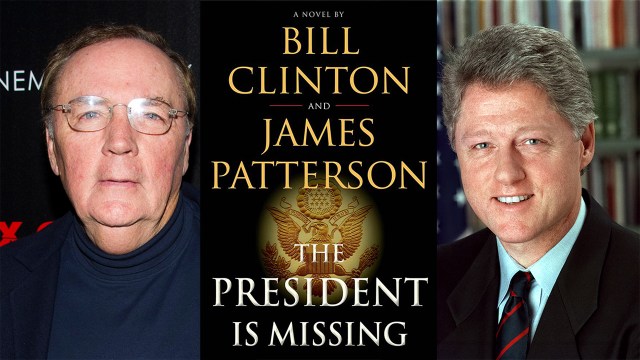
    When it was announced that Bill Clinton was writing a book, most people assumed it would be a cross between 50 Shades and Fear And Loathing In Las Vegas. Sadly, our hopes of a steamy memoir about Slick Willy Clinton polling the electorate were dashed when it was announced that human bestseller machine James Patterson would be co-authoring. Patterson is what you might call box office, one of the most successful – and richest – authors in the world, even if he has his critics – as horror maestro Stephen King bluntly put it, Patterson is a terrible writer but he’s very successful.

    So the book will be a hit, no matter what, even if the title – The President Is Missing, which according to the publishers is about a president that goes missing – doesn’t suggest a gripping, unputdownable page-turner. But not every politician has had success when dabbling in the creative arts.

    Painting – Churchill painted to alleviate depression, Hitler was a failed artist, and Franco was  better than you would think. But beyond all those were the paintings of George W Bush, whose portraits of world leaders – and himself in the shower – were startlingly poor. Of course, art is completely subjective, but when a 14 year old entrant in the Texaco Art Competition makes W’s works look like a potato print, it is time to retire the easel. However, he did exactly the opposite – he released a book of portraits, this time on a subject that meant nobody could criticise his work: War veterans. Frankly it was the least he could do after starting a war himself.

    Acting – It should set off alarm bells for all of us that so many actors become highly successful politicians. Reagan, Schwarzenegger, Glenda Jackson; it is a surprisingly smooth transition from pretending to be someone, to being a politician. Perhaps the oddest transition was that of Illona Staller, known by her stage name la Cicciolina. The Hungarian-born model (and porn star) stood for the Green Party in Italy and served one term, one of the most memorable moments of which was when she offered to sleep with Saddam Hussein in return for peace in his country. Perhaps if George W had painted that scenario he might sell a few more copies of his book.  However, he would have to compete with the talents of conceptualist artist Jeff Koons, who married Staller and created a series of massive portraits of he and his wife engaged in explicit sexual acts. So politics isn’t all paperwork.

    Music – Wyclef Jean ran for president of Haiti, Youssou N’Dour ran for office in Senegal, Sonny Bono became a US congressman, and our own Bono seems to have more influence with world leaders than our politicians do. It’s not surprising to see idealistic musicians attempt to turn their lyrics into actions. And then there’s former TD Paul Gogarty, who brought his baby to a Green Party press conference calling for a general election, and on another occasion shouted ‘f**k you’ across the floor of the Dáil at Labour TD Emmet Stagg. If he was to record music, you would assume it would lie somewhere between The Sex Pistols and the theme music from In The Night Garden. But Gogarty’s project, His Sweet Surprise, is a very sweet surprise – synth-heavy pop songs with catchy choruses. His time in politics may have been brief, but his music (and swearing) definitely made more of an impression than his party colleagues, such as the lightbulb guy or the other guy, you know, the one who cycled everywhere.

    Writing – Clinton’s foray into writing is unusual in that it is a work of fiction. Most former presidents just churn out a memoir or three, along with several impassioned books on how they could make the world a better place if only they were still in charge. The only previous work of fiction Clinton was affiliated with was the Chinese counterfeiting of his memoir, the imaginatively titled My Life. The Chinese version of it – which came out before the book was actually released – featured countless anecdotes of Clinton talking about how great China was and how their technology was vastly superior to America’s. It also included a scene in which Bill informs Hilary this his nickname is Big Watermelon, which somehow seems entirely plausible.

    But when it comes to forays into the world of creative writing by politicians, few come close to our own Alan Shatter. His one novel, Laura: A Story You Will Never Forget, shot to prominence when a complaint was made to the censors office about it. Fittingly for a man born on Valentine’s Day, Mr Shatter included a few scenes of the protagonists engaging in the physical act of love – which is what they called sex back in 1989 when the book was first published. After the complaint to the censors board and subsequent furore, the book was republished, proving that the old adage of ‘no such thing as bad publicity’ is true in the arts, if not in politics.

    While Mr Shatter is undoubtedly one of the most brilliant minds to have graced Dáil Éireann in modern times, one does have to wonder if the much talked-about sex scenes in Laura would have been better if he was a little less brilliant – perhaps a little less mind and a little more body would have turned his well-written, sterile prose into top-notch filth. He does, however, get bonus points for including this classic Irish chat-up manoeuvre:  “She knew that she had been foolish for not taking the necessary precautions herself, but Brannigan had assured her that he always withdrew in time and that she was not at risk.”

    It was either that or tell her his nickname was The Big Potato.

  • Cities, Eurovision, giant rats

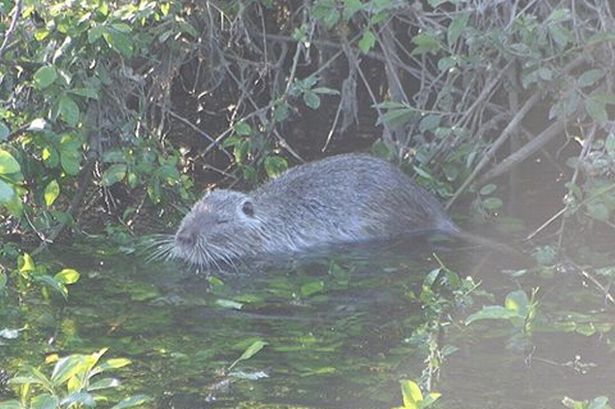
    A giant fucking rat in the Lee. Via http://www.irishmirror.ie/news/irish-news/pictured-one-metre-long-coypu-10435721.amp

    Column Watch – week three. The mood is tense. Somehow it hasn’t been cancelled yet, but this one might do the trick: 


    We are flocking to cities. According to the data provided by Census 2016, nearly two thirds of the population of Ireland now lives in an urban area, with 25% of us living in Dublin. Perhaps it is the lure of The Pale’s high quality broadband,  Starbucks and Subway on every street corner, or the fact it has every mode of public transport short of a monorail, but we are heading in our droves towards its bright lights. However, there is a downside.

    The Japanese understand the negative effects of too much time spent in cities, as the greater Tokyo area is the most populous metropolitan area in the world. The Japanese  have a word for healing the soul through a return to nature – shinrin-yoku. Its closest translation is ‘forest bathing’, or simply the medicinal benefits of taking a walk in the woods.

    It is one of many Japanese words that have no direct translation into English, another being Shogania  –  or ‘a situation that can’t be helped, and also is out of our control’, much like our epic losing streak in Eurovision.  

    Japan aren’t in the Eurovision – but it can only be a matter of time. The presence of Australia in the competition is an open door to all of planet Earth (and much of our solar system) who fancies having a go at music’s zaniest song contest. This year’s spectacle even featured a streaker, draped in an Australian flag, baring his backside, presumably as an allusion to a nation from the arse-end of the globe taking part in what is theoretically a European event.

    The culprit turned out to be a Ukrainian who has made a name for himself in the worst currency of all – pranks. The ancient art of pranking had died a well-deserved death until YouTube came along and made upsetting children/the elderly/cats into an actual career for the chronically annoying. But Vitalii Sediuk, the man behind the behind, made a rookie error – he chose to try and make his mark on a TV event that looks like an explosion in a fireworks factory. For all his ‘hilarious’ efforts, he ended up a vanilla also-ran on a night of giddy, deranged cabaret.

    But beyond the buttocks, dancing Harambe and yodelling, the most striking thing about the competition was how eerily familiar the songs sounded, from Germany’s take on David Guetta and Sia’s Titanium, to Moldova’s Saxobeat-aping take on the sax solo from My Lovely Horse. The winning act, a young psychology graduate from Portugal, made a plea for ‘real music’, which would suggest he didn’t take much notice in college when they covered passive aggressive behaviour. Salvador Sobral’s lofty stance was a bit rich, coming from someone who came seventh in Portugal’s version of Pop Idol, singing a song that sounded like a knockoff from the soundtrack to LaLa Land. However homogenised the music seemed, it was nice to hear Sobral singing in his native tongue, especially for some Portuguese speakers who have taken up residence in Ireland.

    The awkwardly titled coypu is native to Brazil, but has settled right into the grassy savannahs of the Lee Fields on the edge of Cork city. Also known by the less appealing name of ‘swamp beaver’ (or the terror-inducing ‘giant river rat’), they have a thick, dark pelt and bright orange teeth, much like a 1970s TV presenter.

    The coypu have fit right in Cork – AKA Ireland’s Brazil –  with its subtropical climate, passionate footballers, lilting dialects and oppressive Catholicism. While the coypu pose no direct threat to humans, and are noted for being friendly – or as friendly as one would want to be with a giant river rat – they have caused extensive damage in other countries, devouring aquatic plants, collapsing riverbanks and generally freaking people out by virtue of the fact that they are, as already stated, giant river rats. Although if building on swamps and collapsing banks is their forte, they could always go into property development.

    The important news about our newfound fauna is, of course, that they are edible. Their meat is low in cholesterol and they are bred for food markets in countries like Kyrgyzstan and Uzbekistan as ‘a poor man’s meat’, which is really only a negative if you consider how poor the average person in Kyrgyzstan and Uzbekistan is.

    A recent upsurge in their popularity (as food, not friends) has been noted in Moscow, where a hipster restaurant has put them on the menu as burgers and hotdogs. The meat is described as being ‘somewhere’ between turkey and pork, a flavour description so vague that it is somehow less appetising than the entire concept of eating a giant river rat.

    But Cork tastes are exotic. Thus, given the Rebel City’s love of tripe and drisheen washed down with Tanora and Beamish, chowing down on a massive rodent should be no bother, especially when it is cost effective. Like most city dwellers, Corkonians have a crippling addiction to dining out and overpriced coffee, leading to a state that the Japanese call Kuidaore – or to have bankrupted oneself buying good food and drink. So the next time you go wandering the banks of your own lovely Lee in pursuit of some shinrin-yoku, it might be an idea to bring some condiments with you.


  • Communion: A True Story

    DSC_0212

    So my son made his First Holy Communion. He goes to a Catholic school, was baptised, and we generally operate within the structures of Catholic Ireland – simply because it is easier than trying to operate outside it. There are few non-religious schools, and to be honest, I went to a minority faith school and always felt like a bit of an outsider in the community, although that might have had something to do with my Camus-style existentialist angst. Nobody needs a guy quoting Nietzsche on the sidelines of a hurling match. Community is as much about who is excluded as who is included. Much of Ireland operates on this level – who ‘we’ are not.

    The pic above of us at the Communion without the youngest two kiddies just makes me wonder WTF happened to my jawline – I look like Earthworm Jim.

    Also, fans of terrible writing – and if you’re reading this I assume you are – will note that the post title was taken from Whitley Strieber’s tale of how he was abducted by aliens, which is 30 years old this year. I love this from Wikipedia:

    Following the popularity of the book, the author’s account was subject to intense scrutiny and even derision. Some disparagement came from within the publishing world itself: Although published as non-fiction, the book editor of the Los Angeles Times pronounced the follow-up title, Transformation (1988),[12] to be fiction and removed it from the non-fiction best-seller list (it nonetheless made the top 10 on the fiction side of the chart).

    “It’s a reprehensible thing,” Strieber responded.

    “My book is a true story … Placing this book on the fiction list is an ugly example of exactly the kind of blind prejudice that has hurt human progress for many generations.”

    Personally, I believe that challenging non-scientific nonsense is the only hope we have of saving ourselves – and that includes made-up aliens and nonexistent gods.  Anyway, I wrote some nonsense about religion – it’s worth noting that there were many takes on religion here the week, a notable coming one from maverick distiller Peter Mulryan in the paper of record. But here’s my lukewarm/not-that-funny take on it all:


    First Holy Communion season is here again, or ‘Loan Shark Week’ as it is also known. It is a special day in a young Catholic’s life, when boys get to wear their school uniform on a Saturday and be given enough money for a PS4 Pro before they have left the church, while the girls get to wear a miniature wedding dress, as though they were about to enter an arranged marriage with a 2,000-year old carpenter from the Middle East. If they’re very lucky they might also get a silk umbrella, which would come in very handy if there was a chance of sun, which, as with any special occasion in Ireland, there will not be.

    At our son’s ceremony we were informed that we should respect the sacred rites and not take photographs during the Mass. However, the good news was that the guy with the massive video camera and lighting rig in front of the altar would be selling DVDs of the day later in the week. Obviously my son’s teacher hadn’t been schooling him in the ancient traditions of Ireland, as he turned to me and whispered ‘what’s a DVD?’ Naturally, I cleared my schedule for the afternoon to teach him the audiovisual catechisms of my youth, from the old testament’s primal sin of not rewinding VHS tapes before returning them to the store, to the one commandment of DVDs, ‘thou wouldst not steal a car, so why wouldst thou pirate a DVD?’. It was a day of revelations for my son, who concluded that the olden ways are weird. Just wait until he learns that the Irish State was considering taking a blasphemy charge against the Cheshire cat from Tim Burton’s Alice In Wonderland.

    While it seems odd that Stephen Fry’s comments were broadcast at all, given that they aire on a station that still considers the Angelus a valid part of its daily programming, it is curiouser and curiouser that they were on a show titled The Meaning Of Life – surely a fair warning that there would be a discussion of all aspects of human existence. Fry’s comments on what he might say to a god, were he to meet one, weren’t even directed at Catholic Jesus, but rather all Jesuses everywhere, including the tax-efficient sci-fi laser Jesus of Scientology.

    Perhaps Fry’s comments would have been less hurtful if they were made by an Irish person, who had served their time here in the dour days of the Eighties and Nineties, being dragged from holy well to moving statue, and from Novenas to Knock, in pursuit of enlightenment. But anyone who did go through that period would tell you that it is almost impossible to discuss religion without offending someone. It is much like the sporting world – get fans of two opposing teams to discuss whose team is superior and watch as it descends into a screeching match of such escalating frequency that only Roy Keane’s beloved dog Trigger can hear them – and Triggs has been in doggy heaven for five years now. Or he might be in doggy hell, it really depends on how he felt about Saipan, in which Keano was either a fearless messiah or a blaspheming heretic, depending on your own personal beliefs, or whether you are from Cork or not.

    The whole Fry blasphemy debacle has been slightly embarrassing, not least because the laws themselves are so incredibly vague that Jesus Himself would probably have to show up to get a prosecution. And I’m fairly sure he is busy giving sending DMs to televangelists.

    The Irish blasphemy laws also garnered a large amount of pointed throat-clearing and eyebrow-raising from atheists, as the statutes do not categorise as a religion ‘any organisation that employs excessive psychological manipulation of its followers’, which is really a description of all religions, as well as the GAA, various weight loss groups, sci-fi conventions, and those National Lottery ads that suggest you might want to buy an island.

    For anyone who does wish to go back to the good/bad old days in Ireland, when were weren’t allowed to question faith at all and Fr Ted was considered highly sacrilegious, there is good news from religion’s arch nemesis – science. Mathematicians from the University of British Columbia and the University of Maryland have published a study this week which proposes that, mathematically at least, time travel is possible. Great news for anyone wishing to head back to the more innocent days of the early Nineties, when the abortion debate was raging in Ireland, America was at war in the Middle East, and Johnny Logan was writing Eurovision winners for us. Just remember to bring your XtraVision card.


  • The Weekly Bill

    So I am now an Irish Independent columnist, which is great as I think the whole world needs to listen to what I have to say right fucking now. This is my first lash at it, which ran in last week’s paper. It is a series of Christmas cracker jokes disguised as a news digest/OpEd from hell. Enjoy!


    It seems hard to believe that Brexit, AKA The Great British Bunk-Off, is still rumbling towards its inevitable unpleasantness. The meal at 10 Downing Street between Juncker and May, held to thrash out some of the more awful possibilities of Liminal Britain’s Series Of Unfortunate Events, sounded like a moody teen telling their parents that they were moving out of home and thus would need 60k pocket money a week and full access to the fridge and WiFi. All the occasion was short was Theresa May turning into Richard Dreyfuss in Close Encounters, fashioning a sculpture of the white cliffs of Dover out of mashed potato, whispering ‘strong and stable’ over and over while her alarmed dinner guests exchange concerned looks with each other. A full account of the feast of awfulness was carried in the German newspaper Frankfurter Allgemeine Sonntagszeitung (FAZ), fitting given that many read it whilst enjoying a feeling best encapsulated by a very German word – Schadenfreude.

    Schadenfreude was the word of the week, after the disaster of Fyre Festival, an exclusive event on a private Bahamian island that collapsed into disaster for its wealthy, exclusive clientele. Like Cinderella after midnight, their luxury cabanas turned out to be disaster relief tents, while the culinary delights they were promised transformed into a salad leaf and what might have been bread. Pop punk deities Blink 182, who are apparently still going, cancelled their headline slot outright. It brought to mind a festival disaster I attended in the late Eighties. Lured with the prospect of a once in a lifetime experience to the exotic location of Medjugorje, I was startled to find our luxury accommodation featured blocked toilets and en suite snakes,  while the headline act, The Virgin Mary, failed to show up at all. The whole debacle was so embarrassing for host nation Yugoslavia that they broke up a year later. Mind you, it wasn’t as disappointing as Electric Picnic 2006, when I went along to enjoy The Rapture, only to discover that it wasn’t the ascent into heaven of true believers and purging of the sinners, but rather a band of the same name. And apparently, this wasn’t grounds for a refund.

    Confusion over titles also brought some much needed levity to our criminal justice system, when a jury selection was held up by a barista being mistaken for a barrister. It was the sort of whimsical nugget served up at the end of the news bulletin, like petit fours after the main course of war, famine and plague. In fact, it was exactly the sort of light hearted japery that usually adorns café chalkboards. It’s hard not to feel sorry for the barista tasked with coming up with these daily quips. Being paid a mortgage-defying wage to rise at 5am to make frappucinos for depressed millennials, whimsy must be a foreign land to the average barista. Yet they persevere, scratching out witty messages about hamsters being mixed up with hipsters, trying to convey the warmth and humour of their establishment in just a few short words, as like barristers, they become experts in reducing sentences.

    Bealtaine finally arrived on Monday, the ancient pagan feast marking the start of summer. Celebrated in some areas with bonfires – usually depending on how much green waste there is lying about the garden – it is a reminder of our pagan past. The past of the Pagan Federation Of Ireland was also resuscitated recently, when a viral post of theirs resurfaced on Twitter. Responding to a request that they provide an American odinist couple with an officiant who did not perform same-sex or mixed-race handfastings, they politely declined before closing with the ancient celtic farewell of ‘f**k off’. It made you think that maybe we should give the pagans another shot – would it be so bad to hand over the running of a few hospitals to them? Who wouldn’t want a flatlining loved one being tended to by Gandalf, bellowing ‘you shall not pass’ as he warms up the defibrillator? Of course the greatest bonus to getting them to run the hospitals is that it would end all fears about nursing numbers, as druids always come with a very large staff.

  • Battle royale

    So the Indo asked me to write a bit on the royal visit to Kilkenny. Naturally I completely misinterpreted the brief on the piece and had to rewrite it; the final printed version is here, while this is the original:

    We have come a long way as a country. The announcement that HRH Prince Charles was going to be visiting Kilkenny was greeted with a national shrugging of shoulders, a sign that we have moved on from the angry young nation we once were to a more mature approach. We now see a royal visit as being like Christmas drinks in your house with neighbours you don’t especially like, but need to keep onside in case you need to borrow a generator at some point.

    In fact, it might even be acceptable to say that it would be nice to have our own aristocracy. Sure, we have our own version of royalty, like Queen Miriam O’Callaghan, ruler of the airwaves, pirate king Johnny Ronan, snatching up gluten-free princesses and whisking them away to his north African hideout, or the Dauphin Nicky Byrne, whose increasingly complex riddles saw his Million Euro Challenge show marched to the guillotine. If only he had listened to his father in law, Emperor Bertie, he would have known that the plain people of Ireland care not for complex mathematics, nor even rudimentary bookkeeping.

    So we have our own yellow-pack royalty – but it’s not really the same. There is something entertaining about watching genuine aristocrats go about their business, like a cross between Teletubbies and Game Of Thrones. All that pomp and circumstance, the pageantry of it all, the zany names and goofy accents. The only real royalty we have is Puck Fair’s King Puck, a terrified goat in a cage, dangling 50 feet off the ground like a hairy David Blaine.

    Kilkenny was the perfect choice of venue for a royal visit, for it was King James I who granted it royal charter as a city in 1609, which led to centuries of confusion as visitors pointed out that it really is just a large town. Anyone suggesting this heresy might want to do so in private, as Kilkenny was also home to one of the first witch trials – and subsequent burnings at the stake – in Europe. Held in 1324, the trial involved Dame Alice de Kyteler and her servant Petronella de Meath. Part of the charges claimed that Alice had a demon as incubus ‘by whom she permitted herself to be known carnally’ and that he appeared as a cat – something that should sound familiar to any poor hurler who had the arse ridden off them by the Cats in Croke Park over the last two decades.

    The two were found guilty of the crimes, and while Petronella was flogged and burnt at the stake, Dame Alice fled to the UK. Aristocrats – a great bunch of lads.

    It is Kilkenny’s rich medieval history that has drawn Charles to the city, according to Chris Hennessy, the head barman at The Dylan Whisky Bar.  Chris said that the rumours of the royal visit started some months ago, but were confirmed in the last three weeks. Asked how the news was greeted by locals, he says “People were just glad that something was happening outside Dublin”.

    While there are two definite stops for the couple – Rothe House, a 17th century merchant’s townhouse, and the stunning Kilkenny Castle – The Dylan might appear on the itinerary. As the number one whiskey bar in Leinster, it is entirely possible that a whisky enthusiast like Charles might pop in for a quick dram. The Prince is a keen supporter of whisky producers, having given a royal charter to Scotland’s Laphroaig, a distillery whose fire-and-brimstone whisky would go down a treat with the Kilkenny puritans who flambéd Petronella de Meath. So if HRH should pop in for a liquid lunch, what would Chris serve him?

    “To start I’d go with an original aqua vitae. This was the drink that later became what we know as whiskey, and the first recipe for it comes from the Red Book of Ossory, penned in 1324 by Bishop de Ledrede at St Canice’s right here in Kilkenny. We have recreated it from that original recipe, so he could start by tasting whiskey’s ancient past. Then I would serve Redbreast 12, to show the traditional Irish style of whiskey, and finish with the new Teeling Brabazon, to give a glimpse of the future.”

    Chris points out that the visit really does seem less about publicity – of which there has been little – and more out of the royal couple’s genuine curiosity about the Marble City. Asked if the bar had considered any ways to cash in, he says “We did think about getting in cardboard cut-outs of them, but we were worried we might get a visit from the secret service agents.”

    While the royal visit – and subsequent boost in profile – should be of great benefit for the city, it really is a shame that some of the younger royals don’t make a trip across the water before Brexit makes it a bit of a nightmare to get through immigration.

    Charles and Camilla’s visit may be the biggest thing to hit the town since the Black Death touched down in 1348, but who among us wouldn’t like to see Will and Kate bringing the kids over for a weekend? Who wouldn’t want to bump into them stocking up on shorts and T-shirts in Market Cross Penneys, as their kids rip the place to bits? Or witness Harry and Meghan loudly arguing outside Joe’s Takeaway at 3am whilst spilling garlic chips down their tops? Imagine the boost in Kilkenny’s tourism profile if little George was seen in a miniature Kilkenny kit, swinging a hurlóg at passers-by, while his dad struggled to get a slab of Smithwicks into the back of a horse-drawn carriage.

    In the absence of a monarchy of our own, maybe it’s time we simply accepted the royals back into our bosom – after all, they are practically related to us, for both Kate’s family and that of Charles and his sons, can be traced back to the High King Of Ireland, Brian Boru. Boru’s lineage can also be traced to JFK, Ronald Reagan, Barack Obama, and even our own Baronet, Ryan Tubridy. In fact, Boru’s sprawling family tree shows that when it comes to producing devil-may-care aristocrats with complex marital relations, we really are up there with the best of them.


  • Snakes on an astral plane

    tenor.gif

    So the Indo asked me to write a bit for Paddy’s Day. It was meant to be 17 signs you’re Irish, or alternatives way to mark the day, so I got confused and ended up with something between those two. Of all the things I wrote for the paper this was the one I stumbled over the most. Thus, it ended up being a somewhat overwrought and overlong 1,200 words on whatever the hell this is: 


    I want to tell you a story. A story about a young man from a country far away, who yearned for a better life. Lured here with promises of a great job and excellent working conditions, he found himself forced into slavery, working in filthy conditions and surrounded by animals. No, I’m not talking about Brent Pope, but of our patron saint, Patrick. Like all young men growing up in Wales he dreamed only of playing rugby in a coal mine with the rest of his choir, but after spotting an ad in the local ogham stone looking for young talent to work overseas, he signed up and was shipped off to Ireland to herd sheep. Granted, it could have been worse – he could have been forced to work the late shift in a Spar on O’Connell Street, and while he really ought to have heard alarms bells when the recruitment agency was run by a man named Niall Of The Nine Hostages, his fate – and ours – were forever entwined thereafter.


    He did escape eventually, but after a brief interlude back home, presumably working as a roadie for Tom Jones, he spotted a gap in the market back in Ireland for guilt. Our national identity has been linked – for better or worse – with the Catholic faith ever since, but perhaps now is a good time to think about all the things that make us who we are.


    1. Form a disorderly queue: Few things capture the essence of Irishness like the depressing mayhem of our attempts to queue. Having been raised with the horizontal battlefront queueing system in pubs, our transition from jostling pintbabies to confused pintmen and pintladies every time we are expected to form a straight line is something to behold. Like a particularly drug-addled horse at the start of the Grand National, our restless spirit won’t allow us to simply stand in a line waiting our turn for anything, be it to board an Expressway bus, select from a breakfast buffet, use self-service checkouts, or attend a removal.  
    2. Do what thou wilt and that shall be the whole of the law: For a country with so many zany self-imposed religious rules, we really struggle to comply with some of the more basic statutory ones. Any rule we don’t like becomes John Bull’s Law, and thus is to be ignored until we become four green fields once more. This list includes TV licenses, any and all avoidable taxes, picking up after your dog, and a whole host of others. This St Patrick’s Day why not celebrate our innate lawlessness by parking in in a junction box, walking in a cycle lane, cycling on a footpath, or simply wandering into a random queue at the halfway point.
    3. Avoid confrontation: We love a good donnybrook, even going so far as ironically naming a well-to-do part of Dublin after our beloved mass brawls. But those are collective affairs – we are the fighting Irish, not the fighting Irish person. One-on-one, we are terrible at standing our ground. You can point to any number of historical reasons for it, but we are completely incapable of asking someone to stop cycling on the footpath, or to not skip the queue, or to stop spitting their gum onto your shoes. Even when we do try to confront an issue, it ends coming out as a series of increasingly apologetic ‘sorrys’. So when some giant stands right in front of you at the parade, or a sleeveen slithers in to get served ahead of you at the bar, swallow that anger down, and store it up for the next donnybrook. On Paddy’s Day you shouldn’t have too long to wait.
    4. Talk without speaking: We are a nation of talkers, and we love nothing more than chewing over the important issues of the day, such as potatoes, rain, or the effects of rain on potatoes. Just as the Inuit have a veritable blizzard of words for snow, we have a dozen flowery words for potato and more than nine million for rain, but they all carry deeper layers of meaning. Here are a few translations to get you started:
      ‘Tis fine out’ – I am filled with a sense of doom.
      ‘The forecast is for rain’ – All is right with the world.
      ‘Are these the new potatoes?’ – I no longer love you.
    5. Is there anything to be said for another Mass: Most of us are products of the Catholic education system, where the central tenet, as Billy Connolly once noted, was ‘Jesus is dead and it’s all your fault’. St Patrick may have helped wrap our national identity in the shroud of the holy Roman Catholic empire, but there are other faiths in this world and this land, and we could do with learning a bit more about them. As a country that venerates Foster And Allen, Gerry Adams and Daithi O Se, we should have no problem understanding any religion that worships lads with beards. Which is basically all of them.
    6. An béal bocht: Apart from the Belle Époque of 2006-2007, during which we pretended to be rich, nothing satisfies us like pretending to be poor. Everything is a struggle, we tell the person seated next to us on the flight to Mallorca. We are finding it so hard to make ends meet, we tell the car dealer as he hands over the keys to a 171 ozone killer. When will John Bull stop his insane tax laws, we ask the bank manager as we remortgage our third home to buy another. The poor mouth is an integral part of our identity, and even with big ticket purchases we go to great lengths of humblebrag about how they were the deal of the century, despite everyone knowing full well that you didn’t get that Fabergé egg in TK Maxx.  
    7. Demonic possessiveness: Our grasp of history may not be the sharpest, given that 90% of our schooling was given over to Catholic Guilt 101, and what we do know mostly relates to John Bull and his cockamamy laws that we refuse to abide by. However, woe betide anyone from another country try to claim something Irish as their own. All we need is to hear a simple phrase like ‘award-winning British actor Michael Fassbender’ and we turn into a nation of Wolverines. Granted, Fassy was born in Germany, but when he emotes as Professor Mutato in X-Men, or expresses anguish in that film about Copperface Jacks, Shame, and the Kerry accshint comes out, it is as stirring to us as listening to A Nation Once Again whilst eating a bowl of lovely floury pops on a grand soft day atop Carrauntoohil. Anyone who thinks they can lay claim to him, or any other Irish success story – be it whiskey, Olympic boxers, or the cure for leprosy – can pull themselves a nice cold pint of cop on.
    8. Be pernickety about St Patrick’s Day: The American use of the four-leaf clover in place of a shamrock is annoying enough (who does the fourth leaf symbolise, Colonel Sanders?), but it’s their cheerful use of ‘St Patty’ that seems to get under our skin the most. Perhaps this is because at any one time there are about two million Patricks in this country and not one of them is known as Patty. But sher as long as they keep mislabelling 50,000 of our lads over there as ‘undocumented’ as opposed to ‘illegal immigrants’, they can call him whatever they want.
    9. Pessimistic optimism: The Irish carry in their hearts the sense that things are fairly terrible, but they could always be worse. We like talking about our ‘Third World health/education/transport system’, despite the fact that it is now known as the developing world, and despite the fact that we have clearly never been there. The same mind that can spend 25 minutes describing a crater-sized pothole will eventually grudgingly admit that there are probably worse potholes in Alleppo and that what’s happening there is actually pretty bad and, to be fair, this really is a great country if only they could build a roof over it, and that postman in the Blue Stacks said our summer will be so hot that the earth will slam into the sun, so everything will be grand in the end, we can’t go on, we will go on.
    10. Make and do: Whether it be poetry, music, human life, or sovereign debt, the Irish create at an exponential rate, and our cultural impact on this planet is something to behold. We somehow managed to consensually colonise much of the civilised world, peddling craic and multiplying like Tribbles. What other country has a national day of celebration that the whole world wants to be part of? The UK talks of a special relationship with the US, but it’s a relationship where date night involves invading Iraq. We roll up to the White House once a year with a bowl of small weeds we dug up in the back lawn and somehow the entire month of March is given over to a celebration of us. To be Irish is something of a little miracle, a nation of dreamers that weaponised charm and spread out across the world like a cheerful green mold – and that is something worth celebrating, even if it is by standing in the rain watching a parade of disco dancing toddlers and tractors for two hours. Sher where else would you be?
  • The glorious now

    DSC_0027

    Craft used to mean strength. The original word in German and Scandinavian languages meant power, or might, but it was in Old English that the meaning was expanded to include dexterity or a skill in art or science. Modern use – and abuse – of the term by food marketing firms has led to it becoming almost completely without meaning, but it still resonates. It suggests a more human product, as though somehow machines make soulless goods, and only the touch of a human hand can somehow magically imbue a product with a greater flavour, personality or depth of character.

    All over the world, whiskey producers are angling to leverage the word craft to their advantage. Somehow the romance of small firms, individual brands, and the idea of the distilling auteur have embedded in the minds of consumers. But what does craft actually mean? That was the question posed by Alexandre Ricard in late 2014. The CEO of Pernod Ricard said he was struggling with the term, and questioning what defined a craft spirit – was it a question of scale, or of skill? The firm’s more recent explorations of the term included buying Smooth Ambler, thereby buying into two categories they were underexposed in – ‘craft’ spirits and bourbon. But even as he asked the question, Ricard already had plans to explore craft on his firm’s own terms, and on its own ground.

    DSC_0024

    The micro distillery in Midleton opened with much fanfare in late 2015 just as the sales of Jameson really hit their stride, charging past the five million case mark. The micro distillery was a departure for Midleton, bringing operations back to the site of the old distillery for the first time in four decades. It also eschewed automation and digital displays in favour of levers and dials. Since opening, it has served a dual purpose; as a showpiece for the tours of the distillery, and also as an incubation space for experimentation.

    The sheer scale of the main plant is breathtaking, but not especially romantic. Its vast size also means that experimentation is a challenge, as any new methods or ingredients would see the company forced to commit to working with large quantities. Great if you have a success, not so much if you create a dud. So the microdistillery has become a breeding ground for experimentation, a fact celebrated recently under the umbrella of the Methods & Madness range. As part of that range’s launch, a select group of whiskey bloggers, journalists, influencers and one clueless local (me) were invited to the Irish Whiskey Academy for a tasting of some of their experiments with Master Distiller Brian Nation.

    DSC_0039

    Like everything in life worth doing, creating new distillates in the microdistillery wasn’t the easiest task, given that the wash is still being made in the main plant, a fact they hope to rectify by building a brewhouse within the microdistillery building: “We’re hopeful – we’re applying in the next year for some form of brewing and it’s a little bit up in the air at the moment whether we try to put a brewing facility up above and send the wash down into the microdistillery, or whether we install a full brewhouse down into the micro,” Nation explains.

    “Preferentially we would like to see the brewhouse down there but what it does mean is that you have to bring a lot of grain handling down to the building and that brings its own issues around ATEX and dust zones. We have a building alongside the micro that we need to see if we can house all of that, but that would be the ideal for us.

    “Because then you have the whole place compact in one area, you can play around with your cereals – we spoke a little while ago about playing around with different yeast types and you really have the opportunity to explore what is possible from the micro.”

    But main plant’s brewhouse is not micro – it is macro.

    “That is part of the problem. So you are taking a brew through a mash filter and putting just one or two into a fermenter, but then you have to make sure that you get the wort up above the cooling coils of the fermenter, because if you don’t then you actually kill it all off, so it is actually quite difficult at the moment.

    “What we’re doing is to try and use as much of the time available to us without having the brewing capabilities, so hopefully by the end of next year we should have something.

    “When we had opportunities in the main plant we tried different cereals, and they are the next whiskeys that we are going to taste. The first thing we’re going to taste is what we were making when we were in the microdistillery this morning, which is a barley and malt mash – about 60% barley and 40% malt.

    “If you were to compare it to the pot still distillate that we produce up in the main plant, it has a lot of those characteristics, but for us it tends to have a little bit more character in it, it has a bit more spice and more fruitiness and for me I tend to get a little bit of clove and liquorice coming through it as well.  This is at 40%; obviously we run the pot stills down there at 84.4% but we watered it down as we didn’t want to overwhelm you.

    “For a new make spirit – and this is coming back to the triple distillation process but also coming back to the use of unmalted barley – you have creaminess on the mouthfeel as well, and I feel it’s good to showcase to people that you get that creaminess in the new spirit as well, it’s not a really harsh whiskey to take, even thought it’s a new distillate.”

    DSC_0044

    Next up was the rye. Typically associated with the northeastern United States, rye whiskey is undergoing a global resurgence after almost completely disappearing during and after Prohibition. A typical rye whiskey will be at least 51% rye, with malted barley and corn. Midleton’s take is slightly different: “So this is a mash bill of rye and malted barley so we effectively replaced the barley with rye and we put it through our batch brewing process above, fermented it and brought it down here where it was distilled.

    “It’s typically about 60/40 (rye/malt). What we found  from the distillate is that on the nose it seems a harder note coming through it, a little less creamy. You know sometimes the way sometimes when you taste something it brings back a memory rather than a scientific taste? For me this reminds me of some boiled sweets that you used to get – the rhubarb and custard ones. But you can see – this has gone through the same process and it actually is quite different (from the pot still spirit) in taste and flavour, there’s still the spiciness there as well, and for me you tend to get that malty characteristic coming through as well.”

    Midleton are obviously keen on this spicy new distillate, as they have committed to another aspect of the craft movement – the idea of grain to glass traceability.

    “We’re quite excited about the rye. We have sown a hundred and 60 acres of rye in Enniscorthy – two different types of rye, and that should be harvested in September of this year, and the plan is to use that for distillation. We’re quite excited about that – because we saw how good this rye turned out. And were actually looking at doing this on our grain side, our column side.”

    As for what a rye spirit from a column still would go into: “It’s going to be something new – we have a few ideas but we’re not going to divulge that at the moment; but effectively what we’re going to do, or at least what we are aiming for, is that instead of going for the 60/40 split it would be 100% rye.”

    While they haven’t used a malted rye yet, they may in the future depending on the yields from the harvest in the autumn. Part of the narrative of the foundation of the microdistillery was the discovery of a lost recipe book belonging to John Jameson II.  So did Jameson The Second have any rye recipes from 100 years ago?

    “There  are some John Jameson recipes that show an inclusion of rye in it so that’s one of the reasons that we actually started looking at rye, but now we are looking at different ways of doing a full rye just to see what it’s like.”

    As for the taste of the rye distillate, it differs slightly from its pot still mixed mash cousin: “What I like about what we are producing here is that even on the taste – because of the triple distillation and the smoothness of the triple distillation they are quite palatable even as a distillate on their own. What we have here is straight off the stills, but what we have done with some of it is put it straight into casks – we kept very little of the distillate, the last of the distillate is effectively gone today what we have tried to do as well is to see how well they are going to mature – we are laying out stocks in normal barrels but we are also trying to put them into smaller barrels because you tend to get a faster maturation time there and it gives you a better feel for how maturation is going to progress on a bigger scale as well so we are quite happy with that at the moment.

    “The other side of it as well is that when we – and again this is a learning process for us – when you decide to take something like rye into your plant and you try to mill it using equipment for barley, if you have a hammer mill, it’s amazing the impact it has on your capacity and the speed at which you can mill material through and that was a big learning curve for us because you assume a hammer mill will do what it needs to for any grain but depending on the type of grain, depending on the density of the grain, depending on the size of the grain, it’s going to have an impact, so we are seeing that as we go along as well.”

    But if the rye was a challenge to distill, the next sample was the fruits of some very intensive labours. Oats may make an incredibly healthy breakfast cereal, having been recently proved to aid gut and heart health, but they did little good to Brian Nation’s health as he struggled to distill them.

    Historically oats would have been used in brewing in the Middle Ages, but very few distillers use them to make whiskey, save Silver Western Oat whiskey from High West – another craft distillery that was on Pernod’s shopping list in the run up to the Smooth Ambler acquisition, before High West ultimately succumbed to Constellation Brands.

    As Nation discovered, there is a reason few people distill with oats.

    “What we found with the oats is that they are a nightmare to process through the plant because it has such an amount of husk on it and it is quite a light grain, it was unbelievable what we went through, when you have gristbins  that are filling up with half – say we took six tonnes into a gristbin of barley, and the gristbin was full, three tonnes of oats would fill the same space, and they were choking the mills. We thought this would be easy – it’s simple, it is such an easy grain to deal with – and then we tried to process and brew and it was quite difficult. Again, another learning curve.

    “I would probably say that we are fairly unique in this (the use of oats) at the moment. Normally what you would have found is that oats would have been put into a mash bill at a very small percentage for a lauter tun or a mash tun because what it did was it aided filtration.

    “It didn’t really add anything to the flavour at the time but it was more of an aid for ensuring that your filter beds had enough of a grist of oats in it to allow the drainage to come though, whereas we are using it now at a much higher percentage to see what the impact on the flavor is. We were pleasantly surprised with it.

    “This is a mash bill of malted barley and oats, again replacing the barley with the oats so again it’s a 60/40. What we felt with the flavour from this is that it tends to come across a little bit lighter but you do tend to have this oatmeal, cereal-bar notes coming through. Still has creaminess – not the same level of fruit as the rye or pot still, but still a quite interesting distillate. A dryer finish, and that cereal note following through but again you can see the difference that the cereal has made on the overall distillate side.”

    Of course, the three distillates were just a sample of what has been taking place in the microdistillery: “At this stage I think we have 11 types of distillate that we have produced. Not all of them fantastic, but we are seeing how they mature because sometimes you might produce a distillate that that on its own may be too heavy or whatever, but when you put it into a barrel and mature it a little and see what the impact is there; it might actually combine very well. That’s what we have done with anything we have produced at the moment.”

    And while they have used traditional-size casks, Nation explains how they also use micro-barrels for their micro distillate.

    “Three to five-litre barrels. We get them specially made. It sounds small, but you have to remember the volume of distillate that we are producing down here compared to up there (in the main plant). The maximum output for this plant is 50,000LA on a five day operation a year, obviously if you went on a 24 hour period you would double that or maybe get it to 120,000LA. For us to be able to put away some of it in normal barrels and then use the three or five litre barrels to see how it gets on.”

    Along with planning to create a brewhouse at the site of the microdistilery, they are also considering a maturation space in the same historic buildings, meaning that you have the full cycle of whiskey making in one historic place. As for the main distillery, they just took delivery of another three massive pot stills from Forsyths. Nation talks about the stills and how they were so large they had to be shaped by hand, as the machines could not accommodate their extraordinary size. He talks about being in Rothes and seeing one coppersmith inside the still and another outside, hammering every spot on the surface of the stills. “That is skill; that is craft,” he says.

    He is right: Craft isn’t about size, but about skill. The craft of Midleton Distillery goes back to the traditional meaning of the word – strength in art, science and technology. The chronophobia of the whiskey scene – boosted by over-eager marketing departments – has led to a situation where a stunning feat of modern engineering like Midleton is treated like a mild embarrassment. It’s an attitude that brings to mind the quote from Paul Valéry’s Pièces sur L’Art at the start of Walter Benjamin’s Work Of Art In The Age Of Mechanical Reproduction:

    “Our fine arts were developed, their types and uses were established, in times very different from the present, by men whose power of action upon things was insignificant in comparison with ours. But the amazing growth of our techniques, the adaptability and precision they have attained, the ideas and habits they are creating, make it a certainty that profound changes are impending in the ancient craft of the Beautiful. In all the arts there is a physical component which can no longer be considered or treated as it used to be, which cannot remain unaffected by our modern knowledge and power. For the last twenty years neither matter nor space nor time has been what it was from time immemorial. We must expect great innovations to transform the entire technique of the arts, thereby affecting artistic invention itself and perhaps even bringing about an amazing change in our very notion of art.”

    Valéry wrote those words in 1931, but they might as well have been written today, as they express the same, timeless fear – that scientific advancement means the death of the soul. The team in Midleton have shown that it is their technological might that enables them to experiment and find new ways to practice an age-old skill. As the Jameson juggernaut rolls on, it will be in the trials and errors of the microdistillery that some of the most interesting work takes place. As noted Jameson lover Samuel Beckett wrote: No matter. Try Again. Fail again. Fail better.
     

  • Monarch of the hen

    I went on a stag once. It was a bit like Hostel, only less glam. So the Indo asked me to write about it:


    There are few occasions as redundant in the modern world as the stag do. Ostensibly a way of marking a man’s ‘last night of freedom’ before embarking on married life, they have developed a reputation for a level of debauchery that would make Caligula blush. As a result, they have fallen out of favour – and yet they persist. Men still take part in this arcane practice, engaging in excessive drinking, casual misogyny and ritual humiliation of themselves and the stag – and now it turns out that they don’t really enjoy it all that much. A study carried out by researchers Daniel Briggs from Madrid University and Anthony Ellis of Salford University and published in the fittingly titled journal Deviant Behaviour found that males just go along with all the ‘shenanigans’ of a stag do without actually enjoying them. The report’s authors assert that the  excessive consumption of alcohol and embarrassing behavior are partially rooted in commercial ideology, which has become firmly embedded in the attitudes of young men.


    So we hate the stag do – but why is it still happening? Surely ever since David Beckham donned a sarong and ushered in the era of the metrosexual, men shouldn’t feel pressure to behave like rabid vikings, pillaging European capitals in pursuit of paid-for nudity and self destruction? Apparently not. Stag weekends still exist because men are scared they might appear less manly if they say they do not wish to pay a thousand euro for a weekend that will leave them with lasting post-traumatic stress disorder and cirrhosis of the liver. Nobody wants to say ‘this is not ok’ and break the spell. Stag dos are like the emperor’s new clothes, except the emperor is chained to a lamp post in Temple Bar with his eyebrows shaved off.


    With stags, it’s hard to know which comes first – the booze or the poor decisions. The drinking starts in the morning, continues all day and isn’t seen to be over until people are losing consciousness or their lunch (unless the ‘eating is cheating’ rule has been adhered to, another signifier of almost terminal masculinity).


    Usually there will be a daytime preamble – go-karting, paintball, or something else involving machines and fake war. This, surprisingly, is the most normal part of the event – it involves exercise and is essentially harmless fun, a bunch of men running about like kids, pretending to be either Eddie Irvine or Jason Statham, ramming each other at 90kph or shooting each other in the head and groin for 90 minutes. It is when darkness falls that the true horror manifests – the trip to the strip club.  A clouded mind is often best when entering these charnel palaces, so thank the lord for those 12 pints and two dozen paintballs to the head. Strip clubs are masculinity’s lowest ebb, places that defy all reason – why is it arousing to pay someone to take off their clothes in front of you? How is that gratifying? We live in a glorious age of digital delight, where all manner of erotica – as well as willing partners –  are available at the touch of a button; so why is anyone willing to pay 20 euro to sit on their hands while a disinterested young lady adopts a pose known as ‘Crouching Stripper, Winking Butthole’ in front of them? Your guilt may compel you to try and connect with her as a human being, asking her about her ‘real’ life. This is a terrible idea, for as soon as she told you she was a dog groomer and you made a quip about her well-manicured chihuahua, the rest of the dance was conducted in a terrifyingly awkward silence.


    Strips clubs are monstrous – temples of expoitation that smell funny and make you feel sad.. Even the iron-willed stag party attendee who avoids the horrors of the private dance will have to endure the over priced beer and constant harassment to spend money on the least erotic encounter of his entire existence. But the trip to the strip club is a box that has to be ticked before the stag moves on to the next stage in the ritual  – the casino.


    After the Twin Peaks-esque interiors of the strip club,  a casino seems positively bright and airy, despite often being located in the basement of a fast food joint. Surrounded by dead-eyed men in shiny suits and soundtracked by the crashing din of slot machines and quiet sobbing, at least gambling is a marginally sounder investment than paying someone to take their clothes off while they aggressively chew gum. Once the stag has wasted some more money and braincells, it’s off to the next celebration of a life he cannot wait to leave behind – the nightclub. This is where things get tricky, as you are back amongst ordinary people, people who may not feel especially safe around 17 drunken men, one of whom is dressed as a Swiss milkmaid. If the group manages to get in – and that is a fairly big if – this is possibly the last memory they will have of what they will spend their lives telling people was a ‘great’ weekend. There was patter, there was banter, they were lads being lads, having one last hurrah. But as anyone who has been on a stag will tell you, the best part is getting home, having a long shower involving a lot of carbolic soap and watching Antiques Roadshow with your significant other, hoping they don’t ask too many questions.


    The stag do is an anachronism – a grotesque parody of masculinity taken to its terrible extremes. But there are exceptions. A stag party in Michigan recently was crashed by a stray dog and her seven pups, who were malnourished and filthy. The men brought them in, fed them and washed them. They spent their beer money on puppy food and ended up adopting the pups. The group now meet up at weekends so the pups can still see each other – all considerably more positive omens for the stag’s married life than the wretched creature who slumps home with little more to show for his weekend than a skin-based parasite and a heart full of shame.


    The report into stags has shown that men no longer want this tedious horrorshow – perhaps it is time to finally call it a day on the seedier aspects of it and embrace a new version of masculinity that celebrates the best parts of being a man – unless that most male trait of all, stubbornness, gets in the way.


    Popular stag destinations:

    Prague

    A beautiful city with a seedy underbelly, it seems forever on the brink of becoming a scene from Hostel. Apart from the usual pits of depravity, there are also several gun ranges where you can go to drunkenly fire an AK47. Huzzah!

    Vegas

    The other end of the economic scale from Prague, Vegas (baby!) is imprinted on our minds as a stag destination thanks to The Hangover. It offers more prestige than Prague, but ultimately is a similar experience, albeit with a 12 hour flight home to think about what you’ve done.

    Budapest

    Even more guns than Vegas and Prague combined, and cheaper than both. Worth going there alone for the hilarious patter you can have by ordering the local liqueur Unicum.

    Dublin

    Expensive, and often more terrifying than a poorly lit Czech backstreet, your flights to eastern Europe probably cost less than a pint in Temple Bar. Avoid.


    Alternative ideas:

    Foraging classes

    When the US sends nukes flying like maybugs and Ireland turns into a scene from The Road, who is going to provide for your loved ones? You, that’s who. Learn how to feed your family through foraging – see www.wicklowwildfoods.com.

    The Camino

    Technically a pilgrimage, it also allows the atheists among us pause to reflect on the beauty of the Spanish countryside, whilst also stopping at several taverns along the way. Or you could just walk to Knock with a bag of cans.

    The Wild Atlantic Way

    The key to a good marriage is to never take things for granted. With that in mind, fall back in love with Ireland by driving, cycling, or rambling along the stunning west coast. There are companies offering all manner of activities along the way, but Rachel Nolan of Rachel’s Irish Adventures offers tutored trail running, cycling and – most importantly – whiskey tasting events for the more civilised stag.

  • Rebel Alliance

    The Cork branch of the Irish Whiskey Society went independent, so to help promote them as they were out of the warm bosom of the national body, I wrote some guff for a freesheet here in Cork. They cut it down, but here it is in all its glory.

    Cork people have trouble following orders. From siding with Perkin Warbeck in the War of the Roses, to siding with Roy Keane during the Battle Of Saipan, we have a long and illustrious history of rebellious, independent thinking – and a new chapter in that history has just been written. The Cork branch of the Irish Whiskey Society was set up three years ago to satisfy the growing interest in all things whiskey. Initially operating under the auspices of the Dublin branch, the Cork strand has since grown in numbers to the point where they felt it was time to fly the nest and become the fully independent Cork Whiskey Society.

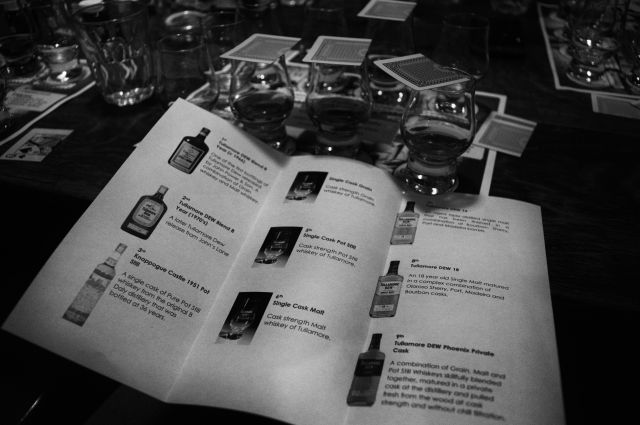
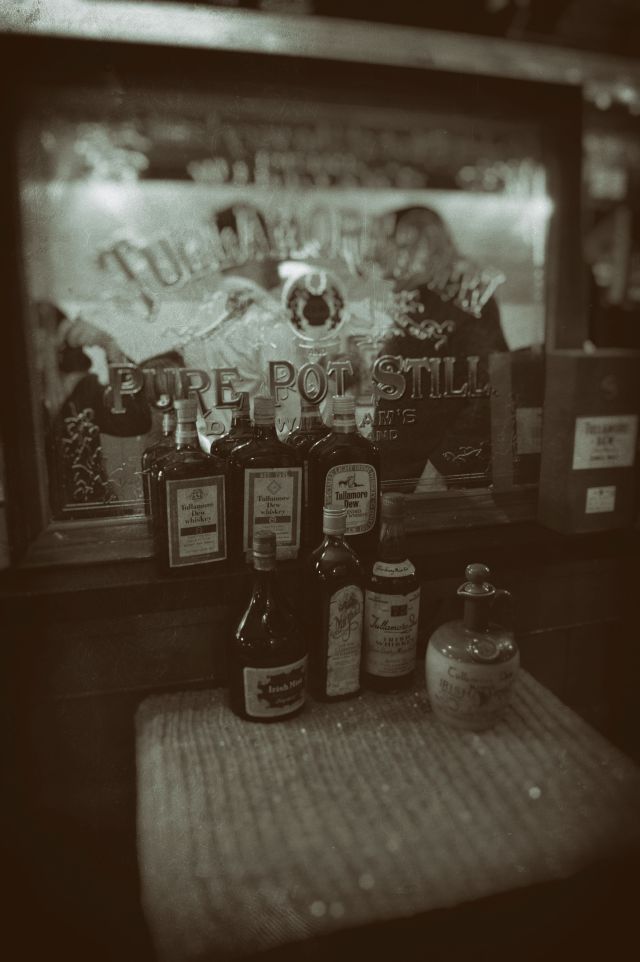
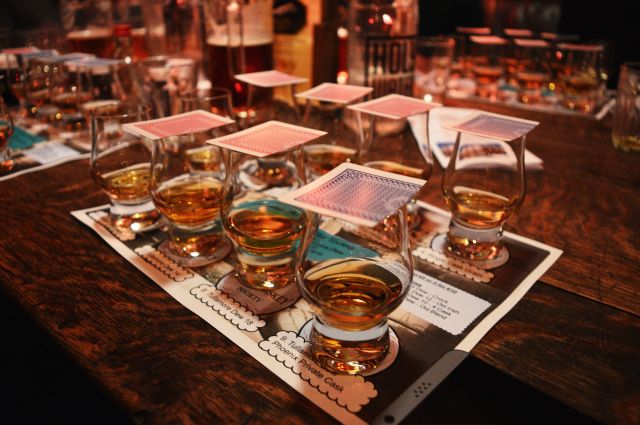
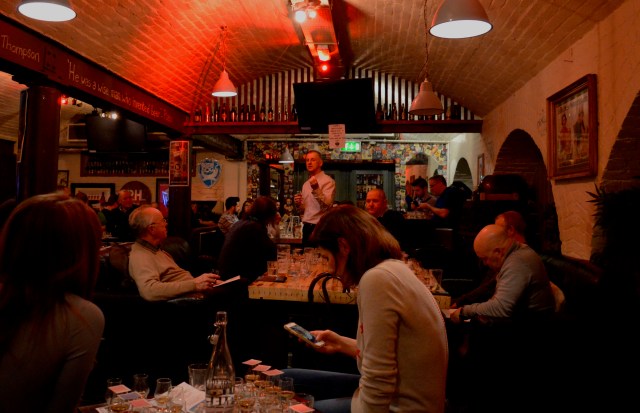
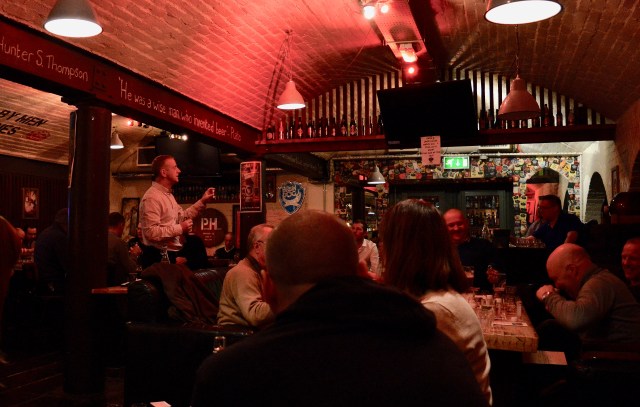
    The rebels leading this charge – Liam Murray, Eric Ryan, Ray Foley, Conor Ryan, Arney Gadegast and JP O’Riordan – hosted their inaugural event just before Christmas, and followed this up with their second tasting last Monday night in the Porterhouse – a bar that has strong links to whiskey, having been owned by the late Oliver Hughes of Dingle Distillery, and housed in the old warehouses of whiskey bonders Woodford Bourne, now part of the Mardyke entertainment complex. The host for the night was Tullamore DEW brand ambassador John Quinn, who was full of praise for the Cork society and the professionalism of their operation.

    John talked the 40+ society members and guests through some of the whiskeys on the menu for the night, going into the history of each of them and throwing in a few anecdotes and legends while he was at it.

    The Cork Whiskey Society spend a lot of time and effort (and obviously, money) sourcing rare whiskeys, and Monday night’s collection was no different – there was a 1950s Tullamore Dew blend, a 1960s Tullamore Dew blend, a selection of cask strength Tullamores (comprising of grain, pot, malt), the new 14 and 18 year old Tullamore expressions and a special treat from a private distillery cask.

    The piece de resistance was the presence of the illusive Knappogue Castle 1951, which costs between 700 and 1,000 a bottle. The other whiskeys, while released under the Tullamore DEW brand, came from Bushmills in the North and Midleton in the deep south, but Knappogue Castle 1951 is a 36-year-old pot still from the original Tullamore distillery owned by the Daly family – a whiskey not many people will ever get to try. The Knappogue Castle 1951 that the Cork Whiskey Society tasted on the night was a family cask – in other words, one of the best single casks chosen by the Andrews family, founders of the Knappogue Castle brand. This makes it even rarer – with a value of more than a thousand euro.  
    The night also featured other good fortunes, as there was a raffle of rare and collectible whiskeys, proving that as with all things Cork, independence is the way forward.

  • Dad shaming

    So the Indo asked me to write a piece on RTE’s sports reporter Des Cahill – Ireland’s most likable journalist – and his star turn on Dancing With The Stars. I don’t watch TV, nor do I have any interest in of knowledge of sport, but I do have a passion for paid work, so here we go: 

    In the late Eighties, the Voyager I spacecraft had completed its tour of our solar system and was about to leave it forever for the vast emptiness of outer space. At a distance of about 6 billion kilometers from Earth, the NASA team controlling it from Earth gave an order for it to take a photo of its home planet before it disappeared from sight. The resulting image, taken on Valentine’s Day 1990, became known as the Pale Blue Dot. It inspired Carl Sagan – one of the team who gave the order to capture the iconic image – to write a message of hope under the same title, pointing out that in the great void of space, perhaps we should all learn to get along a little bit better on this pale blue dot, the only home we have ever known.

    Our own opportunities for philosophical stargazing these days are limited by street lights, hoodies, Ireland’s cloud onesie, and that digital heroin, our phones. So thank the stars for Dancing With The Stars, and – specifically – the celestial Des Cahill. In a panorama of twinkling little twinkle-toed stars, Des is like Jupiter – a solid physical presence that makes all others seem like gaseous clouds, or possibly heavily-tanned asteroids.

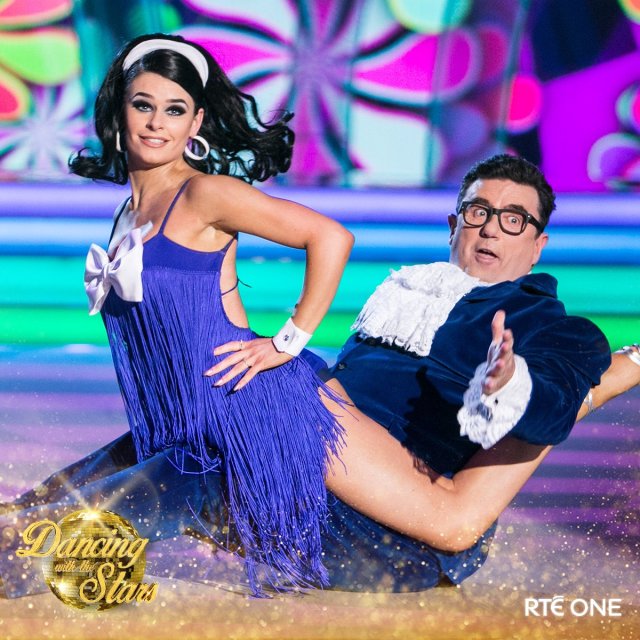
    His reassuringly physical form sweeps into our skies once a week to delight and enthrall us with his slightly elliptical and erratic orbit around Karen Byrne. Des’s performances have scientifically proved, once and for all, that the dadbod is the most desirable (and apparently aerodynamic) physique for the modern man. But this isn’t something that happens overnight – it takes decades of training.

    Being a sports journalist, Des would have been at an early advantage, having attended many GAA supper dances in his career. Like the rustic, horse-dealing half-brother of a dinner dance, the supper dance is ideal for laying the groundwork for the dadbod, featuring in its late stages a motion that may be mistaken for dancing, but more importantly, a healthy dose of fried chicken and chips served in a tinfoil box.

    If a big occasion is being celebrated such as a Junior B final being won, then some Asian fusion may be added via the addition of a large ladleful of curry sauce, most of which will end up on the ground, to ensure a rigorous movement of the legs and thorough stretching of the groin muscles. How else could Des have prepared for last Sunday’s salsa, which saw him nail The Dessie Swim – a more relaxed version of The Worm that saw him dragging his velour-clad posterior across the floor whilst being straddled by his dance partner. God be with the days when the most erotic thing on Sunday nights on RTÉ was Theresa Lowe asking a family of Leitrim sheep farmers if they knew where in the Czech Republic the town of Bendova was located.

    Apart from supper dances, a well-balanced diet is intrinsic to achieving the dadbod. Too far one way, you achieve the less-than desirable deadbod – this about giving in, not giving up completely. Too far the other and you end up plain old fit, which isn’t what you want at all. Fitness – like sports cars, designer furniture and kale – is for the young. The dadbod is more about comfort – like the mini-van, well-worn sofa, and cake. Ask yourself this; if attempting a Dirty Dancing-style overhead lift with your dance partner, which would you prefer to fall on you – a human sideboard with rock hard abs, or a loveable bean bag?

    Exercise is another key element, and it is important that this is carried out in the most low-cost way possible. The dadbod is topped off by the dadbrain, a kind of supercomputer solely designed to prevent any money ever being spent on anything.  Thus, no money will be wasted on gym membership when there is a dog literally crying out to be walked instead. Twice a week the family husky – a breed that, unlike its owner, has evolved to cover vast distances – will be taken for a brisk ten-minute stroll around the estate, with the duo returning triumphant and breathless from their Jack London-esque adventure, ready to reward themselves with a dinner of steak (trim the crispy fat for the dog, he’s earned it), mash, gravy and fried onions. If a game of fetch was enjoyed during the walk,  a slice of gateaux can be added to the menu, because you read somewhere that Michael Phelps eats 50 pancakes for breakfast and sher look at him he’s like an eel.

    As with any planetoid mass, the dadbod is all about the core. Sit-ups can be performed anywhere – while attempting to get out of a sofa, bed, low office chair, or almost any position other than a perfect vertical. Everything becomes a sort of ab crunch, complete with huffing and puffing, or possibly a whispered ‘ah jaysis’ at some point. But you push through the pain, because the dadbod is all about endurance – if it could endure Christmas with the in laws, it can endure some mild to severe lower back pain. And that’s it – the training is complete, and the dadbod is ready to take on the world, if it has time, because it still needs to varnish the back wall of the shed or the rain will get in.

    Des Cahill’s turn on DWTS has been such a success it’s hard for the viewer not to turn into Alan Partridge’s dictaphone, spitting out random ideas – Parkour with Des Cahill, Potholing with Des Cahill, Peyote with Des Cahill. And what about all the other sports commentators and their possible hidden talents – MMA with Michael Lyster, BDSM with Marty Morrissey, Hamilton the Musical with George Hamilton.

    Des Cahill’s determination to give virtually any zany outfit and goofy dance move a lash is a solid reminder of how surprising people can be, how interesting we all are, and how hidden worlds turn inside us all. We can only hope that if Voyager I ends up in an intergalactic fenderbender with some alien craft a billion light years away, when they come looking for compo (or our annihilation), they are confronted with the sight of Des, dressed as a bullfighter, flapping his cape like a man possessed, and that they pause, and think ‘ah lads we can’t blow this place up, look at yer man’ – and that they will leave us to continue our strange little lives, hopping around on this pale blue dot, the only home we have ever known.