In 1875, a Cork antiquarian named Philip T. Gardiner donated a cross to the British Museum. The item, found in a bog near Ballycotton in east Cork, was an oddity – a jewelled Celtic cross with a black glass jewel which bore an Arabic inscription which may be interpreted as ‘As God Wills’, ‘In the name of Allah’ or ‘We have repented to God’. The question was – how did a Christian cross come to have an Islamic inscription at its centre? But Ballycotton is precisely the kind of place you would find evidence of the collision of worlds – Arab and Christian, sea and land, old and new.
The village itself is a resettlement of an earlier medieval settlement that was lost to coastal erosion, one which features on maritime maps from the 14th and 16th centuries. The bay has long been deemed a safe harbour, and the village has had a long history of battles with the sea – the RNLI vessel the Mary Stanford sits proudly atop the cliff walk, having saved the lives of 122 sailors over her time at sea, most famously during the Daunt Rock lightship rescue in 1936. The village got its name in the papers for another disaster in 1995, when Hollywood legends Marlon Brando, John Hurt, Johnny Depp and Debra Winger were there to shoot Divine Rapture, a film production which collapsed two weeks into filming when it transpired the production firm behind the film had no money. The villagers a sense of humour about the experience, calling the film Divine Rupture, while Pier 26, a gastropub that sits just above the harbour, has a framed letter and cheque from the film’s producers, apologising for the whole mess. The operators of Pier 26 may well have a sense of humour about life – when work started on a dramatic building overlooking their premises, they were convinced that it was an ultra-modern hotel that would put them out of business. In fact, it was to be the home of a local-boy-done-good who would go on to lead a one-man crusade to reinvent the village he grew up in.
Pearse Flynn fished for lobsters as a boy, rising at 5am and baiting traps before heading out on the trawlers. Later he went to Midleton CBS, then on to UCC where he studied applied physics. He went on to work for tech firms like Wang and Compaq, moved to Scotland and specialised in transforming the way companies did their business, like a more benevolent, approachable Steve Jobs, and currently heads up Creditfix.
Unsurprisingly for someone who grew up at the point where a road tapers off into a pier and then into the sea, Flynn was drawn to rural outposts – his call-centre firm Connect4U set up operations in Dingle and Donegal. Flynn was also an early proponent of Last Mile Distribution System, a late Nineties concept that would see wireless broadband for television – because when you grow up in a rural community, you understand that connectivity is key to survival.
The disintegration of the partnership bidding for the roll-out of the National Broadband Plan came as a blow to those of us in rural areas. When you move to the country, you expect changes to your infrastructure – you spend more time in your car, your car spends more time in potholes, and you are suddenly looking after your own water and sewerage. But the one thing you don’t expect is how poor the broadband is going to be (if you are able to get it at all). We tried one satellite provider who promised great speeds and actually delivered lower than 1mbps. We then moved to fixed line broadband, which gave us top speeds of less than 3mbps. We had only moved three kilometres from the town, but our internet speeds had moved back in time to 1999. We could deal with the potholes, the pumps and the poop if only we could watch Netflix without it going into soft focus every few minutes, or if my son’s video games didn’t take a week to download, or if the broadband didn’t just randomly cut out every few hours, meaning that we are constantly hopping from hotspot to hotspot and network to network. We try to make it work, but it is incredibly frustrating, especially for my children who remember what having decent, reliable broadband was like before I dragged them kicking and screaming into the hills.
High-speed internet may not be seen as vital infrastructure, like clean water or electricity, but it is now central to work and home life for the majority of Irish people. Consider Pearse Flynn and how having a local success story like him has impacted the village of Ballycotton – he bought and renovated the Inn By The Harbour and Pier 26, and is linked with a proposed redevelopment of the old Protestant church on the way into the village. He believes in this quaint little village and wants it to thrive. Outliers like him may only come along once in a generation, but we certainly aren’t going to improve that frequency by denying a generation of Irish people access to decent broadband and all the professional and personal opportunities that it offers, and bridging the last great gulf in the urban-rural divide (apart from the crater-like potholes).
Long before he was the host of one of the biggest chat shows on American TV, Stephen Colbert was a thorn in the side of the American right. Having fleshed out his fire-and-brimstone TV pundit persona (whose full title was The Rev. Sir Dr. Stephen T. Mos Def Colbert) on Jon Stewart’s The Daily Show, Colbert later landed his own series, The Colbert Report, where he used his larger than life alter ego to pour satirical scorn on right-wing pundits by simply pretending to be one.
He even adapted a French pronunciation of his second name – Colberrr, with a silent T – in the style of many immigrants who sought to distance themselves from their heritage in what were deemed ‘less civilised’ nations. In reality, Colbert is an out loud and proud descendant of Irish immigrants, who came to America fleeing the Famine (although he does joke that they actually left Ireland because his great great grandfather killed someone).
As an Irish American, Colbert was perfect for the role of right wing braggart – after all, his persona was created in honour of one of the best known conservative TV stars, fellow Irish American Bill O’Reilly. O’Reilly’s braggadocio and arch-conservatism was an easy target for Colbert’s comedy, with Colbert cast as the playful Loki to O’Reilly’s permanently angry, po-faced Thor. But times change – Colbert’s comedy caught the eye of TV bigwigs, and he was offered the role as host of one of American TV’s biggest draws, The Late Show. O’Reilly’s career changed too, albeit for slightly different reasons.
In April 2017 the New York Times ran a series of articles detailing how Fox News, O’Reilly’s employer, had settled five multi-million dollar sexual harassment lawsuits against their brightest star. Within a week, his primetime show The O’Reilly Factor had lost half its advertisers. Within a month, O’Reilly was fired, a remarkable fall from grace, but an inevitable one given the grand reckoning that was taking place due to the #MeToo movement (head of Fox News Roger Ailes also departed the station after revelations about his treatment of the network’s staff).
O’Reilly was undeterred and opted to continue broadcasting, this time not on a syndicated news network, but on a podcast. This meant he had more time to travel and see the world, so naturally he opted to visit the Old Country. When he tweeted last week that he was in Cavan learning about his ancestors, it was met with mixed emotions – on one hand, it was nice to see him broadening his horizons, but on the other it would appear that he had a lot to learn about Ireland, American history, and basic immigration law. His tweet stated that his ancestors went to America legally, even though the journey took place at a time when America had open borders, and that, because of his impoverished Irish background, he could never be accused of white privilege. Who would ever think of accusing him of that – he, who used his wealth and power to sexually harass women in the workplace, who used his platform to rail against everyone he deemed a threat to his vision of America – ie, anyone who wasn’t white, Christian and heterosexual?
O’Reilly’s tone-deaf, antagonistic tweet showed that he was no more Irish than his comedic counterpoint Colbert – despite O’Reilly telling his biographer “I’m one hundred percent Irish, which is very unusual, you know, for an American this day and age. My bloodline is all Celtic, which is frightening. I mean, you know, I have all of those Irish tendencies, the blarney, which has really served me well, I must say.” Ah yes, the blarney, of which no Irish person ever speaks. That blarney angle is used to explain the presence of a number of Irish Americans in public life – TV pundits like Sean Hannity and Pat Buchanan, politicians like Paul Ryan, even poor old Sean ‘Spicey’ Spicer are all proud of their Irish heritage, even if we aren’t.
All seem to have the notion that their ancestors were not immigrants in the modern sense – their ancestors were a ‘better’ kind of immigrant, who came to work and help build America, rather than the ‘modern’ variety, ie, immigrants who are not white. But even here in an increasingly liberal, compassionate Ireland we are guilty of perpetuating the same myths – we cling to the term ‘undocumented Irish’, a semantic rebrand of our illegal immigrants living in America. The term suggests that our immigrants are different, they are better, they are following the centuries old transatlantic route to greatness, manifest destiny and the American dream.
But one thing you can say for Irish American pundits is that there are plenty of them from all political spectra – for every Hannity there is a Jimmy Fallon, every Buchanan has a Bill Maher, and every O’Reilly has a Colbert, who through a skin-crawling awkward interview with Cillian Murphy (Colbert made leprechaun references) and Pierce Brosnan (Colbert asked him what it is like to be a British icon), shows that on right or left, ‘100% Irish American’ will never mean 100% Irish. After all, we Irish are far softer on borders than the Americans – the Welcome To Cavan sign Bill O’Reilly was photographed next to seemed to mistakenly believe that the landlocked Lake County was somehow part of Ireland’s Ancient East.
So you’ve decided to create a supervillain. Every good story needs one – they make the good guys look great, and reassure us that there are such things as moral absolutes. First you will need a complex childhood, with an early parental divorce, a fragmented relationship with a father, and a nightmare school experience where your future evil genius will be beaten to a pulp and thrown down flights of stairs. Undeterred, they will excel at their studies, going on to university before dropping out and forging their own path as an entrepreneur. They will make a lot of money while still young, and draw the sort of adoration we only reserve for the insanely wealthy, even though behind the scenes their personal lives will be difficult, with costly, public divorces. They will live their lives with flair and panache, and be the envy of us all. Then to finish, give them a curious Transatlantic accent, say, American crossed with South African, and a strange name – think Max Zorin from Live and Let Die, or Hank Scorpio, the benevolent megalomaniac from The Simpsons. Something like Elon Musk. Except obviously that name is taken, and its owner is far from a supervillain, despite how we like to skew his narrative.
Musk ticks all the boxes of a Bond villain – tall, good-looking, brilliant, immensely wealthy, and his childhood is the one described above. However, Musk is really more of a sci-fi superhero, as he takes the philosophies of Isaac Asimov’s Foundations series – that technology should make the world a better place – as his guide and has dedicated himself to helping others. No ivory tower or underground lair for Elon, he seems happy enough to engage in the bants with his fellow humans over the internet, and this is where SuperMusk starts to look a little less wonderful. When he engineered a mini submarine to help get the trapped kids out of the cave in Thailand, he was less than impressed after one of the lead divers said it was unworkable and a PR stunt. Musk reacted by calling the man a paedophile in a tweet that he has since deleted. Virgin mogul Richard Branson would never do something like that, we thought to ourselves. No, Branson would probably be too busy mounting another legal case against the NHS, as he did last year over Virgin Care losing out on a contract. In fact, it seems almost impossible to find a super wealthy individual who doesn’t occasionally act like a super-villain (the exception is, obviously, Bill Gates, the Ned Flanders of tech billionaires).
So Musk is brilliant, and, like a lot of brilliant people, he is a little odd. This is part of what makes him so interesting, and such a reassurance to ordinary people like me that maybe we are better off being a little bit thick, as, despite his riches and his brilliance, he rarely seems at peace. Musk is fighting a war on another front over revelations that he donated to both Republican and Democrat PACs in order to gain access to the corridors of power and press the case for action on climate change. He may be short-tempered, but he can’t be criticised as being short sighted, as climate change is one of the key motivators of much that he does. Musk understands that sometimes you have to cosy up to power to affect change.
Of course, some cosy up to power just to make a dime, and before President Donald Trump was coupling with Russian President Vladimir Putin in Helsinki, Conor McGregor, Ireland’s ambassador to the united states of unconsciousness, was meeting Putin at the World Cup in Russia. How could he do such a thing, we screeched. Easily, is the answer: McGregor is a businessman, and he has a product to sell. McGregor has a whiskey coming out titled Proper No. Twelve, in honour of where it all began for him, Dublin 12. Although the whiskey is a while off being seen on shelves, a video on McGregor’s lifestyle brand Instagram page, Mac Life Official, shows him meeting Putin and telling him he has a bottle of his own whiskey to give him. Then, on McGregor’s own Instagram he posted a photo of himself with his arm around Putin, and called him ‘one of the greatest leaders of our time’. But McGregor isn’t just a fan of Vlad’s leadership or Judo expertise – he knows that Putin is President of Russia, a nation that was the fastest growing market for Irish whiskey last year, according to International Wine and Spirits Research (IWSR), with a jump of almost 20% in sales on the previous year. So heaping accolades on him probably has more to do with economics than on any moral judgement and that, to quote Bond supervillain Max Zorin, intuitive improvisation is the true secret of genius.
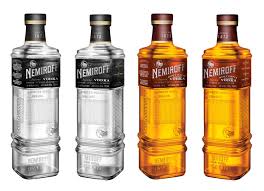
Fellow gentlemen drinkers – do you yearn for a more manly drink? Do you lament the erosion of the bar/lounge divide, or women being allowed to drink pints? Are you confused by the modern bar scene, with its unisex toilets, non-binary mixologists and alluring flamboyance of cocktail culture? Well, good news from the east, where one vodka firm has decided to take their product from the category of ‘the tasteless stuff ordered by people who don’t know what to drink’ and place it firmly in the BroZone. Marking their 25th – and hopefully final – year, Ukrainian vodka producers Nemiroff have gone all in and placed all their chips on the masculinist square with a vodka aimed solely at men.
Yuriy Sorochinskiy, CEO of Nemiroff, said: “Throughout the centuries we fought for the right of men to consume high-quality vodka – brave as their spirit and strong as their will. We stay loyal to our traditions despite all the obstacles that have been placed in our path.” Obstacles like suffrage, presumably.
The relaunch of this particular vodka has seen them redesign the packaging into a manly, angular square bottle, rather than a clearly womanly, round bottle shape preferred by everyone in the world – except Johnny Walker. In fact, Johnny Walker would do well to take note of Nemiroff’s bold rejection of a century of progress, as their own struggles back in March showed. To mark Women’s History Month, the iconic Scotch brand replaced the figure of Johnnie Walker with a woman, and renamed the limited edition bottle Jane Walker. ‘What a terrific idea’, somebody in Diageo thought to themselves as they signed off on it. Sadly, in an unsurprising turn of events, almost nobody agreed, and once again it, much like Nemiroff CEO’s statement, it was a statement from senior management that really punched in the launch codes.
“Scotch as a category is seen as intimidating by women. It’s an exciting opportunity to invite women into the brand,” Stephanie Jacoby, vice president of Johnnie Walker told Bloomberg. If there’s one thing the ladies love, it’s being told that they are intimidated by an inert liquid. Roughly two seconds after this statement, the fair and gentle sex unleashed hell on the brand, and all Diageo’s good intentions from the limited edition – donations to various organisations championing women’s causes and, obviously, brand promotion – were lost in a mighty cacophony of people of all genders wondering what Diageo were thinking.
Won’t somebody think of the female cyclists? That was the cry from beloved political buffoon Boris Johnson this week as he stepped down from his role of pretending to get on with Theresa May to spend more time in his main role as the Kaiser Soze of Brexit. Johnson is a remarkable character, who has managed to hide his ruthlessness and cunning behind by creating a Bertie Wooster-esque persona, in much the same way John Wayne Gacy used to dress up as Pogo The Clown to entertain kids, when behind the scenes he was killing 33 people and dumping their bodies in the crawl space under his house. BoJo has mumbled and bumbled through his career, quietly leaving a trail of dead in his wake, former friends, enemies and frienemies, all left with naught for their tussles with BoJo, save for a coating of white blonde hairs, as though they were mauled by a rabid-yet-loveable Golden Retriever.
Johnson’s resignation letter is a tour de force in passive aggression and poorly disguised attacks on May, but one of the most jarring lines was about the threat to cyclists – and, very specifically, female cyclists – from what Boris calls ‘juggernauts’. Female Cyclists Vs Juggernauts sounds like a really poor Japanese monster movie, or perhaps an electro-punk band you’d catch at an all-day charity gig in Whelan’s, but Johnson’s inclusion of this line in his letter shows just how caring he is, thinking of all the lady cyclists riding sidesaddle on their crossbar-less bikes, trying to hold on to their bonnets with one hand as ‘juggernauts’ whip by them. Normal people call them lorries Boris, or if you are speaking to those with notions, HGVs.
A cyclist himself, Johnson previously brought his concerns about HGVs and the visibility of cyclists to the EU, and four years ago the EU ruled that it would change the shape of HGV windows to make it easier for drivers to see cyclists. The new, safer lorries hit the roads from next year, proving that the system works. Sadly, by that time Britain will be looking at the EU in their rear view window as the Brexit juggernaut rumbles over the white cliffs of Dover, and BoJo celebrates escalating trade wars and rising prices with an angular bottle of manly Ukrainian vodka.
Indo col 62 in which I engage in further pre-apocalypse musing.
If this recent spell of incredible weather has taught us anything, it is that there’s nothing wrong with a little rain. Two weeks of blistering heat was all that was needed to turn our forty shades of green into many shades of yellow, umber and brown. The upside is that you don’t have to mow your lawn, now that it looks like it has been napalmed, but the downside is that crops aren’t doing so well. Over the past eight months we have had the worst storm in decades in Ophelia, the worst snow in decades in The Beast From The East, and now this blisteringly hot weather for which we are meant to be thankful, rather than concerned.
After the first few days out at the beach, and after you’ve spent half your food budget on factor 50, which you have slathered on so thick that your family looks like a Kabuki theatre troupe, the sun gets pretty irritating. Even at night we have fans running, windows open, and a swarm of associated bugs coming in and bothering us in our fretful, fevered sleep. And now, on top of everything, there is going to be a hosepipe ban, which will plunge the heatwave-plagued suburbs into a Cold War; neighbours spying on neighbours from behind lace curtains, old scores over garden boundaries being settled by calling in the water police, senior citizens being dragged away in black vans for using an illicit watering can to try and hydrate their hydrangeas – in this bleak dystopia, water is the supreme commodity. How long then, until we see water dealers popping up on street corners, selling bottles of Evian out of a gearbag at 50 euro a pop? How long until they start stepping on the product by cutting it with water from the Grand Canal? When you ask them what all the green stuff is in the bottle, they just shrug and tell you it’s ‘vitamins’, when it’s actually pond scum. How long until Ireland becomes a bit like Mad Max if it was set in a disused waterpark? A while, probably. But we could still do with some rain, sooner rather than later.
The sun has brought out some strange creatures – bright red, bloated, waddling around on the sand on their shapely cankles. I speak of course of the humble sea toad, a species not native to our waters, but who obviously heard about the looming water shortage and thought he would come closer to shore to laugh at us from his watery home. Well the joke’s on him, as he ended up being caught off the Kerry coast by the Cú Na Mara trawler on the Porcupine Bank, a place that one would expect to find porcupine fish, but sadly no, just the comedic blob that is the sea toad.
The sea toad is something of a celebrity, having appeared in Blue Planet II due to the odd fact that it has legs that it uses to crawl along the seabed. Obviously after his 15 minutes of watery fame he now thinks he is able to saunter into Irish waters and possibly even onto land, where he would blend in with various other bright red globulous lifeforms swarming our beaches for the last week. Soon he would be stealing Fungi’s job as Ireland’s ambassador to the oceans, strutting around Dingle demanding free pints (I hear he he drinks like a fish), then he runs in the local elections, and as long as he fixes a few roads using Atlantean sub-contractors, he would be right in. I say this madness must stop now, and we need to build a sea wall around Irish waters, burn effigies of Toadfish Rebecchi from Neighbours along the coast, and send the message that if we can’t eat you with a side of new potatoes, then you are not welcome in our waters, no matter the weather.
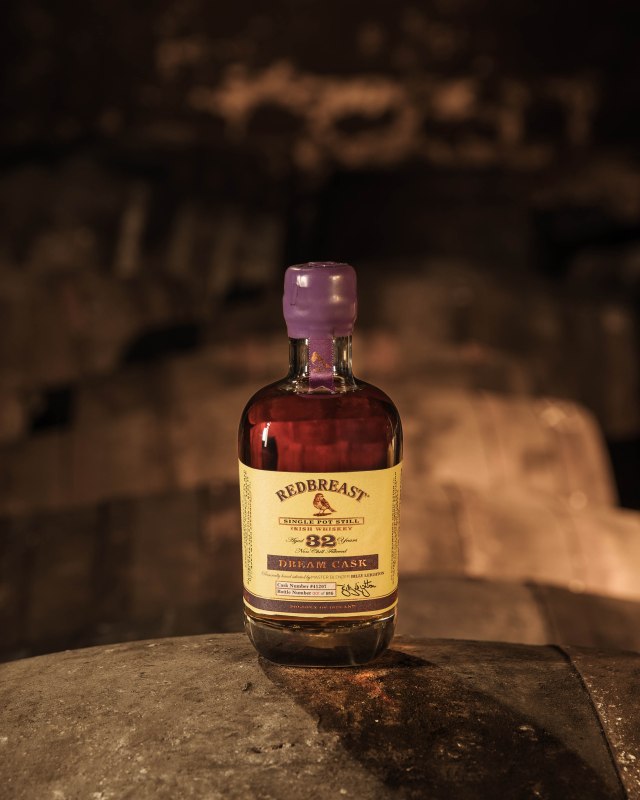
32-year-old Redbreast Dream Cask, with the land that produced it in the background. Up Cork.
Between 1924 and 1932, a series of studies were carried out in Hawthorne Works, a Western Electric factory outside Chicago. The aim was to test if workers were more productive in brighter or dimmer lighting. Over the course of the study, a pattern emerged. When the lights were raised, the workers were more productive than they were previously. The lights dimmed, and the workers were also more productive than they were previously. In fact, the only time the work rate slumped back to its average was when the workers were not being studied. Soon it became apparent that the light levels had little to do with the results, and what was motivating the workers was the fact that they were the subjects of a study. This became known as The Hawthorne Effect, or the observer effect – whereby the act of study changes elements of what is being studied.
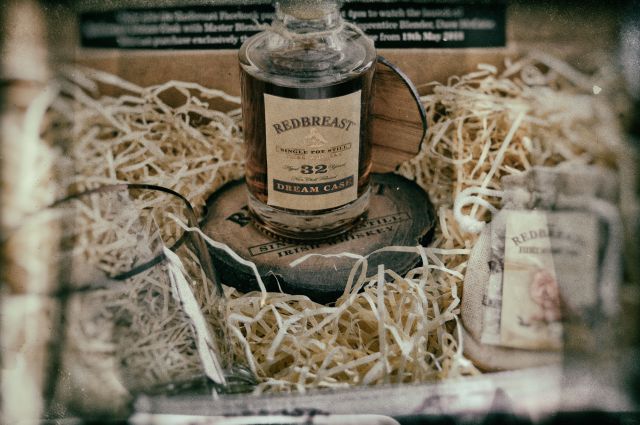
I find it hard to understand how the more productive bloggers manage to rattle out reviews at the pace they do, or how they maintain their enthusiasm. Images of bloggers’ sample hordes just make me sad – dozens or hundreds of miniature bottles just sitting there undrunk, because once your blog starts getting traffic, you will never keep up with the influx. Obviously, I am mercifully unburdened of traffic, so mine is an open road, bar the odd sample from the neighbours at IDL, such as this:
There are two schools of thought on tasting notes – one, you taste a whiskey, and then you tell people what it tasted like in the plainest possible terms. Or two, you use the opportunity to get creative. I quite like the latter – I love the SMSW tasting notes as they are generally batshit – wild, freewheeling notes that pull you into times and places you will never be, sensations you will never have. I love the more esoteric notes, which go beyond simple descriptives and instead operate more like poetry, giving you an oblong view of the whiskey, a code to be broken, a riddle to be solved. Because while I would always say in public that, hey, it’s just a drink, in my head I always know that it’s more.
A whiskey is about time, place and memory – it’s great if you think it tastes like custard, but I’d be more engaged if you told me it reminds you of the desserts of stewed apple and rubbery custard your nan gave you, because it evokes memories unique to you. It’s that little reveal that I like, clearly because I am a nosey shit, but also because, while there may be some objective tasting notes that the majority of people could agree on, it’s the uniqueness of an individual’s notes that are most interesting. So fuck objectivity.
Blair Bowman was a student at Aberdeen University when he happened to be in Barcelona for World Gin Day. As a whisky lover – Bowman was the founder of the Aberdeen University Malt Whisky Society – he decided to find out when World Whisky Day was. There wasn’t one, so he decided there should be. Fast forward three years and Bowman sells the World Whisky Day concept for an alleged six-figure sum. He is still involved, and it goes from strength to strength, with Irish whiskey makers getting over the spelling of it to join in the (promotional) fun.
To mark World Whisky Day 2018, IDL released a 32 year old Redbreast in a 50cl, €500 bottling. All 816 bottles sold out in hours. It seemed fast – even though there 2,000 of the Mano A Lamh bottles back in 2015, the customer quotas of two per buyer meant that despite being an incredibly reasonable €65, it didn’t sell out for weeks. But Mano wasn’t that old, nor exclusive, nor did it come at a time when the Irish economy is picking up almost at the same speed as the global interest in Irish whiskey. But still – the Dream Cask sold out in hours. It wasn’t long before it became clear why.
Whiskey is many things – delightful beverage, social lubricant, chrism of the soul – but it also happens to be a relatively solid investment. The Dream Cask was an old whiskey, with an age statement, in a uniquely Irish style (single pot still), that was limited to less than 1,000 bottles. The flippers – those who buy bottles purely to sell again at a profit – were always going to swarm around an item like this. However, what must have sent them into a feeding frenzy was the realisation that, thanks to a glitch in the IDL website, customer quotas were not applied. The results were spectacular:
I got sent this earlier. 17 bottles of Redbreast Dream Cask. All perfect condition. The owner hopes to get €20000 for them. pic.twitter.com/UB6lBpcWgJ
— ℙ𝕠𝕥 𝕊𝕥𝕚𝕝𝕝 𝕎𝕚𝕝𝕝 🥃+🍺 (@PotStillWhiskey) June 21, 2018
Now, this isn’t to suggest that all 800 bottles were sold in lots of 17 to flippers; after all, how many people would have had eight and a half grand laying about? But if you were one of those who had €500 or a grand to buy one or two, and discovered they sold out, partly thanks to some folks buying dozens, then you would be pretty unamused. Also, while harcore whiskey nerds might do bottle shares or sell you one for cost, the flippers are simply going to flip. And, as John Egan pointed out, having so many bottles in the hands of the flippers skews the value – they will be in it for a decent price, not to simply hook another whiskey pal up. They are like ticket touts, forcing the ordinary fan to fork out above normal prices for access to an exclusive event – the tasting of a very old Redbreast whiskey.
So was the Dream Cask worth €500 for 50cl? Before I get to that, here are some of the finer points:
Billy Leighton at work, but what the fuck is going on in the bottom left of this pic?
Redbreast Dream Cask is a limited edition, 32 Year Old single pot still Irish whiskey – a single cask that was hand-selected last year by Master Blender, Billy Leighton, as his favourite Redbreast whiskey. The cask was chosen for having the perfect balance of pot still, Spanish oak and sherry flavours, which can usually only be achieved through blending – bringing to life Redbreast’s signature sherry style.
The whiskey was originally unveiled during a Facebook LIVE tasting to mark Redbreast’s World Whisky Day 2017 celebrations. Participants and viewers praised the quality and rarity of what is now the oldest Redbreast Irish whiskey ever to go on sale, with many requesting that the whiskey be made available to buy.
Redbreast Master Blender, Billy Leighton, commented: “In almost 40 years as a blender, Redbreast Dream Cask is a real highlight as I am able to select my own, personal dream Irish whiskey and share it with the world. Our inaugural tasting in 2017 was by far the largest whiskey tasting I have ever held, and the feedback we have received from the whiskey community on the liquid has been phenomenal, so it’s an honour to see it bottled to mark World Whisky Day 2018 – and watch this space for our 2019 plans.”
The Redbreast Dream Cask represents the perfect contribution of flavours through a careful maturation journey rounded out by a particularly sublime sherry butt. The original date of bonding goes back to 31st October 1985, with single pot still Irish whiskey filled into re-fill American Oak ex-Bourbon barrels. Then, on 8th March 2011, the whiskey was re-casked into a first-fill Oloroso Sherry-seasoned butt. The resulting whiskey is luxuriously smooth with wood resin notes reminiscent of well-polished antique furniture, lots of ripe fresh fruit flavours and an extremely balanced finish that slowly fades.
Redbreast Dream Cask is bottled without the use of chill-filtration at 46.5% ABV and is available in very limited quantities through Redbreast’s online private members’ club, The Birdhouse, for €500 per 50cl bottle.
Back to my musings:
Nose: The old classic quote about Redbreast returns – this is Christmas cake in a glass, but with Christmas pudding, brandy butter and some sherry trifle in there for good measure. Absolute decadence. I’ve had some heavily sherried whiskeys recently that just over-egged that cake – too sweet, too paxarette-esque – but this is just that rich, balanced sherry note that you want in a whiskey, where it never obliterates the fact that this is whiskey, not an actual sherry. Honeycomb, cappuccino, a little roasted tomato and Ballymaloe relish, that slightly tart acidity tingling the sinus. It’s the power of the scent here – not overpowering, just deep. This is what I wanted from the Bow Street Jameson 18 and the 2018 Midleton Very Rare – a nose that was a prelude to something.
Palate: All those stewed fruits from that festive dessert trolley, jam sponge, sherry, glacé cherries. Christmas pudding scorched with burning whiskey. There is a dryness here that I wasn’t expecting – but that tartness on the nose gives way to a tongue-smacking, mouth-coating, oily liquid. This whiskey reminds me of the cask we opened when I did the Irish Whiskey Academy back in 2014 – at the time I remember it was so good my ears popped. Just that wallop of flavours, and you find yourself smacking your lips for some time after. Spices, tobacco – the usual suspect, and more.
Finish: On and on and on – a mouthful of slowly dissolving hopjes, ripe banana, figs, the tail end of a Fisherman’s Friend, Lyons’s Black Treacle, peanut brittle. By now you have probably guessed that I have a sweet tooth, but there is a lot more in this whiskey – the TCP mouthwash dryness and the tart, bitter fruits built into the back end mean this is more than a shortcut to sensory diabetes. I could easily match this with some pitch dark chocolate or some patient zero level blue cheese – it operates on multiple levels.
Overall: So was it worth €500? If you bought one, then yes it was. But if you didn’t get one, and tried to, your yearning for it is probably more to do with the human condition than the actual liquid. We always want what we can’t have, and that longing gets worse the more elusive the item becomes. That said, I am one of the assholes who bought four Mano A Lamhs.
If you didn’t get a bottle of the Dream Cask, and are disgusted with how it played out, it’s worth pointing out that it is highly likely that World Whisky Day 2019 will probably see another release very much like this. This event was a first for IDL, so I’d give them a pass on the customer quota SNAFU and also on the poor packaging, as some purchasers found their tumblers smashed when they opened the box (replacements were sent). At least we can console ourselves with the mental image of the flippers opening box after box, filled with broken glass, slicing their greedy little hands open.
The Dream Cask is an incredible whiskey, but €500 for 50ml, not at cask strength, is a lot. Maybe you earn €60k+ and have no kids. Then for you it is well worth it. Even if you earn less than that and this is a real luxurious treat for yourself, then go on, spoil yourself, you’re worth it. But for me, almost no whiskey is worth more than €200. I know there are conditions that affect price, like rarity and demand, but as I said before, it is still just a drink (and also so much more).
Whiskey is about moments – I drank this sitting at a computer in my kitchen. If I had been at a whiskey festival, sharing it with friends, I would probably feel it was well worth the money. But this is part of the observer effect – I am studying this whiskey, rather than just enjoying it for what it is, and that changes the results. But I’m privileged to have tried it, especially in a generous 10cl sample, that came with a tumbler, pen, lapel pin, and coaster. If I had any sense I would have kept it closed and stuck the lot on eBay for €200. Je ne regrette rien.
It has been a tough week for us nerds, thanks to those backstabbers at the World Health Organisation. We always felt safe in the knowledge that, as the WHO are a body made up of scientists, that they were geeks like us. So, you would assume that if they were going to start labelling various fun pastimes as addictions, they would stick it to the jocks by coming up with ‘sports addiction’. It makes sense: Who hasn’t been at an underage football game and seen some absolute headbager on the sidelines screaming death threats at the referee, or who doesn’t know someone who has used up all their annual leave to watch every second of the World Cup. But no, apparently sports addiction is not a thing. Instead, the WHO went after eSports instead, by taking aim at that most defenseless of targets – gamers.
With their pasty flesh, atrophied muscles, headset indentation on their skull and general inability to function in the real world, the hardcore gamer is largely nocturnal creature. Lurking about the house after everyone has gone to bed, subsisting on a diet of corn snacks and Monster energy drinks, they spend almost all of their lives in what they call the BattleForce Nerve Centre, AKA their bedroom. They don’t know how to talk about important real world events – like how this heatwave is actually quite unpleasant, or how Nadine Coyle says the word ‘flour’ – but prefer to scream death threats and satanic incantations into a microphone at a 13 year old in Brazil. The serious gamer was already a tragic creature, and now, thanks to the WHO, they are an addict too. How pathetic. Except obviously, this isn’t what gamers are like at all, as it is instead a lazy, ignorant stereotype. The age when we could claim the gamer as some socially maladjusted weirdo is long gone, as Anna Malmhake shows.
Malmhake has had a glittering career. Working with world-conquering brands like Coca Cola and Absolut, the Swede also spent five years as CEO of Irish Distillers Limited from 2011 to 2016 as the firm – and the Irish whiskey category which it dominated – shifted into hyperspeed, before returning to Absolut as CEO. Malmhake also happens to be a devout gamer. In a post on her LinkedIn in 2016 she detailed her love of video games and how they influenced her work life, specifically the lessons she learned from gaming – teamwork from WoW, conquering fear from Destiny, and forward planning from Civilisation.
In her final lesson from gaming, she delivers this message: “Lesson from any game where people can work out that you are a woman and there is a competitive element: the men who don’t like seeing women around are in 100% of the cases the underperformers. When playing online games, I early on realised there is a tiny but vocal group of guys out there, who can be incredibly intense in their negativity towards female players. After a while, I started realising a pattern – none of these guys were good players. On the ranking lists, they would be below average…And you know what? In the world of business, I find the same pattern to be true.”
For every scare story about children playing Fortnite for seven hours a day, there are many, many stories of brilliant, successful people who play video games for hours a day and still excel professionally and personally. The WHO’s declaration of a ‘gaming disorder’ begs the question – is there anything that we can’t we be addicted to? Their list of symptoms is like a template for any kind of obsessive behaviour – impaired control over gaming (frequency, intensity, duration), increased priority given to gaming, continuation or escalation of gaming despite negative consequences. You can take those three examples and stick almost anything in instead of gaming – food, sex, the GAA, exercise, hopscotch, books, painting, being alone, being with others, religion, saving, spending. Where do passion and enthusiasm end and obsession begin?
It would appear that the WHO is reacting to some genuine concerns and a lot of parental hysteria over what are becoming relatively normal activities for children – firing up a console and losing yourself in a digital wonderland. As long as children have some balance to their pastimes – a balance that it is up to their parents to help them achieve – video games pose no greater threat to their minds than repeatedly reading Lord Of The Rings did to mine. That said, there is the cautionary tale of British comedian Tim Vine, who read the Lord Of The Rings so much that he ended up mumbling about orcs and trolls all night. Apparently he was Tolkien in his sleep.
John Banville famously once said that writers make bad fathers. Clearly, I am no John Banville, but I can see where he was coming from. I was a bad father long before I became a bad writer, but my creative process involves me disappearing inside my own head. I become introverted, distracted and short-tempered – a fact brought home to me when my three year old sat up at my computer one day and shouted ‘for god’s sake I’m trying to work’ at the point on the floor where he would normally be standing. I didn’t know whether to laugh or cry.
My introversion when writing probably explains why this column has often seen me go far beyond navel gazing and actually commit a kind of emotional harakiri, spilling my guts onto the page. An old friend pointed out that I had mined myself so deeply that it was probably only a matter of time until I wrote a detailed account of my next colonoscopy. Oh, how we laughed.
I was quite late in life discovering that I had a significant family history of bowel cancer on my biological father’s side of the family. It was quite the revelation, given that I had ironically managed to place myself right in the line of fire thanks to my poor life choices – stress, smoking, alcohol abuse, and dietary choices that were almost exclusively based on their function as soakage. As I near the age my biological father was when he died, I decided to get myself checked out. It was just another sad irony that they date the hospital gave me was the day after Father’s Day, meaning that on a day when I should have been eating a large fry, quaffing imperial stout and kicking back for a Star Wars marathon, I was imbibing litres of moviprep and scuttling around the house like the bad guy in a romcom who had eyedrops put in his soup.
The preparations for getting a colonoscopy are fairly basic – a good old fashioned spring clean of your gut, and a dressing gown for the hospital. My wife pointed out that there was no way I would be wearing my tatty, Big Lebowski style dressing gown. Surely I would be ashamed to be seen in such a garment? I pointed out that as I was basically going to have the crew from Primetime Investigates crawling up my backside with full lights and camera, shame was a remote concept. So it was on Monday morning that I found myself curled into the fetal position, wondering why the sedatives hadn’t knocked me out, as I stared at a monitor showing a fairly in-depth tour of my lower intestine. After about ten minutes I was done, wheeled back out to my bay to lapse into a mildly traumatised slumber. I woke up later, had my first food in 36 hours (‘the best tea and toast in Cork’ is how the nurse accurately described it), before getting a belated Father’s Day gift – a nurse telling me to break wind as much as I possibly could. Finally, I had found a judgement-free zone where men can just be men.
After my 21-gun salute to manliness, I got dressed and had a chat with the doctor. It was at this point I realised how scared I had been. In fact, I had spent more than a year convincing myself that there was something wrong, that I was sick. It was constantly there in my subconscious, anxious whispers that I was going to die young, that this was my inescapable fate. Apparently, I was wrong. So why did it take me so many years to just get a health check? Why was I so scared to say that I was worried? Why are men, in general, so bad at talking about our mental and physical well-being? Last week was Men’s Health Week – the fact that we need a week to encourage men to talk about basic health issues show that masculinity needs a reformation. It’s not just about being able to discuss having a camera shoved where the sun don’t shine, but about our fears, our stress, our worries. But through all of my worrying, in the back of my mind was one thought – if I die young, how will my kids remember me? As the angry guy, sitting at the computer, shouting at them every time they need attention? Perhaps I should follow David Simon’s stinging riposte to Banville’s comments on parenthood and writing – family is family, the job is the job – and accept that being a half-decent parent and a half-decent writer are not mutually exclusive. After all, it would appear I have plenty time left on earth to work on getting better at both.
Friends, come with me now as I chart a course directly into the all-consuming cultural maelstrom that is Love Island. It shames me to admit that up to this series, I had never seen a single sleazy second of it, but this year I couldn’t avoid it. A co-worker who spends much of his time rhapsodising Ken Burns documentaries declared it to be the best TV he had seen in years. And so it was that I sat down with a cynical sneer across my face, ready to archly tell anyone listening of how the tricoteuse of the French Revolution knitted while heads rolled down from the guillotines. This is the death of the intellect, I mused, as I attempted to navigate the uncharted, shallower channels of my Sky box. ‘Here be ITVs’ I chuckled to myself. Except, of course, I was soon high on Love Island’s heady mix of social awkwardness, emotional frailty, and a cast that looks like it was designed by Mattel. They have Barbies, they have Ken dolls, and they had Kendall, who looked like a Bratz doll and cried like a Tiny Tears, and thus was marched off the show for bringing everyone down.
Love Island is like a soap opera set in an Irish college – people with varying degrees of competence at their own native tongue attempt to get the shift, with mixed results. It’s ‘I’m A Celebrity’, only instead of eating kangaroo anus, they are eating each other’s faces, and it is almost as horrifying. High points so far include the reveal that Alex – who looks too perfect to be human – is actually 22, despite looking thirtysomething. It would appear that he has been cursed by the gods with incredible beauty and the lifespan of a mayfly. And who can forget supremely woke Eeyore (not his real name) whose then-soulmate forgot his name and said the sound of his breathing made her sick. His reaction upon being told this caused his zen facade to fall asunder and he became most unchill. What a show.
Love Island is every sad and joyous thing about humans distilled down to a few godlike bodies clad only in tiny swimwear and the bang of want. But like all reality shows, the best part of it is the schadenfreude. It is a show that makes me glad to be old, doughy and married, and thus ineligible for residency on Love Island, or any landmass associated with love, be it peninsula, promontory or landfill.
As with all reality programmes, pundits are queueing up to tell you that Love Island is a symptom of our cultural decline, as though up until Endemol vomited the first season of Big Brother onto our screens we all sat around reading Ulysses and listening to Rachmaninoff. Love Island is as intellectually stimulating as you make it – you can watch it for swimwear tips, to ponder on the human condition, to laugh at the contestants or with them, or to just kill an hour in the evening after a long day of worrying about your deteriorating finances and health. Sure it’s bubblegum TV, but as the doomsday clock ticks closer to midnight, it’s nice to have something to wash away the bitter taste of fear.
Of course much of that fear is now obviously unfounded, as this week the real Love Island was Singapore, where the will-they won’t-they Mexican nuke-off between Trump and Un came to a bromantic conclusion. One is a deranged egomaniac who controls the media and propagates lies with every breath, the other is a North Korean, what on earth could they have in common, apart from crazy hair, crazy ideas and a penchant for bizarre pet names for each other – dotard and little rocket man being two. Hey you two, get a room – perhaps in the five star Trump Hotel Pyongyang that is no doubt looming in our future.
Speaking of the end of life on Earth, it appears Mars is back on the agenda as a potential home for us. NASA’s rover Curiosity has discovered organic compounds, an indication that there may once have been life on Mars. However, the compounds aren’t the only news from the red planet – Curiosity has also recorded seasonal methane patterns, in much the same way we see seasonal methane spikes the day after Paddy’s Day. Mars does seem to be our best chance of starting over once we are done murdering this planet, but we might want to bring a jacket – another NASA rover, the Opportunity, is currently facing an end to its 14-year trek across the planet as it has been engulfed in a dust storm. We hear ‘dust storm’ and think of Saharan winds dumping red dust on your car. Dust storms on Mars are slightly different – this one covers an area 18 million square kilometres and is so dense that it has blocked out the sun, bad news for the solar powered Opportunity. But it’s still be best shot we have at a new home, so here’s to the cast of Love Island 2525 coming live from Mars, where a gaggle of emaciated humans who attempt to procreate in boiling heat. So not that different really.
It’s hard to beat a good day’s drying. I mean sure, you could enjoy the great weather by spending time out and about with family or friends, but in reality there are few things more enjoyable than getting wash after wash done, safe in the knowledge that not a single radiator will be involved in getting them dry. After a winter that overstayed its welcome by about three months – a period in which the average family home had the humidity level of a tropical rainforest thanks to clothes being dried indoors – the simple pleasure of hanging out laundry and knowing that getting it dry is a zero-cost exercise brings joy to the heart of misers everywhere. The only way this scenario could be sweeter is if you get the washing powder for free.
Is there ever a bad time to get free washing powder? Apparently, yes. If you’ve just run ten kilometres in 23 degree heat might not the best time, but especially so if you are a woman. The goodie bags from the Dublin Women’s Marathon contained a few items, but the ones that got the most scrutiny were a generous single dishwasher tablet and a sachet of washing powder. The message was clear: You’ve trained for months, working hard on your mind and body to get ready for the race, and now it’s done it’s really time for you to get back to what really matters – your domestic chores such as washing plates and clothes.
Of course, some runners were quick to point out that they had received similar gifts in many other marathons, and just as many pointed out that they never received gifts like these before. If I were to take part in a marathon and be given a gift aimed at me because I am a man, say a bushel of pornography, a signed photo of MacGyver, or a lathe, I would probably be pleased. This is because I am a man and I don’t care what you give me as long as it’s free. But it is hard to figure out how those who selected items for the bags could be so tone deaf – offering gifts that imply domestic servitude at a Women’s Mini Marathon. If only they had included a colour catcher to stop your red handmaid’s cape from running into your white bonnet. Under His eye!
If Leaving Cert science taught me anything, it’s that we always get great weather for exams. This is because it is an area of high pressure followed by one of deep depression, and also because God, like anyone over 40, wants to be able to go to the beach without any teenagers flinging a frisbee into His face, so He schedules heatwaves during exams.
My daughter is sitting her Junior Cert today, and she, like most of her class, has no idea why she is doing it, what the purpose of it all is, or what she wants to do in life. I’m not sure what to say to motivate her, apart from mentioning escalating house prices. Sometimes I worry that my relaxed approach to her education is wrong, that I should push her more, or try and offer her some career guidance, despite the fact that my LinkedIn profile is littered with burned bridges, poisoned wells and smoking craters where my contacts list should be.
But then I think back to a young man who gave us a talk in college about how to become a video editor. He told us about his hard work and creativity, his focus, how he studied hard and was one of the youngest video editors at his level. We all thought he was great. After he left, our lecturer informed us that what the young man had failed to tell us was that his parents were both editors and that he grew up in a house that had its own editing suite. He simply chose to edit that out of his narrative. So at least I can reassure my daughter she could pursue a lukewarm career in journalism, although she might want to skip transition year and get in fast before they pull up the drawbridge completely.



 Triple Distilled Communications